
Flooring Guides - Clad and Craft Tradding LLC
Short answer: The question can SPC flooring be installed over existing tiles UAE homeowners ask most is a simple one to answer: yes, in most cases. Tiles make an excellent base because they are flat, hard, and stable. The job works when the tiles are firmly bonded, the grout lines are filled or levelled, and door clearances are checked. Tiles that are loose, cracked across a large area, or very uneven should be repaired or removed first.
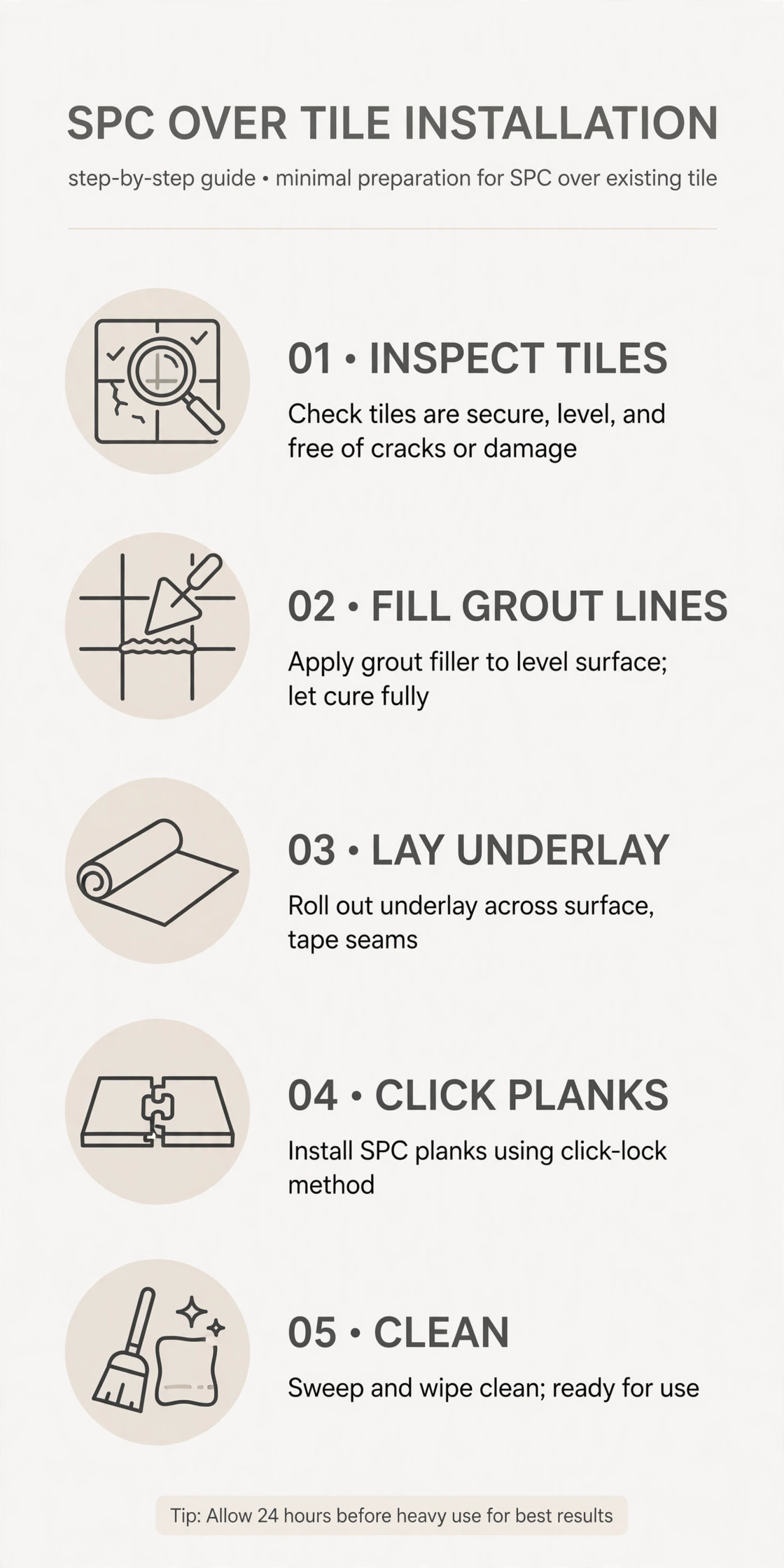
Why this question matters so much in the UAE
Walk into almost any apartment or villa in Abu Dhabi that is more than a few years old and you will find tile. Developers here tile everything: living rooms, bedrooms, hallways. It is durable and it was the default choice for decades.
But tastes change, and so do tenants. That cold glossy tile that looked fine in 2015 now makes a rental apartment feel dated, and villa owners want the warmth of a wood look without the maintenance of real wood. The biggest objection we hear is always the same: “Do we have to break up all the tile first?” Breaking tile is noisy, dusty, slow, and it creates a mountain of debris. For an apartment, it can also mean complaints from neighbours and building management headaches.
The good news is that in most cases, you do not have to. SPC is a floating floor, which means it clicks together and sits on top of the existing surface rather than being glued to it. A sound tile floor is one of the best surfaces to float SPC over.
Can SPC flooring be installed over existing tiles UAE: the conditions
An installer will check four things before giving the green light.
The tiles are firmly bonded. Walk the floor and listen. Solid tiles sound solid; loose or hollow tiles sound drummy when tapped. A few loose tiles can be re-bonded or removed and filled. A floor where large sections sound hollow is not a reliable base and needs a different approach.
The surface is level. SPC needs a flat base. Small grout lines are fine and get dealt with in prep, but if the tile floor has significant lippage (edges sticking up) or slopes, the SPC planks will flex over the unevenness. Flexing stresses the click-lock joints, and stressed joints eventually separate or break. A long straightedge or level laid across the floor reveals the truth quickly.
The tiles are clean and dry. This sounds basic, but tile floors in kitchens and entrances hold grease and grime in the grout lines. The floor must be thoroughly cleaned so nothing interferes with the underlay sitting flat.
Door clearances work. SPC plus underlay adds height, typically around 5 to 7 mm over the tile. Doors need to clear the new floor level. In most UAE homes this means trimming the bottom of interior doors slightly, which is a quick job. Entrance doors, especially fire-rated apartment doors, need checking too. This is a planning detail, not a dealbreaker, but it must be measured before installation day.
Prep work: what happens before the first plank
Proper prep is what separates a floor that lasts from one that fails in a year. Here is what a professional installation over tile involves.
First, any loose, cracked, or drummy tiles are dealt with. Small areas get re-bonded with tile adhesive or removed and filled with a levelling compound. The goal is a base with no movement and no sharp edges.
Second, the grout lines are addressed. Deep or wide grout lines can telegraph through to the SPC surface over time, meaning you eventually see faint lines mirroring the tile grid, or the planks flex slightly into the gaps. The standard fix is skimming the floor with a levelling compound or a suitable filler so the grout lines sit flush with the tile faces. For tiles with very narrow grout lines, a good underlay alone is often enough.
Third, an underlay goes down. Many SPC products come with an attached underlay, and even then installers often add a thin additional underlay over tile for sound reduction and to smooth out micro unevenness. In apartments, this also helps with the impact noise that travels to the unit below, which neighbours will appreciate.
Fourth, the room is measured and planned. Planks are laid out so the seams are staggered properly and the first and last rows are a sensible width. Expansion gaps are left at every wall, covered later by skirting. This planning stage is quick for an experienced installer and it shows in the finished floor.
If you want to understand the base requirements in more depth, our guide on how to prepare a subfloor for SPC flooring covers the standards we work to.
When the tiles should come up instead
Laying over tile is the right call most of the time, but not always. An honest installer will tell you when removal is better.
If the tile floor has widespread hollow spots, the base is unreliable and SPC laid over it will eventually move and creak. If the floor is significantly uneven, no amount of underlay will fix it, and a levelling compound thick enough to correct it may cost more in labour than just removing the tile. If there is moisture coming up through the tile, for example in a ground-floor villa with no damp proofing, that moisture issue needs solving at the source, and covering it up only hides the problem. And if the added height creates unsolvable problems, such as an entrance door that cannot be trimmed and a step down to a balcony that becomes a trip hazard, removal may be the cleaner option.
In these cases, removing tile is dusty and disruptive for a day or two, but it gives a perfect base for the new floor. It is better to do it once properly than to lay a new floor over a bad base and regret it.
What about LVT or laminate over tiles?
The same principle applies to other floating floors, with small differences. Quality LVT flooring can also go over tile, but because LVT is more flexible than SPC, the prep needs to be even more careful about grout lines and flatness. Any unevenness shows through flexible vinyl faster. Laminate can go over tile too, but laminate brings its moisture vulnerability with it, so in kitchens and entrances it remains the riskier choice. For most tile-over projects in the UAE, SPC is the material our installers reach for first, and you can see why on our SPC flooring page.
How long does it take?
For a typical apartment living room and hallway, a professional team usually completes the prep and installation in one to two days once materials are on site. Before you book dates, run your room measurements through our free flooring calculator so the material quantity is right first time. And if you are still weighing up the material itself, read our honest answer to is SPC flooring good for UAE climate. A full villa takes longer, but the tile stays, the dust stays minimal, and you are not living in a construction zone for a week. The speed of a tile-over installation is one of its biggest advantages for families who cannot move out during the work. We cover full timelines in our guide to how long flooring installation takes for a villa.
Not sure whether your tiles are a suitable base? Send us a WhatsApp message with a few photos of your current floor. We offer a free site visit anywhere in Abu Dhabi, where we will tap-test the tiles, check the levels, measure the door clearances, and tell you honestly whether a tile-over installation will work in your home.
FAQ
Can SPC flooring be installed over existing tiles in the UAE?
Yes, in most cases. Firmly bonded, reasonably level tiles make an excellent base for floating SPC. The tiles need to be sound, grout lines filled or levelled, and door clearances checked. This is standard practice in UAE apartments and villas.
Do grout lines need to be filled before laying SPC over tile?
Deep or wide grout lines should be skimmed with levelling compound so they sit flush with the tile faces. If they are left as deep grooves, they can telegraph through to the SPC surface over time or let planks flex into the gaps, stressing the click-lock joints.
Will installing SPC over tile make the floor too high?
SPC plus underlay typically adds around 5 to 7 mm. Interior doors usually need a small trim at the bottom, which is routine. Your installer should measure all door clearances and transitions to adjoining rooms before installation day.
Can you install SPC over cracked tiles?
Isolated cracked tiles can be repaired or filled as part of the prep. Widespread cracking or large hollow areas mean the tile base is unreliable, and in that case the tiles should be removed rather than covered.
Is it better to remove tiles before installing SPC?
Removal gives a perfect base but adds days of dusty, noisy demolition and debris removal. If the existing tiles are sound and level, laying over them gives an equally good result with far less disruption. Removal is only better when the tile base itself is failing.
Does SPC over tile work in kitchens and bathrooms?
Yes, SPC is waterproof so it suits kitchens well. For bathrooms, SPC works on the floor but the wet areas still need proper waterproofing detailing at edges and around fixtures. Discuss the bathroom specifics with your installer during the site visit.
Get your tiles assessed before you decide
Every tile floor is different, and a ten-minute assessment tells you everything: tap test, level check, door measurements. Message us on WhatsApp to book a free site visit anywhere in Abu Dhabi. We will tell you whether your tiles can stay, what prep they need, and give you a clear plan for the installation. You can also explore the materials on our SPC flooring page or visit us at Shop No. AA-110, Capital Mall, Mohamed Bin Zayed City, open daily from 10:00 to 22:00.
Short answer: To answer is SPC flooring good for UAE climate directly: yes. SPC is one of the best-suited flooring materials for the Emirates. Its rigid stone composite core does not absorb water, barely expands or contracts with temperature swings, and stands up to the humidity and AC cycling that damage laminate and real wood. The honest caveats are that quality varies between products, direct sun can still fade cheaper surfaces over time, and installation quality matters as much as the material.
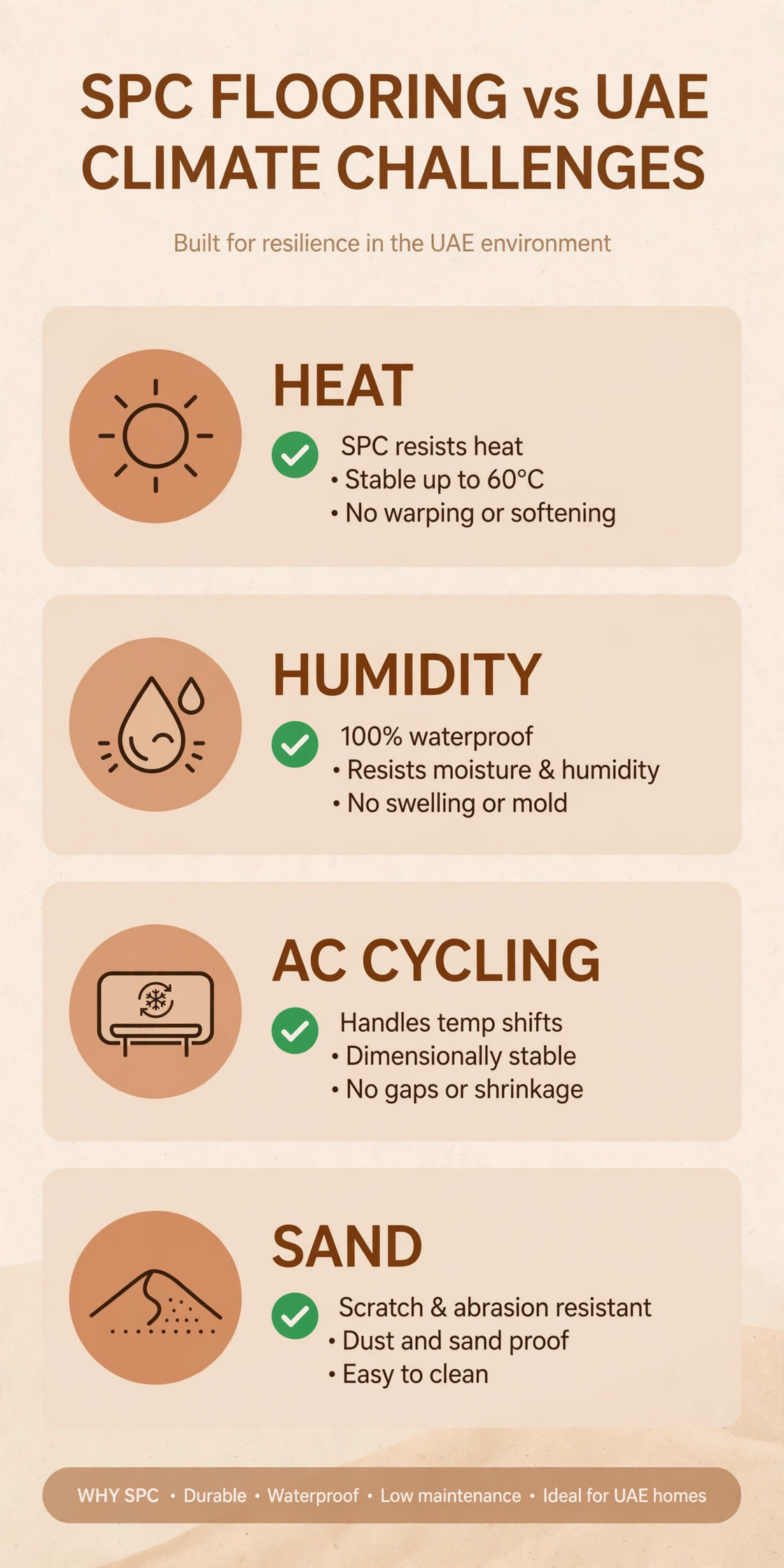
What SPC flooring actually is
SPC stands for stone plastic composite. Each plank is built in layers: a wear layer on top that resists scratches, a printed design layer that gives the wood or stone look, a rigid core made from limestone powder mixed with stabilisers, and usually an attached underlay for comfort and sound reduction.
The core is the important part. Unlike laminate, which has a fibreboard core made of compressed wood, or engineered wood, which is still wood through and through, the SPC core does not absorb moisture. It does not swell when wet and it barely moves when temperatures change. That single property is what makes it such a natural fit for the Emirates, where moisture and heat are the two things that kill most other floors.
How SPC handles UAE heat
The UAE summer pushes outdoor temperatures past 45 degrees, and indoor temperatures in a villa can climb fast if the AC is off, for example when a family travels for the summer holidays. Many flooring materials suffer in that scenario. Laminate can gap and buckle, adhesives on some vinyl products can soften, and real wood dries out and shrinks.
SPC is dimensionally stable across a wide temperature range. The rigid core holds its shape, so planks do not gap at the joints or buckle upward after a hot spell. This is one of the main reasons property managers in Abu Dhabi have shifted whole apartment turnovers to SPC: a vacant unit sitting through August with the AC on a timer comes back with the floor looking exactly as it did in May.
One thing to be clear about: SPC handles heat well, but no vinyl product loves being baked in direct sun through glass every single day. In rooms with floor-to-ceiling windows facing the afternoon sun, surface fading over several years is possible with lower quality products. Better products carry stronger UV protection in the wear layer. We go into this in detail in our article on whether vinyl flooring fades in direct sunlight in the UAE.
How SPC handles UAE humidity
Humidity is the quieter killer of floors here. Outdoor humidity regularly sits above 70 percent in the summer months, and every opened door lets a wave of it into the cooled interior. AC units pull moisture out of the air, but the cycling between humid and dry stresses flooring materials constantly.
Because the SPC core absorbs effectively zero water, none of this matters to the plank itself. Spills, mopping, a knocked-over pet bowl, or moisture wicking up from a concrete subfloor will not cause swelling, warping, or edge peaking. Compare that with laminate, where the same conditions are the number one cause of the swelling damage we described in our guide on how to fix swollen laminate flooring in UAE humidity. If your home has a history of moisture problems, SPC removes the material vulnerability entirely.
That said, waterproof planks do not make moisture disappear. Water can still sit on top of the floor or find its way underneath through unsealed edges, and trapped moisture under any floor can cause problems. Good installation with proper edge sealing and a dry, level subfloor still matters. Our guide on how to prepare a subfloor for SPC flooring covers what a proper base looks like.
Is SPC flooring good for UAE climate? The AC cycle test
This deserves its own mention because it is so specific to life in the Emirates. A typical Abu Dhabi home runs the AC hard all day, then someone opens the balcony door in the evening and a wall of warm humid air rolls in. The indoor temperature can swing 10 degrees or more in minutes.
Materials expand when warm and contract when cool. Do that hundreds of times a year and joints loosen, gaps open, and planks start to move underfoot. SPC’s expansion and contraction rate is among the lowest of any floating floor, which is why it stays tight and quiet through years of AC cycling while laminate and wood start to show gaps. If your current floor creaks or has opened up at the joints, the AC cycle is very likely part of the story.
Sand, dust, and daily wear
Sand is a fact of life in the UAE, and it is abrasive. It gets tracked in on shoes, blown in through doors, and carried in on pet paws. Over time it acts like fine sandpaper on any floor finish.
SPC handles this better than most alternatives because of its wear layer. For busy households, a 0.5 mm wear layer or thicker gives years of protection against the daily grind of sand and foot traffic. Textured, matte finishes hide micro scratches far better than glossy ones, so choose the surface finish with real life in mind, not just the showroom lighting. Regular sweeping or vacuuming to remove grit before it gets ground in will extend the life of any floor, and SPC is no exception.
Wondering how much material your rooms need? Our free flooring calculator gives you a quick estimate from your room measurements.
Where SPC is not the perfect answer
An honest answer includes the limits. SPC is excellent, not magic.
First, quality varies enormously. The market has SPC at many quality levels, and the cheapest products cut corners on the wear layer, the click-lock machining, and UV stability. A thin wear layer will show wear quickly in a busy villa, and poorly machined joints can separate. The material category is right for the UAE climate; the specific product still needs to be a good one.
Second, SPC is a hard surface. It is more comfortable than tile, especially with an attached underlay, but it does not have the softness of carpet. In bedrooms where people want warmth underfoot, some homeowners pair SPC in living areas with carpet in bedrooms.
Third, installation quality decides the outcome. SPC is a floating floor that needs a flat subfloor, correct expansion gaps at the walls, and proper transitions at doorways. A bad installation of a good product will still fail. This is true of every flooring material, but it is worth saying because SPC’s reputation sometimes makes people assume any installer can lay it perfectly.
If you are comparing SPC against its closest rival, our head-to-head on SPC vs laminate flooring in the UAE breaks down the differences point by point.
Still deciding? Message us on WhatsApp and describe your home. We offer a free site visit anywhere in Abu Dhabi, where we can check your subfloor, look at your light and layout, and show you SPC samples in your actual rooms so you can see the colours in your own daylight.
FAQ
Is SPC flooring good for UAE climate?
Yes. Its rigid waterproof core resists the two biggest climate threats to flooring in the UAE: moisture from humidity and spills, and expansion and contraction from heat and AC cycling. It outperforms laminate and real wood on both counts and needs less climate-related maintenance.
Does SPC flooring expand in heat?
All materials expand slightly with heat, but SPC’s expansion rate is very low compared to laminate or wood. In normal UAE indoor conditions, including hot spells with the AC off, properly installed SPC with correct expansion gaps does not buckle or gap.
Can SPC flooring handle humidity?
Yes. The stone composite core absorbs effectively no water, so humidity, mopping, and spills do not cause swelling or warping. It is one of the few flooring types that is genuinely comfortable in the UAE’s humid summer months.
Is SPC better than laminate for the UAE?
For most UAE homes, yes. Laminate’s fibreboard core swells with moisture, which is the most common flooring failure we see here. SPC costs more in material terms but avoids the repair and replacement cycle that moisture-damaged laminate often needs.
Does SPC flooring fade in sunlight?
Prolonged direct sun through glass can fade any vinyl surface over several years, and cheaper products fade faster. Quality SPC with good UV protection in the wear layer holds its colour far longer. In very sunny rooms, blinds or curtains during peak afternoon sun help any floor keep its colour.
How long does SPC flooring last in the UAE?
Lifespan depends on the wear layer thickness, foot traffic, and maintenance rather than the climate, because the climate does not degrade the core. With a 0.5 mm or thicker wear layer and normal care, SPC typically serves a busy family home well for many years.
See SPC in your own home before you decide
Samples in a showroom never tell the full story, because your lighting, your furniture, and your subfloor all change how a floor looks and performs. Chat with us on WhatsApp to book a free site visit anywhere in Abu Dhabi. We will bring SPC samples to your home, assess the subfloor, and give you a straight recommendation for your space. You can also browse the full range at our SPC flooring page or visit us at Shop No. AA-110, Capital Mall, Mohamed Bin Zayed City, open daily from 10:00 to 22:00.
Short answer: You can fix mildly swollen laminate by drying the area thoroughly and, in some cases, replacing individual planks. But if the swelling covers a large area, the joints have lifted, or the damage keeps returning, replacement is the smarter move. Many homeowners searching for how to fix swollen laminate flooring humidity UAE causes end up switching to waterproof SPC flooring instead of repairing laminate a second time.
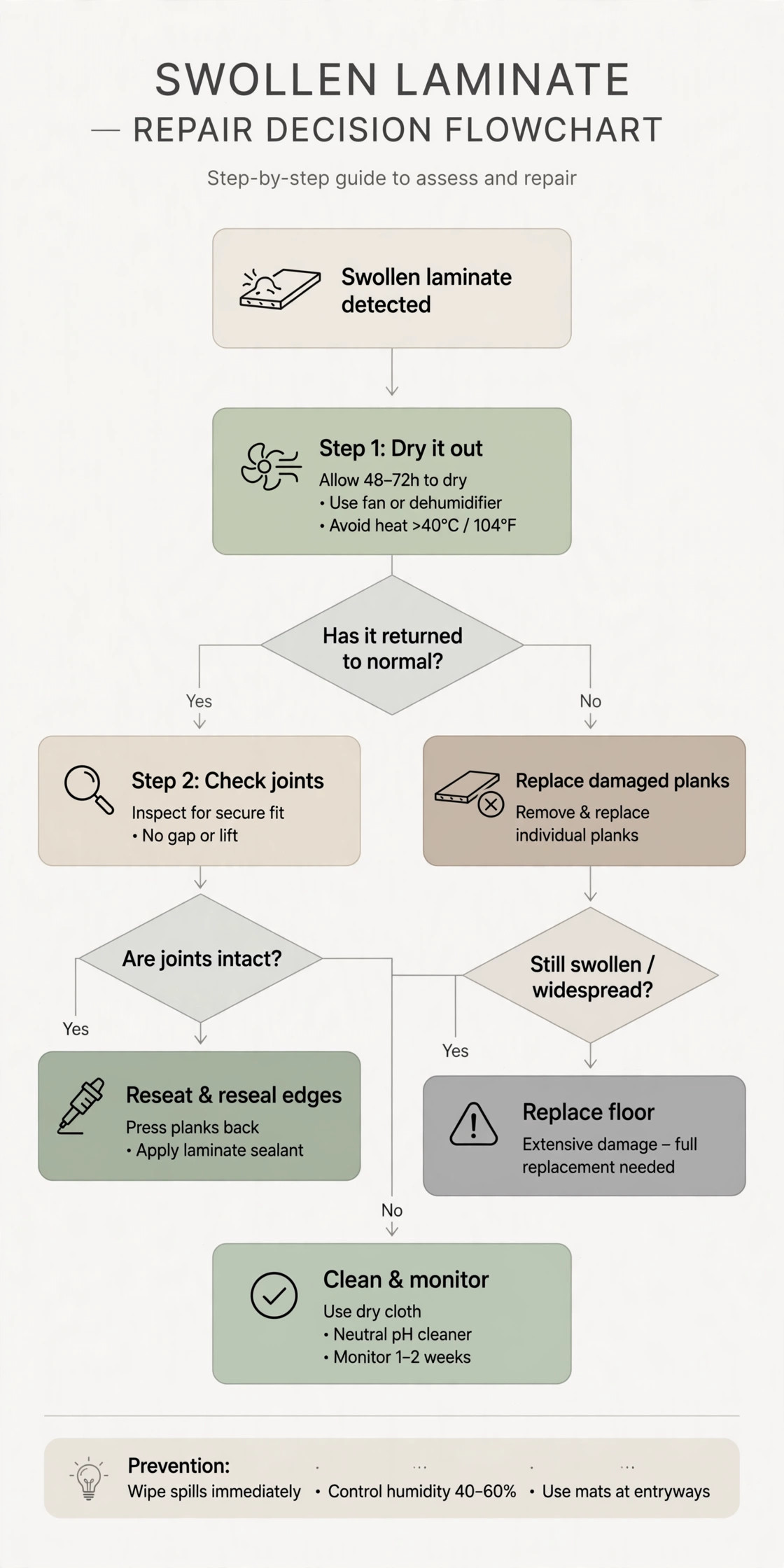
Why laminate swells in UAE homes
Laminate flooring is made of a high-density fibreboard core with a printed design layer on top. That core is essentially compressed wood fibre, and wood fibre absorbs moisture. When it does, it expands, and the planks push against each other. The edges lift, the joints peak, and you get the wavy, uneven surface that homeowners describe as swollen or buckled flooring.
In the UAE, the moisture comes from several everyday sources. Mopping with too much water is the most common one. Air conditioning is another, less obvious cause. Your home sits at a cool, dry temperature for most of the day, then warm humid air rushes in every time a door or window opens. The laminate expands and contracts with each swing, and over time the joints loosen and let moisture in. Spills that sit too long, water bowls, plant pots, and leaks from AC units or washing machines all contribute. Even a villa that was empty for the summer with the AC off can come back to swollen laminate, because the indoor humidity climbs unchecked for weeks.
Step 1: Find and stop the moisture source
Before you touch the floor, find out where the water is coming from. There is no point drying planks that will get wet again next week.
Walk the affected area and look for the obvious culprits. Check under and around the AC indoor unit for drips or a blocked drain line. Look at window frames for condensation stains. Check nearby bathrooms, kitchens, and laundry areas for slow leaks. If the swelling is near an exterior door, rainwater or humidity entering through a poor door seal is a likely cause. In apartments, also consider the unit above; a neighbour’s plumbing leak can show up as swelling in your ceiling-adjacent floor edges.
Fix the source first. Clear the AC drain, reseal the window, fix the leak. If you skip this step, any repair you make will fail.
Step 2: Dry the area completely
Once the moisture source is handled, dry the floor thoroughly. This takes longer than most people expect.
Run the AC at a normal cooling temperature and, if you have one, a dehumidifier in the room. Place fans so air moves across the swollen area. In mild cases, where the swelling appeared recently and the planks have not deformed badly, a week of consistent drying can let the fibreboard shrink back close to its original shape. You may see the peaking at the joints reduce noticeably.
Do not use a heat gun, hair dryer on high heat, or any direct high heat on laminate. Intense heat can delaminate the printed top layer from the core, which turns a repairable problem into a ruined plank. Patience and steady airflow work better than heat.
Step 3: Assess whether the planks can be saved
After a full week of drying, look at the floor honestly. This is the decision point, and it is worth being realistic.
Repair is realistic when: the swelling is limited to a small area (a few planks), the planks have flattened back down after drying, the click-lock joints still engage, and the surface layer is intact with no bubbling or peeling. In this case you can often replace just the damaged planks.
Replacement is the smarter call when: the swelling covers a large area, joints have lifted and will not sit flat, the top layer is bubbling or peeling away from the core, the same area has swollen before, or there is any sign of mould or a musty smell coming from the floor. Mould under flooring is a health issue in a humid climate, and we cover it in detail in our guide to mould under vinyl flooring in UAE humidity.
How to replace individual laminate planks
If the damage is localised and you have spare planks from the original installation, a plank swap is a reasonable DIY job or a quick job for a handyman.
Laminate planks click together, so replacing one in the middle of a floor means working from the nearest wall. Remove the skirting board on that side, then unclick and lift planks row by row until you reach the damaged one. Swap in the new plank, click everything back together, and refit the skirting. The whole job for a small area usually takes an hour or two.
The catch is matching. Laminate batches vary slightly in colour, and a floor that has been down for a few years will have faded or changed tone. A new plank from a different batch can stand out. If you do not have spare planks from the original batch, finding an exact match is often difficult, and a visible patch can look worse than the swelling did.
If the thought of lifting half a room of flooring puts you off, that is understandable. Message us on WhatsApp and we can take a look during a free site visit anywhere in Abu Dhabi. Sometimes a professional repair is quick and affordable; sometimes we will tell you honestly that replacement makes more sense.
When replacement is the better investment
There is a point where repairing laminate becomes throwing good effort after bad. If this is the second time the same area has swollen, the moisture pattern in your home has not changed, and it will happen a third time. If the damage is widespread, the labour of replacing dozens of planks approaches the labour of a fresh installation, without giving you a fresh floor.
This is the moment many UAE homeowners switch materials. Waterproof options like SPC flooring and quality LVT flooring do not have a fibreboard core, so the swelling problem simply does not exist. SPC in particular is dimensionally stable through the AC and humidity cycles that punish laminate. If you are weighing the two materials, our comparison of waterproof laminate vs SPC flooring lays out the differences clearly.
How to fix swollen laminate flooring humidity UAE: stopping it coming back
Whether you repair or replace, a few habits keep moisture damage away.
Mop with a damp mop, never a soaking one. Wring it out well; the floor should dry within a few minutes. Clean spills promptly instead of leaving them. Keep a mat under pet water bowls and plant pots. Run the AC consistently rather than switching it off for long stretches, since steady indoor conditions are kinder to flooring than big swings. And check AC drain lines and window seals once or twice a year, because slow drips cause more flooring damage in the UAE than dramatic floods do. Our SPC flooring maintenance guide for the UAE has a full routine that works for any hard floor.
FAQ
Can swollen laminate flooring go back to normal?
Mild, recent swelling can improve significantly with thorough drying over a week or more, and the planks may sit almost flat again. Severe swelling where the core has deformed, the joints have lifted permanently, or the surface layer is bubbling will not return to normal. Be honest about which case you have.
How do you dry out swollen laminate flooring?
Run the AC at a normal cooling setting, use a dehumidifier if you have one, and direct fans across the affected area for at least a week. Fix the moisture source first. Avoid direct high heat like heat guns, which can delaminate the plank surface.
Is it worth replacing individual laminate planks?
It is worth it when the damage is limited to a few planks, the click-lock joints still work, and you have spare planks from the original batch for a colour match. It is not worth it when the damage is widespread, the batch no longer matches, or the same area has swollen before.
Why does laminate flooring swell in the UAE specifically?
The combination of high outdoor humidity, heavy AC use, and the constant cycling between the two stresses the fibreboard core. Add common moisture sources like mopping with too much water, AC drain drips, and condensation at windows and doors, and laminate faces more moisture challenges here than in drier climates.
Should I replace swollen laminate with SPC flooring?
If moisture caused the swelling once, it will likely cause it again, because the conditions in your home have not changed. SPC has no fibreboard core and is fully waterproof, so it eliminates the swelling problem entirely. For kitchens, entrances, and homes with pets or kids, it is usually the more durable long-term choice.
Can mould grow under swollen laminate?
Yes. Persistent moisture trapped under or within laminate planks can lead to mould growth, which you may notice as a musty smell. If you suspect mould, do not just cover it up; the affected planks should be removed and the subfloor inspected and dried before any new flooring goes down.
Get an honest assessment of your floor
Swollen laminate is one of the most common flooring problems we see in Abu Dhabi homes, and the right fix depends on how bad the damage is and what caused it. Send us a WhatsApp message with a photo of the affected area, or book a free site visit anywhere in Abu Dhabi and we will inspect it in person. We will tell you straight whether a repair will hold or whether replacement with a moisture-proof floor is the better use of your money. You can also visit us at Shop No. AA-110, Capital Mall, Mohamed Bin Zayed City, open daily from 10:00 to 22:00.
Short answer: The best flooring for dogs UAE scratch resistant options are rigid SPC flooring and high quality luxury vinyl tile, both with a thick wear layer. They handle claws far better than laminate or real wood, they do not mind the humidity swings of UAE homes, and they are easy to clean after muddy paws. Ceramic tile resists scratches well too, but it is hard and cold underfoot, which most dogs dislike.
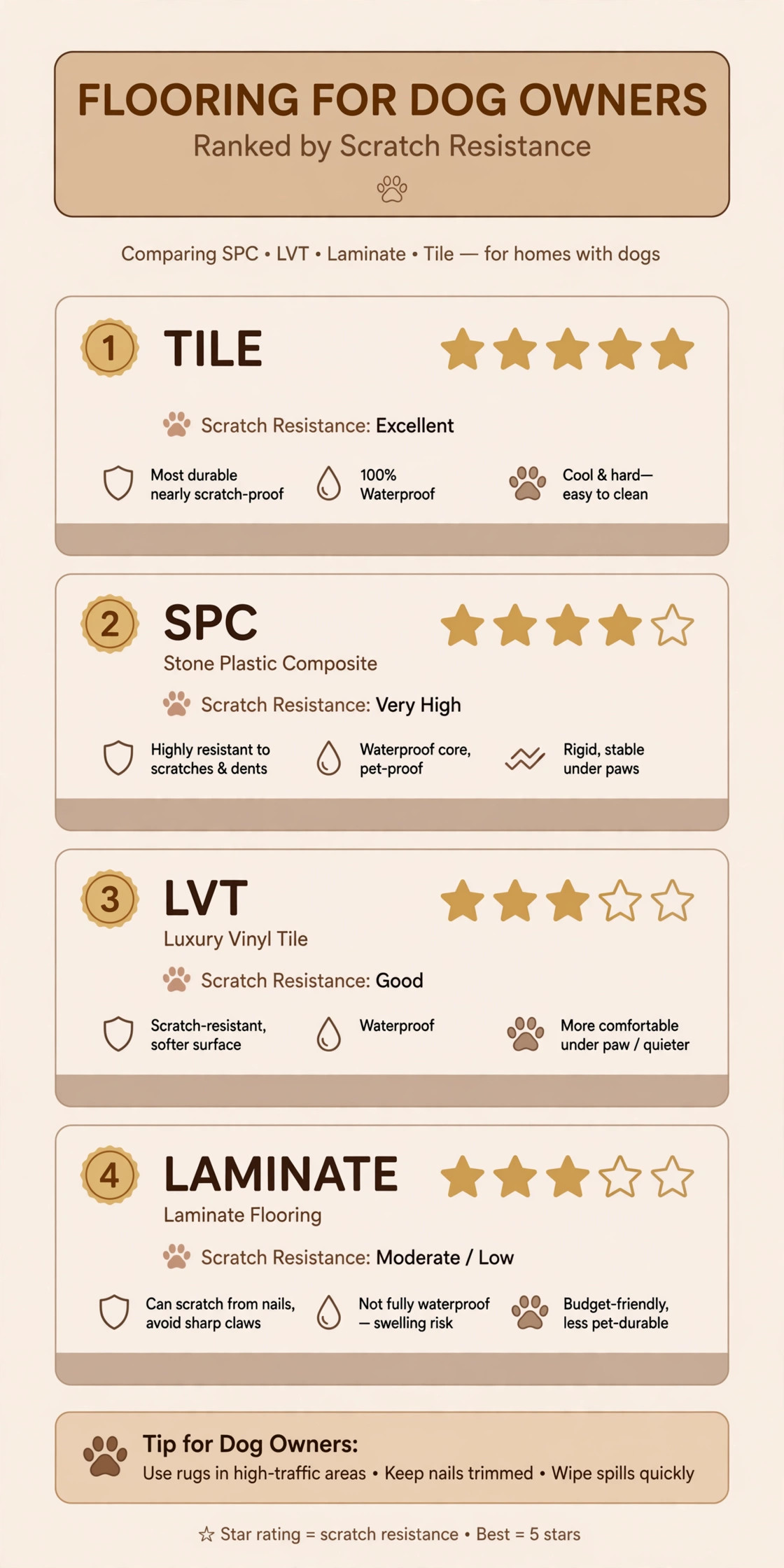
Why dog nails destroy floors faster in UAE homes
Every dog owner in Abu Dhabi knows the sound. Your dog hears the doorbell, scrambles across the living room, and the floor takes the hit. In many homes here this happens on a daily basis, and a few factors in the UAE make the damage worse than it would be elsewhere.
First, many villas and apartments have large open-plan areas with long runs of the same flooring. A dog that gets excited has forty or fifty metres of runway to sprint across. Second, sand and fine dust are a constant reality. Sand gets trapped under paws and between the claws, and it acts like sandpaper with every step. If you live near the beach or in a villa with a sandy yard, your dog brings a surprising amount of grit indoors no matter how often you sweep. Put the long runways and the sand together and a floor that would survive a decade with dogs in a cooler climate can look tired in three or four years here.
The best flooring for dogs UAE scratch resistant materials compared
Not all “pet friendly” flooring is equal. Here is how the realistic options for a UAE home stack up when scratch resistance is the priority.
SPC flooring: the strongest all-rounder
SPC stands for stone plastic composite. It is a rigid vinyl plank with a limestone-based core, which means it barely moves with temperature or humidity changes. That stability is a genuine advantage in UAE homes where the AC runs most of the year.
For dog owners, the key number is the wear layer, which is the transparent top coating that takes the claw damage. Look for SPC with a wear layer of 0.5 mm or thicker. At that level, everyday claw traffic leaves no visible mark, and even a large dog skidding to a stop will not gouge the surface. SPC is also fully waterproof, so the occasional accident or a wet dog fresh from the balcony is not a crisis. It is the option our installers recommend most often to dog owners, and you can see the full range on our SPC flooring page.
Luxury vinyl tile (LVT): flexible and forgiving
LVT is the flexible cousin of SPC. Good quality LVT with a thick wear layer resists scratches nearly as well as SPC, and because the planks are slightly softer underfoot, some dogs find it more comfortable to lie on. The trade-off is that standard LVT can be slightly less dimensionally stable than SPC in rooms with big temperature swings, such as a villa entrance that opens directly to the heat. In bedrooms and living rooms it performs very well. Browse the options on our LVT flooring page.
Ceramic and porcelain tile: scratch-proof but unforgiving
If scratch resistance were the only thing that mattered, tile would win. Claws cannot scratch glazed porcelain. The problem is everything else. Tile is hard, cold, and slippery, especially the polished finishes common in older UAE apartments. Dogs slip on it and older dogs struggle to stand up from it. The same slip problem affects elderly people too, as we cover in our guide to anti-slip flooring for elderly homes in the UAE.
Laminate flooring: looks good until it does not
Laminate can look fantastic on day one, and the better products carry decent abrasion ratings. But laminate has two weaknesses that matter for dog owners in the UAE. The first is moisture. A water bowl that gets knocked over or repeated mopping can cause the edges of laminate planks to swell. The second is that once a laminate surface is scratched through its printed layer, the damage is permanent and highly visible.
Carpet and rugs: comfort with a cleaning cost
Wall-to-wall carpet feels wonderful for dogs, especially older ones with joint problems, because it gives them grip and cushioning. The downside is obvious. Carpet holds odour, traps hair, and stains from accidents are difficult to remove fully in a humid climate where things dry slowly. Many dog owners in Abu Dhabi use a practical compromise: hard scratch-resistant flooring throughout, with washable rugs in the spots where the dog sleeps and plays.
What scratch resistance ratings actually mean
You will see flooring described with terms like “scratch resistant” and sometimes an AC rating (for laminate) or a wear layer thickness in millimetres (for vinyl products). Here is how to read them as a dog owner.
The wear layer on vinyl flooring is measured in millimetres, and for a home with dogs you want 0.5 mm as a minimum. Thinner wear layers, such as 0.3 mm, are fine for a quiet bedroom but will show claw marks in a hallway or living room within a year or two. This is the single most useful number to ask about when comparing products.
Laminate uses AC ratings from AC1 to AC5, which measure abrasion resistance. AC4 or AC5 is the level worth considering with pets. Be aware that the AC rating tests abrasion from foot traffic, not the point pressure of a claw, so a high AC rating helps but does not make laminate equal to SPC for dog households.
Practical tips that protect any floor from dog claws
The right flooring does most of the work, but a few habits extend its life considerably.
Keep your dog’s nails trimmed. This is the single biggest factor. Long nails concentrate force on a tiny point and will mark even the toughest wear layer over time. If you can hear clicking on hard floors, the nails are too long. Most groomers in Abu Dhabi will trim nails during a regular appointment.
Place mats at every entrance. Sand is the enemy, and most of it enters on paws. A good doormat at each door, plus a quick paw wipe for dogs coming in from the yard, cuts the grit that grinds into the floor finish. Use washable rugs in high-traffic dog zones like the path from the sofa to the door and the spot where your dog sleeps. Rugs take the beating instead of the floor, and you can wash or replace them.
Choose the right cleaning routine. Sweep or vacuum regularly to remove sand before it gets ground in, and mop with a damp (not soaking) mop. Harsh chemicals and steam mops can damage the wear layer on vinyl flooring over time. Our SPC flooring maintenance guide for the UAE covers the routine in detail.
Not sure which option suits your home and your dog? Message us on WhatsApp and tell us about your space. We offer a free site visit anywhere in Abu Dhabi, so we can see the layout and recommend the right wear layer. If you want a rough idea of material quantities first, try our free flooring calculator.
Flooring to avoid with big dogs
A few materials are simply a poor match for a household with dogs in the UAE. Solid hardwood and real wood veneer scratch easily, hate humidity, and are costly to refinish. Polished marble and glossy tile look luxurious but turn into a skating rink for dogs, which is a genuine injury risk for older animals.
FAQ
What is the most scratch resistant flooring for large dogs?
Rigid SPC flooring with a 0.5 mm or thicker wear layer is the most scratch resistant practical choice for large dogs in UAE homes. It resists claw marks, handles humidity, and is waterproof. Porcelain tile resists scratches even better but is too hard and slippery for most dogs as a main living surface.
Does laminate flooring scratch with dogs?
Yes, laminate will show scratches from dog claws over time, especially in hallways and living rooms. Higher AC-rated laminate (AC4 or AC5) holds up better, but once the printed surface layer is scratched through, the damage cannot be repaired and is very visible. Moisture makes it worse: see our guide on how to fix swollen laminate flooring in UAE humidity. For dog households, SPC or quality LVT is the safer long-term choice.
How do I stop my dog scratching the floor?
Trim nails regularly so they do not click on hard floors, put mats at every entrance to trap sand, use washable rugs in high-traffic dog areas, and sweep often so grit does not get ground into the finish. These habits protect even the toughest flooring.
Is vinyl flooring safe for dogs?
Yes. Quality SPC and LVT flooring is safe for dogs. It has no splinters, it does not harbour allergens the way carpet can, and it stays cooler than carpet under UAE conditions. Choose products with a textured, non-slip surface so dogs can move confidently without sliding.
Can dog urine damage vinyl flooring?
Quality waterproof SPC and LVT handle the occasional accident well as long as it is cleaned up reasonably promptly. Urine left sitting for many hours can eventually affect the finish or seep at poorly sealed joints, so quick cleanup still matters. Laminate is far more vulnerable because moisture causes the core to swell.
Should I choose light or dark flooring with dogs?
Mid-tone wood looks with visible grain texture are the most forgiving. Very dark floors show dust, sand, and light scratches; very light floors show dirt and paw prints. A textured mid-tone hides the normal wear of a dog household better than either extreme.
Talk to a flooring installer before you decide
Chat with us on WhatsApp to book a free site visit anywhere in Abu Dhabi. We will measure up, check what is under your current floor, and help you pick a scratch resistant option that suits both your home and your dog. You can also visit us at Shop No. AA-110, Capital Mall, Mohamed Bin Zayed City, open daily from 10:00 to 22:00.
Every week someone walks into our Capital Mall showroom, points at the herringbone display and asks the same thing: is it worth the extra? Fair question, because the price gap is real. Here is the full answer: what it costs in the UAE, where the pattern earns its keep and where it quietly wastes your money.
Why does herringbone SPC cost more than straight plank?
The plank itself is not wildly more expensive than a standard SPC plank. The money goes into two things: wastage and labour.
First, wastage. Every zigzag ends in a cut at the wall, and most of those offcuts cannot be reused on the other side of the room. Woodpecker Flooring’s herringbone installation guide puts wastage at 10 to 15 percent for tongue-and-groove herringbone in a simple room, rising to 15 to 20 percent for click-system herringbone, and higher again in small or awkward rooms. That last detail matters, because click SPC is what nearly every UAE home uses. Plan on the higher number.
A UK herringbone guide from Doors2Floors gives the same warning: order 10 percent extra for a straight lay, 15 to 20 for herringbone, and never run short mid-job, because the next batch might not match the first. In the UAE that advice carries extra weight, because reordering a shade from overseas stock can take weeks, and a two-tone floor is the one mistake you cannot unsee.
Second, labour. A straight plank run is fast: long rows, few cuts. Herringbone needs a chalked centreline, constant measuring and dozens of angled cuts at the perimeter. So the fitting rate runs higher, and a room that takes a day in straight plank can easily take two.
What does herringbone SPC cost in the UAE right now?
As a market reference, floorsdubai.com lists herringbone SPC from about AED 95 per sqm at the budget end up to AED 130 for the fancier oak looks, with several popular shades, Ivory Elegance, Serenity, Legacy Harvest and Whisper Oak, all sitting at AED 110. Premium German-made herringbone on the same site runs to AED 195. Our read: AED 110 is the honest middle of the market.
Two things to keep in mind about those numbers. They are material-only listings: labour, skirting, door trims and the 15 to 20 percent wastage all sit on top. And we do not publish our own per-sqm prices, because stock and shades change too often for a printed number to stay honest. Message us on WhatsApp with your room measurements and we will give you a current fitted quote with the wastage already included.
Straight plank vs herringbone: the honest comparison
Most customers are choosing between these two. Here is how they stack up, side by side.
| Straight plank | Herringbone | |
|---|---|---|
| Material cost | Lower per sqm across the market | Higher per sqm, roughly a third more at mid-range |
| Wastage to order | 5 to 10 percent | 15 to 20 percent |
| Fitting speed | Fast, long simple runs | Slow, every row measured and trimmed |
| Forgiveness | Hides minor subfloor dips | Less forgiving, needs a level base |
| Small dark hallway | Sensible and tidy | The pattern disappears and the premium is wasted |
| Big bright living room | Clean and calm | This is where herringbone earns its money |
That hallway row is the one that changes decisions. If your space is a narrow, windowless corridor, herringbone gives you nothing a straight plank does not, except a bigger bill.
Which rooms suit herringbone, and which should skip it?
Herringbone is a pattern that needs light and room to breathe. Give it both and it looks expensive in a way straight plank rarely does. Starve it of either and you have paid extra for a zigzag nobody notices.
Rooms where it shines: open-plan living and dining areas with big windows, a large majlis where guests actually sit and look at the floor, and master bedrooms with good natural light. Long sightlines let the pattern run, and daylight brings out the grain.
Rooms where we talk customers out of it: narrow hallways, boxy studies with one small window, and small bathrooms. A hallway is a runway, not a gallery. In small rooms the pattern can chop the space up visually, making it feel busier. If you want a small room to feel larger, a light-coloured straight plank does more work than any pattern.
Colour choice matters as much as layout. Mid-tone oaks are the safe pick: they hide dust and sand tracked in from outside. Very dark herringbone looks dramatic on day one and shows every footprint by day seven.
Herringbone installation: 5 things worth insisting on
Herringbone punishes sloppy fitting more than any other layout. If you are hiring an installer, these five steps are what separate a crisp floor from a wavy one.
- Acclimatise the boxes. The planks sit in the room for 48 hours before a single one is clicked in, so they adjust to your home’s temperature and humidity.
- Start from the centre. The installer chalks a centreline and works outward, so the pattern lands balanced on both sides instead of drifting toward one wall.
- Dry-lay the first rows. An hour of loose laying shows exactly where the awkward cuts will fall while the centreline can still move.
- Keep both plank types balanced. Herringbone needs its two orientations in equal measure. Running out of one stops the job cold.
- Cut at the walls, not in the middle. Every fiddly trim belongs at the perimeter. The centre of the room should flow untouched.
One more practical point: ask for the labour quote per square metre, in writing, with the wastage allowance stated. A per-day rate on a herringbone job rewards slow work. And keep one spare box from the original batch, so a future repair matches the colour.
Where herringbone works best in Abu Dhabi
We see the pattern requested most in three kinds of homes: Al Reem Island apartments, where open-plan living rooms and floor-to-ceiling glass give the pattern the light it needs; Khalifa City villas, where the majlis is the showpiece room; and Yas Island’s newer builds, with big bright living areas that carry a bold floor without feeling crowded.
The flip side: the typical long, windowless hallway in an older Al Khalidiyah apartment. We have talked more than one customer out of herringbone there, into a straight plank in a warm oak, and every one of them kept the difference for furniture. If you are unsure whether your space suits it, send us a photo of the room on WhatsApp and we will give you a straight opinion before you spend anything.
Still weighing SPC against its closest rival? Our SPC vs LVT guide breaks down where each one wins, and our Abu Dhabi cost guide covers standard planks. If herringbone has won you over, start from our herringbone SPC flooring page.
Is herringbone SPC waterproof like straight SPC?
The core is the same stone-plastic composite, so it handles spills and mopping the same way. The honest caveat: herringbone has far more joints, which means more seams. Fine for living rooms and kitchens; for a bathroom floor we would point you toward larger-format options.
Can herringbone go over my existing tiles?
Usually yes, if the tiles are flat, dry and firmly fixed. But herringbone is less forgiving of dips than straight plank, and an uneven base telegraphs through the pattern. If your tiles have lippage or hollow spots, level first; skipping that is the most common cause of a wavy herringbone floor.
Will herringbone make my small room look bigger?
Honestly, no. It makes big rooms feel grand, but in a small room the pattern chops the space into visual fragments and it can feel busier. A light-coloured straight plank in a wide format does far more for a sense of space than any pattern.
How much longer does herringbone fitting take?
Noticeably longer. A living room that takes a day in straight plank can take two in herringbone, more with alcoves or angled walls. That is why the labour rate is higher, and why you should get it quoted per square metre in writing, not per day.
Can a damaged herringbone plank be replaced?
Yes, but it is fiddlier than swapping a straight plank. The replacement has to match the pattern direction and, more importantly, the batch colour. This is why we tell every herringbone customer to keep one spare box from the original batch. A matching spare turns a repair into a small job.
Thinking about herringbone for your living room or majlis? Message us on WhatsApp with your room measurements. We will arrange a free site visit and give you a straight per-sqm quote, wastage and skirting included.