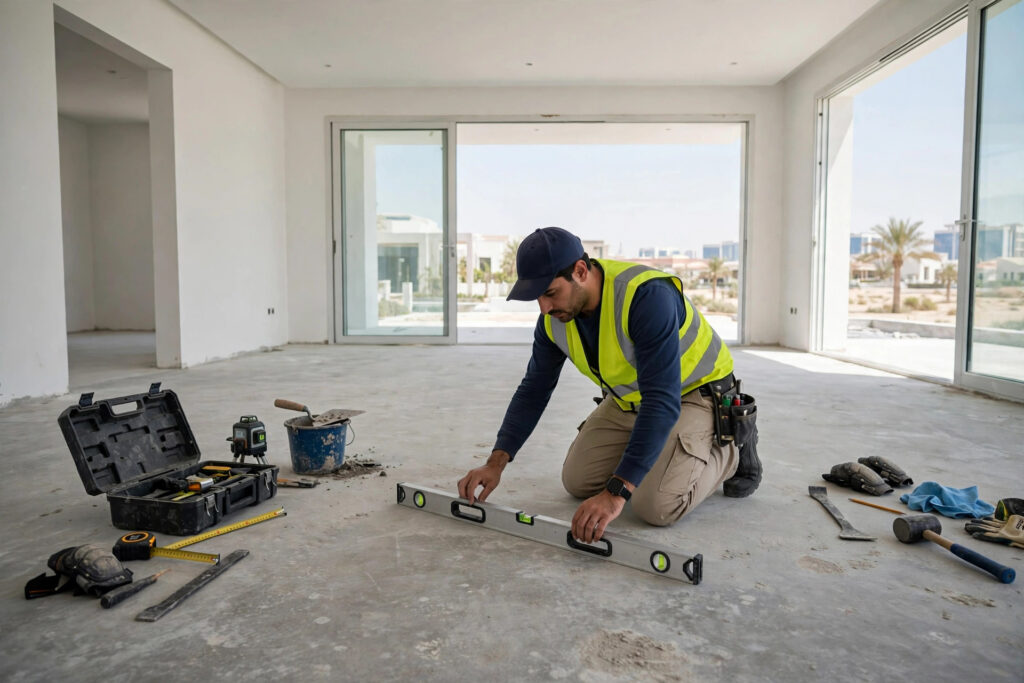
Short answer: To prepare a subfloor for SPC flooring, you need it clean, dry, flat, and sound: sweep and degrease the concrete, check flatness with a long straightedge, grind down high spots and fill low ones, test for moisture, repair cracks, lay a suitable underlayment or vapor barrier, acclimate the planks in the room, and leave expansion gaps at the walls. SPC is forgiving compared to flexible vinyl, but its rigid click joints will fail over a bumpy or damp base. Most SPC problems we are called to fix trace back to skipped preparation, not to the product.
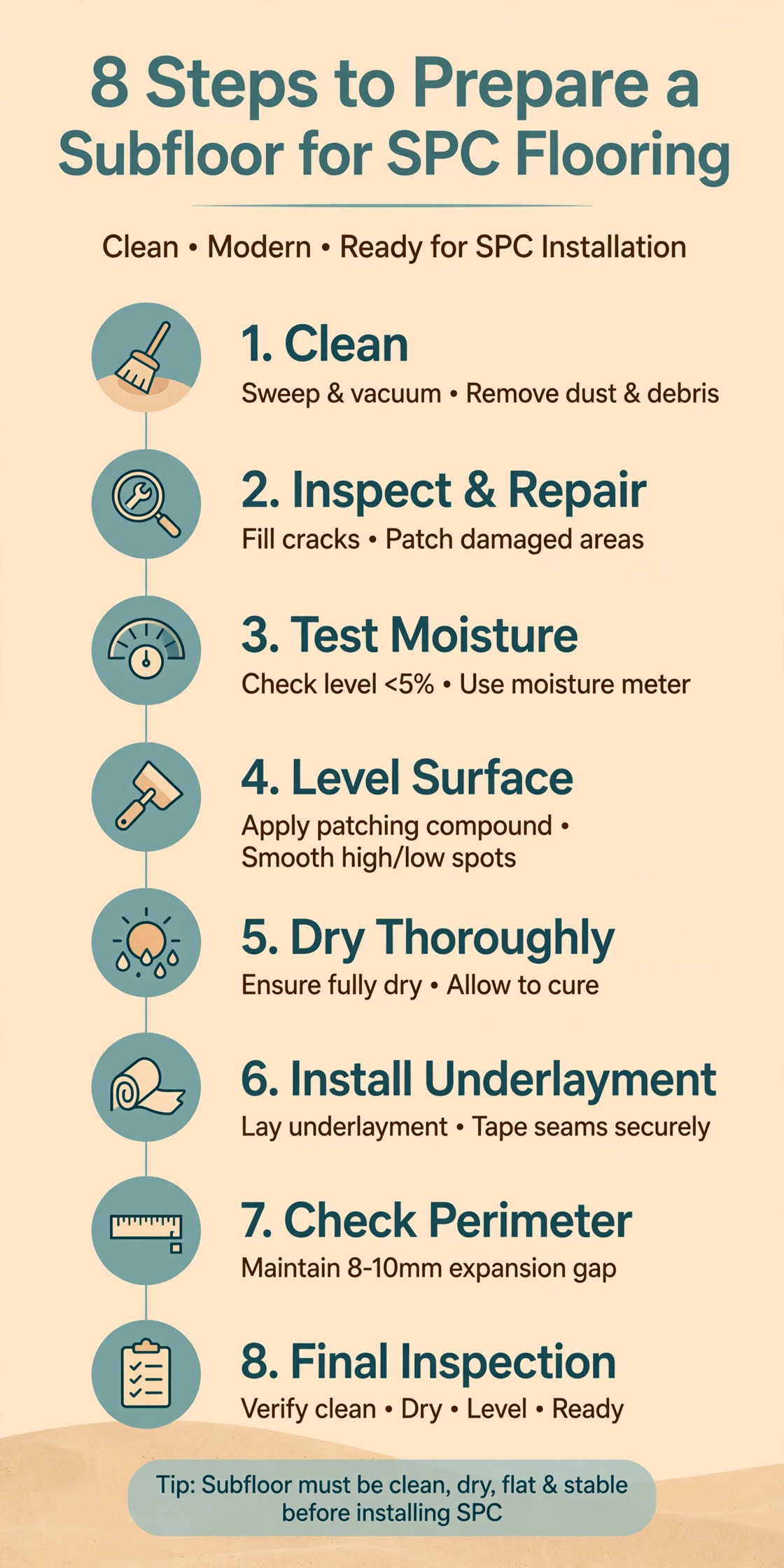
How to prepare subfloor for SPC flooring: why the base matters
The subfloor is whatever sits directly under your new floor. In the UAE that is almost always a concrete slab, sometimes with old tiles still bonded to it. SPC, stone plastic composite, is a rigid plank with a click-lock joint on all four sides. That rigidity is a strength once installed, but during installation it means the planks bridge across dips instead of following them. Walk on a bridged plank and it flexes at the joint; flex it thousands of times and the lock breaks. The plank then lifts, gaps open, and the floor starts clicking or moving. Almost none of that is fixable without lifting the floor and doing the preparation properly, which is why this stage deserves more attention than the laying itself.
Step 1: Clear the room and clean thoroughly
Remove all furniture, appliances, and old skirting if it is being replaced. Then clean like you mean it: sweep, vacuum, and damp mop the slab. In the UAE, fine construction dust and sand get into everything, and grit left under a floating floor will grind between the plank and the base every time someone walks. Degrease any oily spots, especially in kitchens, because leveling compounds and adhesives will not bond to grease. This is also when you pull up any old carpet gripper rods, staples, or adhesive ridges.
Step 2: Deal with the existing floor covering
If old tiles are coming up, remove them fully and scrape the bed flat. If they are staying, which is common, they must be sound: no hollow or cracked tiles, no loose edges. Tap across the floor and listen for hollow spots. Deep grout lines, anything more than a couple of millimetres, should be skimmed with leveling compound so the pattern does not telegraph through the SPC over time. Our guide on installing SPC over existing tiles goes deeper on this decision.
Step 3: Check flatness with a straightedge
Lay a two-metre straightedge or long spirit level on the slab in several directions and look for gaps underneath. As a rule of thumb, most SPC manufacturers want the subfloor flat within a few millimetres over a couple of metres. Mark every high and low spot with a pencil as you go. Pay special attention to doorways, where two pours often meet at slightly different heights, and to the middle of large villa rooms, where slabs can dish.
Step 4: Grind highs, fill lows
High spots get ground down with a concrete grinder and a dust shroud. Low spots and grout lines get filled with a cement-based leveling compound, feathered out well beyond the dip so there is no ridge. Deep fills may need two passes. Let everything cure fully before moving on; rushing this step is one of the most common DIY mistakes, because compound that looks dry on top can still be soft underneath.
Step 5: Test for moisture
Concrete holds water far longer than people expect, especially new slabs and villa ground floors. Press a pin-type moisture meter into the slab in several spots, including near bathrooms, kitchens, and exterior walls. If readings are high, find out why before proceeding: it could be a curing slab that needs more time, a plumbing leak, or groundwater pressure. Installing over a damp slab traps moisture under a waterproof floor, which is exactly how mold problems start. When in doubt, wait and retest rather than hoping it dries under the floor. It will not.
Step 6: Repair cracks and holes
Hairline shrinkage cracks are normal in concrete and usually harmless once filled. Wider cracks, crumbling edges, or holes from removed fixtures need proper repair with crack filler or patching compound. Anything structural, a crack that keeps growing or a slab that moves, needs a builder’s opinion before any flooring goes down. Flooring does not fix structural movement; it just hides it until the joints fail.
Step 7: Lay underlayment or a vapor barrier
On concrete, a vapor barrier or moisture-rated underlayment is standard practice in this climate. It does three jobs: blocks residual slab moisture, cushions minor imperfections, and reduces hollow footfall sound, which matters in apartments. Choose an underlayment rated for SPC and for the moisture conditions you measured. Overlap and tape the seams so there are no gaps for vapor to sneak through.
Step 8: Acclimate the SPC planks
Bring the unopened boxes into the room where they will be installed and leave them for at least 48 hours. UAE rooms swing between hot delivery trucks and cold air conditioning, and planks that go down while still thermally stressed can shrink back and open gaps at the joints later. Stack the boxes flat, away from direct sun through windows, with the AC running at normal living temperature.
Not sure your slab is ready? Send us a WhatsApp message and we will assess the subfloor on a free site visit anywhere in Abu Dhabi, moisture meter in hand, before you commit to anything.
Step 9: Plan expansion gaps and the final clean
SPC moves slightly with temperature, so leave a consistent gap around all walls, pipes, and fixed objects, hidden under skirting or beading. Plan your starting wall and plank direction before opening a single box: hallways usually run lengthwise, and large rooms look best with planks running toward the main light source. Do a final vacuum right before laying. One stray grain of sand under the first row can telegraph a bump through the whole floor.
Common preparation mistakes we see in Abu Dhabi
- Skipping the moisture test on ground-floor villas, then wondering why the floor smells musty six months later.
- Laying over dusty slabs. Fine desert dust plus foot traffic equals a floor that never quite sits silent.
- Ignoring grout lines under the assumption that rigid planks will hide them. They will, for about a year.
- Butting planks tight to walls with no expansion gap, which leads to peaking when summer heat expands the floor.
- Installing before paint and dusty trades finish. SPC should be one of the last things to go in, after the dusty work is done.
How long preparation takes
For a typical villa room with a sound slab, preparation is usually a day’s work: cleaning, leveling touch-ups, and underlayment. Full tile removal, heavy leveling, or drying out a damp slab can add days. If you are planning a whole villa, read our guide on how long flooring installation takes so the preparation stage is properly in your timeline. And if you are still choosing materials, our SPC flooring page and the herringbone SPC collection show what goes on top once the base is right. You can also estimate quantities with our flooring calculator before the site visit.
Frequently asked questions
Can I lay SPC directly on concrete without any preparation?
You can lay it on clean, dry, flat concrete with the right underlayment, but raw slabs are rarely flat enough straight out of construction. At minimum, clean thoroughly, check flatness, and test moisture. Skipping these checks is the most common cause of SPC failures.
Do I need underlayment under SPC on a concrete slab?
In the UAE, yes in most cases. A moisture-rated underlayment or vapor barrier protects against slab moisture and improves acoustics. Some SPC products have pre-attached padding, but that padding is not a vapor barrier, so the moisture question still needs its own answer.
How flat does the subfloor need to be for SPC?
Follow your product’s specification, but as a general rule most SPC manufacturers require flatness within a few millimetres over a two-metre span. Anything beyond that should be ground or filled.
Can SPC go over old tiles?
Yes, if the tiles are solid, level, and well bonded, with deep grout lines skimmed flat. Hollow or cracked tiles must be fixed or removed first. Height at doorways and under doors needs checking too.
How long should SPC acclimate before installation?
At least 48 hours in the installation room at normal living temperature, with boxes unopened and stacked flat. In the UAE, where delivery trucks run hot, do not skip this.
What happens if the subfloor is damp?
Do not install. Find and fix the moisture source, dry the slab, and retest. Installing over damp concrete traps moisture under a waterproof floor and leads to mold, odors, and joint failure.
Book a free subfloor assessment
Preparation is the invisible half of a good floor. Visit our showroom at Shop No. AA-110, Capital Mall, Khourat Al Heel St, Mohamed Bin Zayed City, open Monday to Sunday 10:00 to 22:00, call +971 55 281 9239, or WhatsApp us for a free site visit anywhere in Abu Dhabi. We will check your subfloor’s flatness and moisture and tell you exactly what it needs before a single plank goes down.