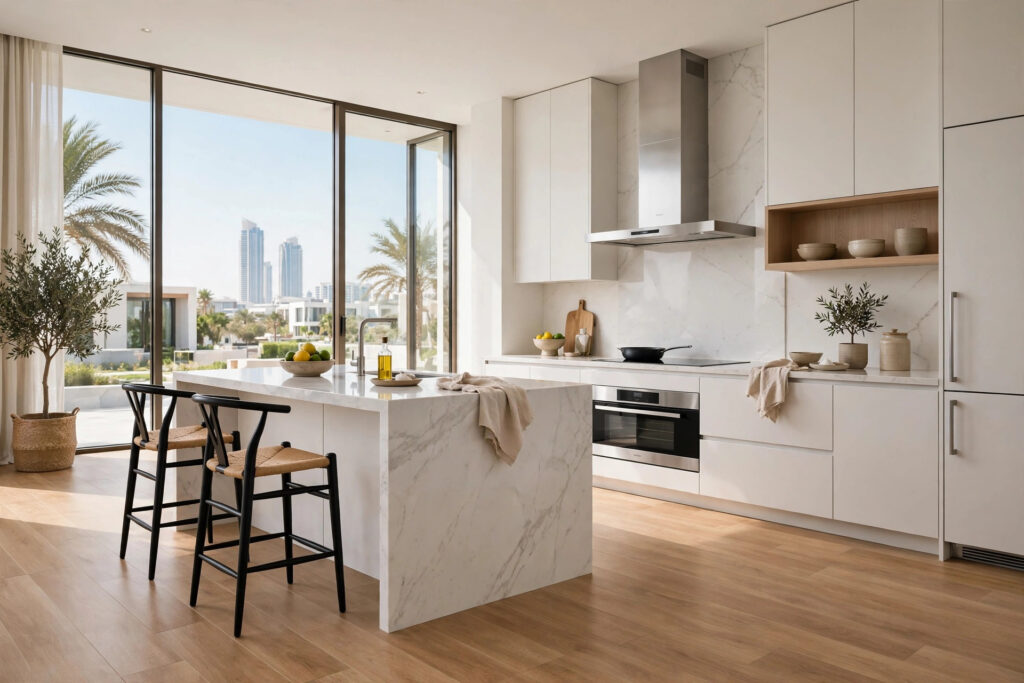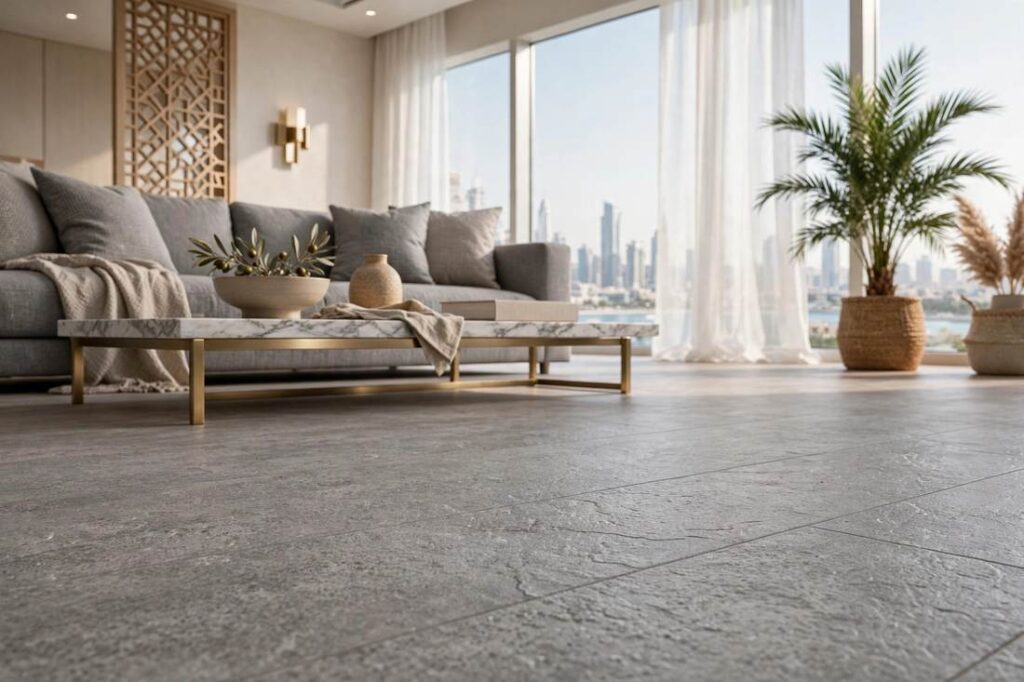
Walk into any flooring showroom in Abu Dhabi and you will hear both names within five minutes. SPC, stone plastic composite. LVT, luxury vinyl tile. They look similar on a sample board and both claim to be waterproof, so customers understandably ask which one actually survives here. The honest answer depends on your floor level, your AC habits and whether water ever gets near the floor.
What is the actual difference between SPC and LVT?
It comes down to the core. SPC packs limestone powder into the PVC core, making a rigid, dense plank. ancuongflooring.com describes SPC as limestone plus PVC with high stability and minimal deformation from temperature and humidity changes, typically 4 to 6mm thick. LVT is mostly flexible PVC, thinner at 2 to 4mm, softer and lighter.
That one difference drives everything else. The rigid SPC core resists dents from heavy furniture and holds its shape when the room heats up. The flexible LVT core feels warmer and softer underfoot and absorbs sound better, but heavy furniture can leave impressions in it over time. ancuongflooring.com notes SPC generally costs more upfront, and frames it as an investment that pays back through longer life and lower maintenance. That matches what we see in quotes across the UAE.
Which one handles Abu Dhabi heat and humidity better?
SPC, and it is not particularly close. The reason is dimensional stability: how much the plank grows and shrinks as temperature swings. Manufacturer test data quoted on made-in-china.com puts SPC expansion at 0.08 percent or less against 0.16 percent or less for standard PVC vinyl. Half the movement means half the risk of gaps opening or planks buckling when your villa sits at 45 degrees outside and 22 inside.
There is a warranty angle too. nutile.co.uk points out that SPC’s rigid core lets manufacturers stand behind the product longer: they offer a 25-year residential warranty on their SPC collections, while LVT with a soft core is generally rated for 10 to 15 years of daily use before compression and wear start to show. A longer warranty is the manufacturer telling you, in writing, which core they trust more.
One honest caveat from the same source: neither product is meant for prolonged outdoor exposure to sun and moisture. A shaded balcony is one thing. A roof terrace in direct August sun is a job for outdoor-rated materials, and we would rather tell you that now than replace your floor in two years.
| Feature | SPC | LVT |
|---|---|---|
| Core | Rigid limestone and PVC composite, 4-6mm | Flexible PVC, 2-4mm |
| Waterproof | 100% waterproof core (nutile.co.uk) | Waterproof core, but glue-down installs depend on the adhesive (nutile.co.uk) |
| Heat and expansion | Expansion 0.08% or less, minimal movement | Expansion up to 0.16%, needs larger expansion gaps |
| Underfoot feel | Hard and firm, like tile | Softer, warmer, quieter |
| Dent resistance | High, rigid core resists furniture dents | Lower, heavy furniture can leave impressions (ancuongflooring.com) |
| Typical lifespan | 20-25 years residential | 10-15 years residential (nutile.co.uk) |
| The humidity verdict | Ground floors, kitchens, villas with any moisture risk: SPC wins | Upper-floor bedrooms and living rooms where comfort matters: LVT holds its own |
Is LVT really waterproof?
Mostly yes, with an asterisk. nutile.co.uk states that both SPC and LVT have waterproof cores, since PVC and natural stone are both inherently waterproof materials. Water sitting on the surface will not damage either floor.
The asterisk is the installation. Much LVT is glued down, and the bond is only as waterproof as the adhesive and the subfloor prep. SPC is usually click-lock floating, so there is no glue line to fail. In a kitchen that gets mopped daily or an entrance where wet shoes land, that difference matters. Water finds the weak point, and the weak point is rarely the plank itself.
Where SPC wins
- Rigid core barely moves in heat, so fewer gaps and less buckling
- Shrugs off dents from sofas, dining tables and office furniture
- Click-lock install, no adhesive to fail in damp spots
- Longer rated life, up to 25 years residential per manufacturer warranties
Where SPC loses
- Hard underfoot, can feel cold in bedrooms during winter AC
- Noisier than LVT without a good underlay
What does the Abu Dhabi climate actually do to a floor?
Three things, and they happen every day. First, heat. chic-floors.com notes summer temperatures past 40°C and recommends SPC specifically because it stays stable in extreme temperatures without warping, while warning against solid wood and low-quality vinyl in direct sun. Second, humidity. The same guide flags summer humidity causing some floors to swell, warp or grow mould, and again puts SPC and porcelain tiles at the top of the list.
Third, AC cycling, which people underestimate. Your floor lives at 24 degrees while the slab beneath it bakes. That daily thermal swing is exactly what flexible vinyl dislikes and rigid SPC tolerates. The 0.08 percent expansion figure for SPC is not marketing, it is the reason installers in the Gulf keep recommending it for ground-floor spaces.
So which should you pick?
Here is how we frame it for customers in our Capital Mall showroom. Ground-floor villa, kitchen, entrance, anywhere water or damp soil is within a few meters: SPC. The rigid core, the click-lock install and the expansion numbers all point the same way. Upper-floor apartment bedroom or living room, no moisture risk, and you care about warmth and quiet: LVT is a legitimate choice and will feel nicer barefoot at 6am.
Budget matters too. SPC usually costs a bit more per sqm than equivalent LVT, but the price gap has narrowed a lot in the last few years. If the gap is small, take the SPC for the longer life. If you want the full numbers, our SPC flooring price guide breaks down every tier.
Where each one shows up around Abu Dhabi
Al Maryah Island apartments are classic LVT territory. Upper floors, no ground moisture, owners who want a warm quiet floor in bedrooms and living rooms. LVT’s softer feel and better acoustics suit tower living, where footstep noise travels to the neighbour below.
Khalifa City villas lean SPC. Ground floors, garden doors opening onto soil and irrigation, kids running in from outside. That is the moisture-risk profile where the rigid core earns its keep. Yas Island is split: the newer villas with big glass walls and sun-soaked living rooms do well with SPC’s heat stability, while upper-floor bedrooms in the same villas sometimes get LVT for comfort. Mixing by floor level is the one mix that makes sense.
Can I mix SPC downstairs and LVT upstairs?
Yes, and it is the most sensible mix. Use SPC on the ground floor where moisture and heat hit hardest, and LVT in upper bedrooms where comfort matters. Use a proper transition strip at the stair nosing and keep the tones coordinated so the house still feels like one home.
Which is better for a kitchen that gets mopped daily?
SPC. Both cores are waterproof, but SPC’s click-lock floating install has no adhesive layer to soften under constant damp mopping. LVT glue-down can work in kitchens, but the install has to be perfect and the adhesive rated for the job. SPC removes that risk.
Does LVT dent under heavy furniture?
It can. ancuongflooring.com flags this directly: LVT’s softer flexible core makes it vulnerable to indentations from heavy furniture, while SPC’s limestone content resists them. Use felt pads under everything heavy on LVT, and think twice about LVT under a piano or a loaded bookshelf.
Which looks more like real wood?
Honestly, it is a draw these days. Both use high-resolution print layers, and a good embossed SPC is hard to tell from oak at a glance. LVT has a slight edge in stone and concrete looks because the flexible format suits large-format tile visuals. Judge the sample in your own light, not under showroom spots.
Is one easier to repair if a plank gets damaged?
Click-lock SPC is easier. A damaged plank can be unclicked and replaced without touching the rest of the floor. Glue-down LVT means cutting out the damaged tile and re-gluing, which is messier and rarely invisible. If you have kids or pets, factor repairs into the decision.
Still torn? The fastest way to decide is to feel both under your feet. Message us on WhatsApp and we will bring SPC and LVT flooring samples to your home anywhere in Abu Dhabi, free. You can also browse our vinyl flooring range or read our guide to the best flooring for villas in Abu Dhabi if you are flooring a whole house.