
Flooring Guides - Clad and Craft Tradding LLC
Short answer: The safest anti slip flooring for elderly homes in the UAE is textured SPC or LVT vinyl with a rated slip-resistant surface, because it stays grippy when wet, feels warm underfoot, and has no grout lines or cold hardness like tile. Bathrooms and entrances need the highest slip resistance, while bedrooms and living areas can use softer options like carpet. Just as important as the material are level transitions between rooms, good lighting, and keeping floors free of the cleaning residues that make them slick. Falls are the leading cause of injury for older adults, so this is one decision worth getting right.

Anti slip flooring for elderly homes in the UAE: where falls happen
Falls among older adults most often happen in familiar places: the bathroom, the kitchen, the entrance, and on stairs. In UAE homes there is a specific culprit worth naming: large-format polished porcelain and marble-look tiles. They look luxurious and they stay cool, which is why developers love them, but a polished tile with wet feet is one of the slipperiest surfaces in a home. Add a bathroom with no window, condensation from hot showers, and a parent or grandparent moving a little unsteadily, and the risk is real.
Public health authorities treat this seriously: the CDC’s fall prevention resources note that most falls are preventable with changes to the home environment, and flooring is one of the highest-impact changes you can make. The goal is not to wrap the house in padding. It is to choose surfaces that grip in real conditions: wet, soapy, sandy, and in bare feet.
What slip ratings actually mean
Flooring slip resistance is measured two main ways you will see on product data sheets.
R ratings (DIN 51130). A scale from R9 to R13, tested with oil on an inclined surface. R9 is the minimum for dry living areas; R10 suits kitchens and entrance areas; R11 and above are for wet commercial zones like pool surrounds. For an elderly person’s bathroom, look for R10 or higher.
Pendulum test values (PTV). Common in British and international guidance, this simulates a shoe or bare foot slipping. A PTV of 36 or above in wet conditions is generally considered low slip potential.
You do not need to memorize the standards. You need to ask one question when choosing: what is this product’s slip rating in wet conditions? A reputable supplier will have the number. If nobody can give you one, treat that as information too.
Best flooring options for elderly safety, room by room
Bathrooms: textured waterproof vinyl or SPC, R10 or above. This is the highest-risk room and deserves the highest-rated surface. Textured SPC flooring or LVT flooring with an embossed, non-polished finish grips bare feet even when wet, and being grout-free means no slippery soap film building up in joints. Keep silicone seals intact so water cannot get underneath. For the full bathroom picture, see our guide to waterproof bathroom flooring options.
Kitchens: textured SPC or LVT. Kitchens combine water, oil, and quick movement. The same textured vinyl family works here: grippy, warm, and easy to clean after cooking. Avoid high-gloss finishes anywhere near the sink and stove.
Entrances and hallways: durable textured vinyl. Entrances collect sand and occasional rainwater tracked in during storms. A textured surface with a mat both outside and inside the door handles this. Hallways are also where most trip hazards live, so keep transitions between rooms perfectly level.
Bedrooms and living rooms: carpet or soft vinyl. Wall-to-wall carpet is the softest landing if a fall does happen, and it is warm and quiet. The trade-off is that thick, soft carpet can catch walking frames and make wheelchairs harder to push; a low-pile, firm carpet is the safer choice. Textured SPC or LVT is the alternative: firmer underfoot but easier for mobility aids.
Stairs: treat with special care. Stairs deserve non-slip nosing strips, good lighting on every step, and a handrail. Carpeted stairs with firm pile, or vinyl with anti-slip nosing, both work. This is one area where professional installation really matters.
The details that matter as much as the material
Level transitions. Even a small lip between the hallway and the bathroom is a trip hazard for shuffling feet. Transitions should be flush or ramped, never a raised metal strip to catch a toe.
Lighting. Falls happen in dim corners. Motion-sensor night lights along the path from bedroom to bathroom cost little and prevent the most dangerous kind of fall: the 3 a.m. one.
Cleaning residue. Some floor cleaners leave an invisible film that makes vinyl slicker, especially when damp. Use pH-neutral cleaners at proper dilution and rinse well. If a floor feels slippery after mopping, the cleaner is usually the cause, not the floor.
Rugs and mats. Loose rugs are a classic fall cause. If rugs are used, they need proper non-slip underlay, taped edges, and low profiles that walking aids can cross. In bathrooms, use mats with suction or rubber backing, and replace them when the backing wears smooth.
Grab bars and handrails. Flooring is half the equation; support is the other half. Grab bars in the bathroom and a rail on every staircase multiply the safety benefit of a good floor.
What to avoid
High-gloss polished tiles and polished stone in wet areas are the main thing to replace or cover. Very thick, plush carpet that grabs at feet and walkers is another. And be wary of stick-on anti-slip strips as a permanent solution: they peel, collect dirt at the edges, and give a false sense of security once worn. They are fine as a stopgap while you plan a proper refit.
Worried about a parent’s bathroom or a slippery villa entrance? Message us on WhatsApp and we will assess the slip risk on a free site visit anywhere in Abu Dhabi and show you rated samples you can test with wet feet, the honest way.
Planning the work with minimal disruption
Reflooring an occupied home with an elderly resident needs planning: do it one zone at a time so there is always a safe path through the house, keep the bathroom usable or schedule around it, and make sure temporary coverings lie perfectly flat. A professional installer who has done occupied villas before will plan the sequence with you rather than just turning up with boxes.
Many of the same principles apply to young children, so if grandchildren visit often, our guides to safe flooring for kids’ rooms and child-safe nursery flooring are worth a read alongside this one.
Frequently asked questions
What is the safest flooring for elderly people in the UAE?
Textured SPC or LVT vinyl with a documented wet slip rating is the best all-round choice: grippy when wet, warm underfoot, and grout-free. Low-pile carpet suits bedrooms. The key is matching the rating to the room, with bathrooms getting the highest.
Are tiles dangerous for elderly people?
Polished tiles are slippery when wet and very hard when fallen on, which is a bad combination. Textured or matte tiles are better, but textured vinyl generally outperforms tile on both grip and impact softness.
What slip rating should bathroom flooring have for seniors?
Look for R10 or higher on the DIN scale, or a wet pendulum value of 36+. Ask the supplier for the rating in writing rather than accepting “anti-slip” as a marketing word.
Is carpet safe for elderly homes?
Low-pile, firm carpet is safe and softens falls, which makes it good for bedrooms and living rooms. Avoid thick plush carpet, which can catch feet and impede walking frames and wheelchairs.
Can anti-slip coatings make my existing tiles safer?
Anti-slip treatments and coatings can improve grip temporarily, but they wear unevenly and need reapplication. For a long-term solution in a home with elderly residents, replacing the surface with a rated product is more reliable.
How much does it cost to make a bathroom floor anti-slip?
Pricing depends on the room size, the product chosen, and the subfloor condition, so it is best assessed on site. What drives the budget is mainly material choice and whether old tiles need removal. WhatsApp us for a free site visit and an honest assessment anywhere in Abu Dhabi.
Make the home safer, one room at a time
You do not have to refloor the whole house at once. Start with the bathroom, then the entrance and kitchen, the rooms where falls actually happen. Visit our showroom at Shop No. AA-110, Capital Mall, Khourat Al Heel St, Mohamed Bin Zayed City, open Monday to Sunday 10:00 to 22:00, call +971 55 281 9239, or WhatsApp us to book a free site visit anywhere in Abu Dhabi. We will bring rated samples, check your transitions and lighting, and plan the work around your family’s routine.
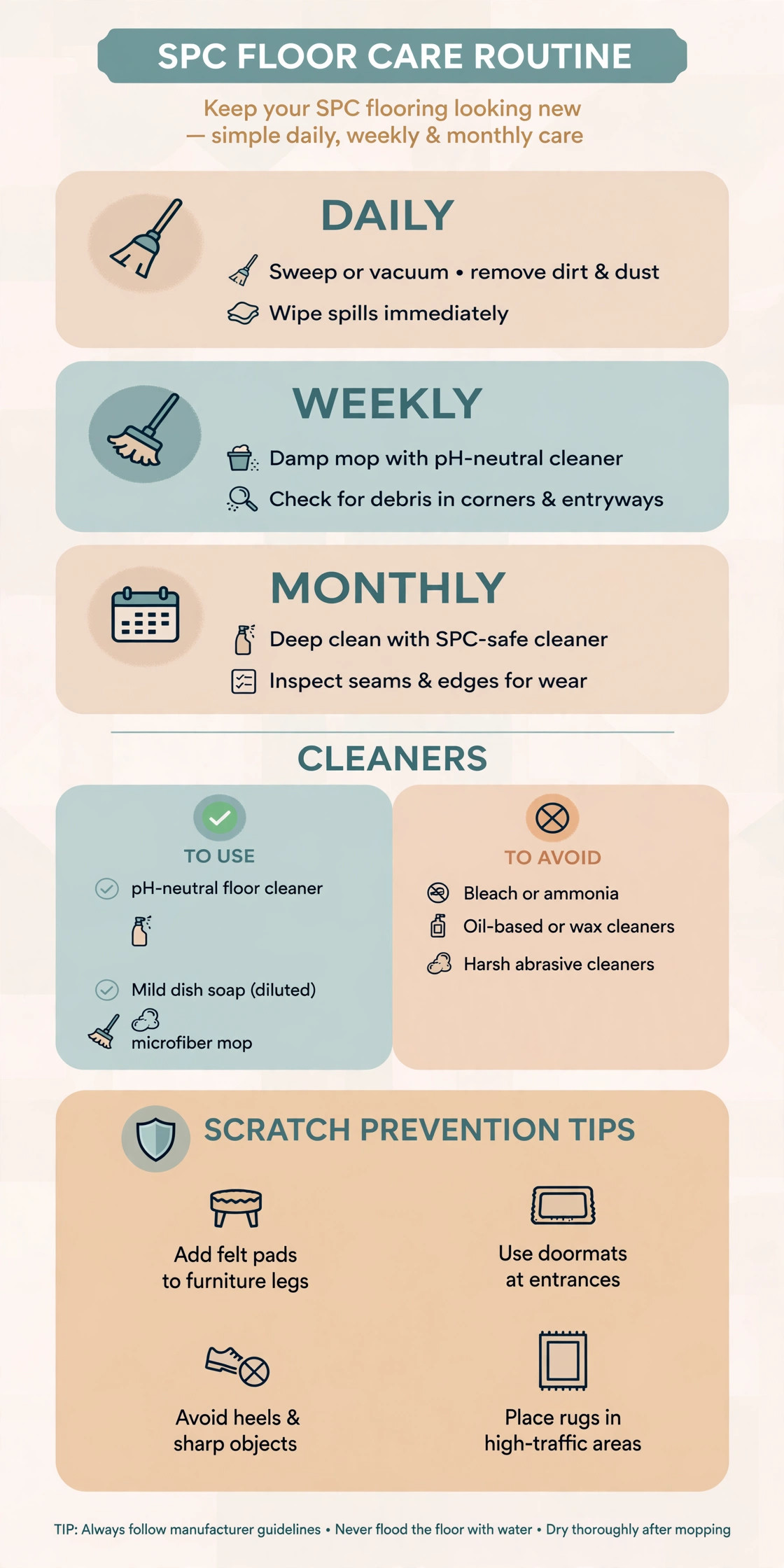
Short answer: Maintaining SPC flooring in the UAE is simple: sweep or vacuum daily to remove sand and grit, damp mop weekly with a pH-neutral cleaner, wipe spills promptly, and use felt pads under furniture. Avoid abrasive scrubbers, steam mops, and harsh chemicals like bleach. The number one enemy of SPC here is not water or stains, it is the fine desert sand tracked in on shoes, which acts like sandpaper underfoot. Control the grit and an SPC floor stays looking new for many years.
SPC flooring maintenance guide for the UAE: the sand and dust reality
SPC stands for stone plastic composite: a rigid plank with a limestone-based core, a printed design layer, and a transparent wear layer on top. That wear layer is tough, but it is not invincible, and the UAE gives it a unique workout. Fine sand blows in through doors, rides in on shoes and abayas, and settles as an invisible abrasive film. Every footstep then grinds that grit against the wear layer. In milder climates, weekly mopping is plenty; here, the daily dry routine matters more than anything else you do.
The good news is that SPC asks for very little beyond that. It does not need polishing, waxing, or sealing. It does not swell from mopping. The entire maintenance program fits into habits you can build in a week. If you are still comparing finishes, browse our SPC flooring range to see the products this guide covers.
The daily routine: two minutes that save the floor
Sweep or dry-mop entryways and high-traffic paths daily. A soft-bristle broom or a dry microfiber mop picks up the grit before it gets ground in. Focus on entrances, the path from the door to the kitchen, and anywhere shoes come off.
Vacuum weekly with the right head. Use a vacuum with a hard-floor setting or a soft brush head. Skip beater bars and stiff rotating brushes, which can dull the wear layer over time. Vacuum under sofas and beds where grit collects unnoticed.
Use doormats at every exterior door. A coarse outdoor mat plus an indoor mat catches most of what feet bring in. Shake them out weekly; a full mat just relocates the sand onto your floor.
Consider a shoes-off habit indoors. Many UAE households already do this, and it is the single most effective floor protection there is.
Weekly mopping: the right way
Damp mop, never soaking wet. Wring the mop until it is just damp, work in sections, and let the floor air-dry; SPC dries in minutes in air conditioning. Use a pH-neutral floor cleaner made for vinyl or hard floors, diluted as directed. A capful in a bucket is usually plenty; more cleaner does not mean more clean, it means residue.
Change the mop water when it looks dirty. Mopping with sandy water just redistributes the grit in a thin film. Microfiber flat mops are ideal because they trap particles instead of pushing them around, and the pads go straight in the washing machine.
Cleaners to use, and cleaners to avoid
Safe: pH-neutral vinyl or hard-floor cleaners, diluted white vinegar solutions used occasionally for light refreshing (not as a daily habit), and plain water for most mopping.
Avoid: bleach and chlorine cleaners, which can discolor the design layer; abrasive powders and cream cleansers; ammonia-based products; oil soaps and wax-based “mop and shine” products, which leave a film that attracts dust and turns cloudy; and steam mops, unless your SPC manufacturer explicitly allows them. Steam forces moisture and heat into click joints, and most warranties do not cover the result.
If a spill leaves a mark, from curry, coffee, or a felt-tip pen, a little isopropyl alcohol on a soft cloth usually lifts it. Test in a hidden spot first, as with any spot treatment.
Scratch prevention: furniture, pets, and daily life
Most scratches on SPC come from three sources: furniture dragged without protection, pet claws, and grit. Stick self-adhesive felt pads under all chair and table legs, and replace them when they wear thin or pick up grit (a gritty felt pad is worse than none). Use wide, soft castors on office chairs, or a chair mat. Lift rather than drag heavy items when rearranging.
For pet owners, keep claws trimmed and place mats under food and water bowls. If dogs are part of the household, our guide to scratch-resistant flooring for dogs covers which wear layers stand up best to claws.
Sunlight deserves a mention too. SPC handles UAE indoor conditions well, but intense direct sun through glass can fade any flooring over time and heat planks enough to stress joints. Sheer curtains or UV-filtering window film on the harshest exposures are cheap insurance. We cover the fading question in detail in our article on whether vinyl flooring fades in direct sunlight.
Humidity, AC, and seasonal habits
SPC is dimensionally stable, which is one reason it suits the UAE: it does not swell in humid months or shrink dramatically under AC the way wood-based floors do. You do not need to manage indoor humidity for the floor’s sake. Two habits still help: do not leave the home sealed and baking for weeks when traveling in summer, since extreme heat cycling stresses every material in the house, and wipe up condensation that forms under cold AC vents rather than letting it sit.
If you are comparing SPC with laminate for a humid space, our guide on fixing swollen laminate shows what happens when a wood-core floor meets moisture, and why SPC owners rarely face that particular problem.
Deep cleaning a few times a year
Every few months, give the floor a deeper pass: vacuum thoroughly including edges and corners, then mop with a proper vinyl floor cleaner, working in small sections and rinsing the mop often. For textured or embossed SPC, a soft-bristle brush on stubborn areas lifts dirt from the grain. This is also a good moment to check transition strips, reseat any that have lifted, and inspect silicone seals in kitchens and bathrooms.
Stubborn scuffs from shoe soles usually come off with a melamine sponge used gently, or a dab of isopropyl alcohol. Avoid scrubbing hard enough to dull the wear layer; light pressure and patience win.
Not sure which cleaner is safe for your specific floor? WhatsApp us a photo of the product label and we will tell you what to use, or book a free site visit anywhere in Abu Dhabi for hands-on advice.
Frequently asked questions
Can I use a steam mop on SPC flooring?
Generally no. Most SPC manufacturers advise against steam mops because heat and forced moisture can damage click joints and void the warranty. Damp mopping with a pH-neutral cleaner is safer and just as effective.
Is vinegar safe for cleaning SPC floors?
An occasional very diluted vinegar rinse is fine for most SPC, but daily vinegar use can dull the wear layer over time. For routine cleaning, a dedicated pH-neutral vinyl floor cleaner is the better choice.
How do I remove scratches from SPC flooring?
Light surface scuffs often buff out with a melamine sponge or a vinyl floor repair marker matched to the plank color. Deep scratches that cut through the wear layer cannot be truly repaired; the plank should be replaced, which is straightforward with click systems.
Why does my SPC floor look dull or cloudy?
Cloudiness is almost always cleaner residue: too much product, oil soap, or wax-based cleaners. Mop with plain water a few times to rinse the film away, then switch to a properly diluted pH-neutral cleaner.
Do I need to polish or seal SPC flooring?
No. SPC has a factory wear layer that needs no polish, wax, or sealant. Adding them usually creates buildup that attracts dust and is difficult to remove.
How often should I mop SPC floors in the UAE?
Damp mop high-traffic areas weekly and the whole house every one to two weeks, with daily sweeping or dry-mopping of entrances. Adjust to your household: kids, pets, and beach trips mean more frequent passes.
Keep it simple, keep it beautiful
SPC rewards boring consistency: dry grit removal, gentle damp mopping, and felt pads. Do that and the floor takes care of itself. To see the range in person, visit our showroom at Shop No. AA-110, Capital Mall, Khourat Al Heel St, Mohamed Bin Zayed City, open Monday to Sunday 10:00 to 22:00, call +971 55 281 9239, or WhatsApp us for a free site visit anywhere in Abu Dhabi. We also stock LVT flooring if you want to compare feels side by side, and our tools page has calculators to plan your project.
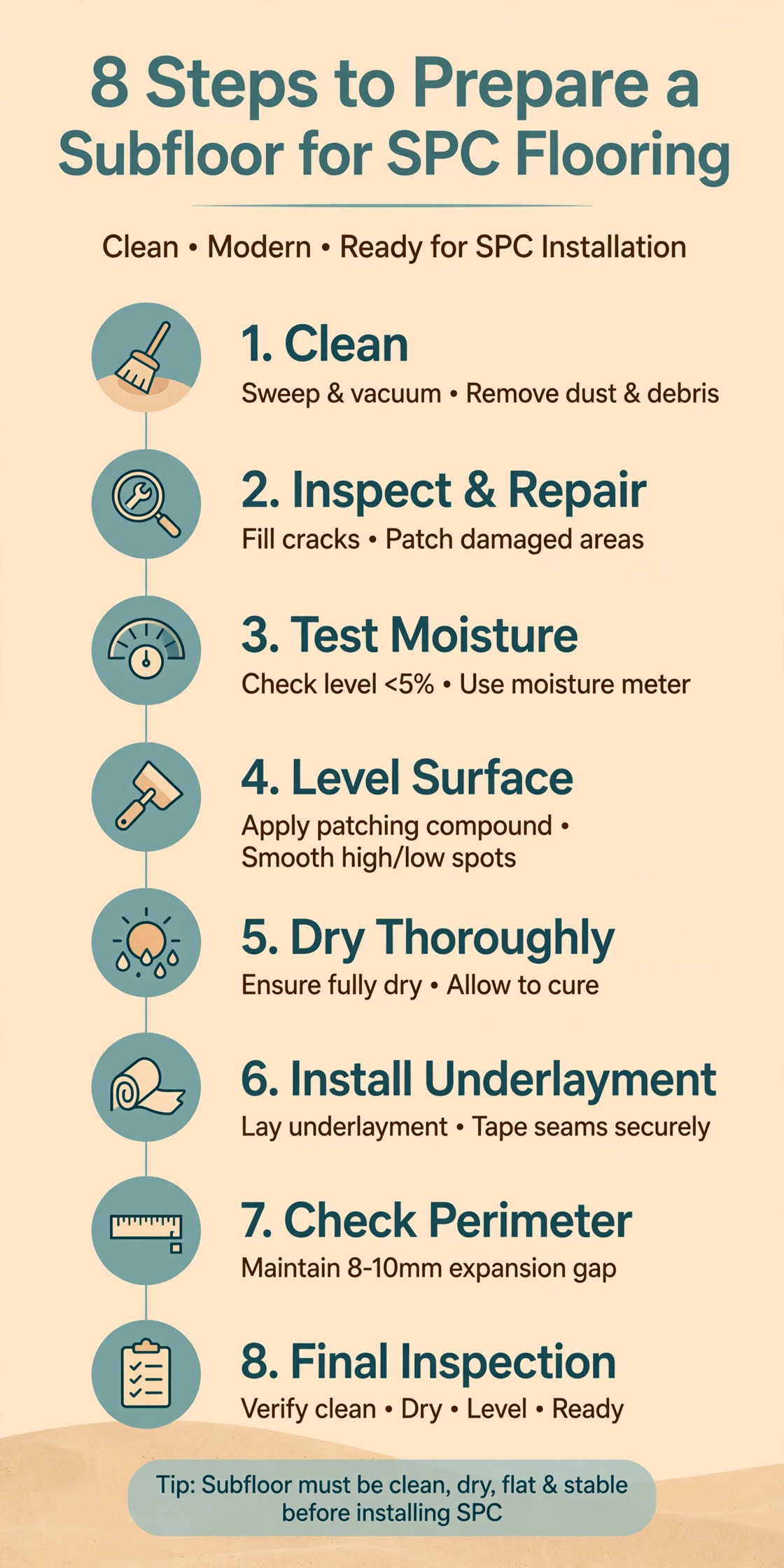
Short answer: To prepare a subfloor for SPC flooring, you need it clean, dry, flat, and sound: sweep and degrease the concrete, check flatness with a long straightedge, grind down high spots and fill low ones, test for moisture, repair cracks, lay a suitable underlayment or vapor barrier, acclimate the planks in the room, and leave expansion gaps at the walls. SPC is forgiving compared to flexible vinyl, but its rigid click joints will fail over a bumpy or damp base. Most SPC problems we are called to fix trace back to skipped preparation, not to the product.
How to prepare subfloor for SPC flooring: why the base matters
The subfloor is whatever sits directly under your new floor. In the UAE that is almost always a concrete slab, sometimes with old tiles still bonded to it. SPC, stone plastic composite, is a rigid plank with a click-lock joint on all four sides. That rigidity is a strength once installed, but during installation it means the planks bridge across dips instead of following them. Walk on a bridged plank and it flexes at the joint; flex it thousands of times and the lock breaks. The plank then lifts, gaps open, and the floor starts clicking or moving. Almost none of that is fixable without lifting the floor and doing the preparation properly, which is why this stage deserves more attention than the laying itself.
Step 1: Clear the room and clean thoroughly
Remove all furniture, appliances, and old skirting if it is being replaced. Then clean like you mean it: sweep, vacuum, and damp mop the slab. In the UAE, fine construction dust and sand get into everything, and grit left under a floating floor will grind between the plank and the base every time someone walks. Degrease any oily spots, especially in kitchens, because leveling compounds and adhesives will not bond to grease. This is also when you pull up any old carpet gripper rods, staples, or adhesive ridges.
Step 2: Deal with the existing floor covering
If old tiles are coming up, remove them fully and scrape the bed flat. If they are staying, which is common, they must be sound: no hollow or cracked tiles, no loose edges. Tap across the floor and listen for hollow spots. Deep grout lines, anything more than a couple of millimetres, should be skimmed with leveling compound so the pattern does not telegraph through the SPC over time. Our guide on installing SPC over existing tiles goes deeper on this decision.
Step 3: Check flatness with a straightedge
Lay a two-metre straightedge or long spirit level on the slab in several directions and look for gaps underneath. As a rule of thumb, most SPC manufacturers want the subfloor flat within a few millimetres over a couple of metres. Mark every high and low spot with a pencil as you go. Pay special attention to doorways, where two pours often meet at slightly different heights, and to the middle of large villa rooms, where slabs can dish.
Step 4: Grind highs, fill lows
High spots get ground down with a concrete grinder and a dust shroud. Low spots and grout lines get filled with a cement-based leveling compound, feathered out well beyond the dip so there is no ridge. Deep fills may need two passes. Let everything cure fully before moving on; rushing this step is one of the most common DIY mistakes, because compound that looks dry on top can still be soft underneath.
Step 5: Test for moisture
Concrete holds water far longer than people expect, especially new slabs and villa ground floors. Press a pin-type moisture meter into the slab in several spots, including near bathrooms, kitchens, and exterior walls. If readings are high, find out why before proceeding: it could be a curing slab that needs more time, a plumbing leak, or groundwater pressure. Installing over a damp slab traps moisture under a waterproof floor, which is exactly how mold problems start. When in doubt, wait and retest rather than hoping it dries under the floor. It will not.
Step 6: Repair cracks and holes
Hairline shrinkage cracks are normal in concrete and usually harmless once filled. Wider cracks, crumbling edges, or holes from removed fixtures need proper repair with crack filler or patching compound. Anything structural, a crack that keeps growing or a slab that moves, needs a builder’s opinion before any flooring goes down. Flooring does not fix structural movement; it just hides it until the joints fail.
Step 7: Lay underlayment or a vapor barrier
On concrete, a vapor barrier or moisture-rated underlayment is standard practice in this climate. It does three jobs: blocks residual slab moisture, cushions minor imperfections, and reduces hollow footfall sound, which matters in apartments. Choose an underlayment rated for SPC and for the moisture conditions you measured. Overlap and tape the seams so there are no gaps for vapor to sneak through.
Step 8: Acclimate the SPC planks
Bring the unopened boxes into the room where they will be installed and leave them for at least 48 hours. UAE rooms swing between hot delivery trucks and cold air conditioning, and planks that go down while still thermally stressed can shrink back and open gaps at the joints later. Stack the boxes flat, away from direct sun through windows, with the AC running at normal living temperature.
Not sure your slab is ready? Send us a WhatsApp message and we will assess the subfloor on a free site visit anywhere in Abu Dhabi, moisture meter in hand, before you commit to anything.
Step 9: Plan expansion gaps and the final clean
SPC moves slightly with temperature, so leave a consistent gap around all walls, pipes, and fixed objects, hidden under skirting or beading. Plan your starting wall and plank direction before opening a single box: hallways usually run lengthwise, and large rooms look best with planks running toward the main light source. Do a final vacuum right before laying. One stray grain of sand under the first row can telegraph a bump through the whole floor.
Common preparation mistakes we see in Abu Dhabi
- Skipping the moisture test on ground-floor villas, then wondering why the floor smells musty six months later.
- Laying over dusty slabs. Fine desert dust plus foot traffic equals a floor that never quite sits silent.
- Ignoring grout lines under the assumption that rigid planks will hide them. They will, for about a year.
- Butting planks tight to walls with no expansion gap, which leads to peaking when summer heat expands the floor.
- Installing before paint and dusty trades finish. SPC should be one of the last things to go in, after the dusty work is done.
How long preparation takes
For a typical villa room with a sound slab, preparation is usually a day’s work: cleaning, leveling touch-ups, and underlayment. Full tile removal, heavy leveling, or drying out a damp slab can add days. If you are planning a whole villa, read our guide on how long flooring installation takes so the preparation stage is properly in your timeline. And if you are still choosing materials, our SPC flooring page and the herringbone SPC collection show what goes on top once the base is right. You can also estimate quantities with our flooring calculator before the site visit.
Frequently asked questions
Can I lay SPC directly on concrete without any preparation?
You can lay it on clean, dry, flat concrete with the right underlayment, but raw slabs are rarely flat enough straight out of construction. At minimum, clean thoroughly, check flatness, and test moisture. Skipping these checks is the most common cause of SPC failures.
Do I need underlayment under SPC on a concrete slab?
In the UAE, yes in most cases. A moisture-rated underlayment or vapor barrier protects against slab moisture and improves acoustics. Some SPC products have pre-attached padding, but that padding is not a vapor barrier, so the moisture question still needs its own answer.
How flat does the subfloor need to be for SPC?
Follow your product’s specification, but as a general rule most SPC manufacturers require flatness within a few millimetres over a two-metre span. Anything beyond that should be ground or filled.
Can SPC go over old tiles?
Yes, if the tiles are solid, level, and well bonded, with deep grout lines skimmed flat. Hollow or cracked tiles must be fixed or removed first. Height at doorways and under doors needs checking too.
How long should SPC acclimate before installation?
At least 48 hours in the installation room at normal living temperature, with boxes unopened and stacked flat. In the UAE, where delivery trucks run hot, do not skip this.
What happens if the subfloor is damp?
Do not install. Find and fix the moisture source, dry the slab, and retest. Installing over damp concrete traps moisture under a waterproof floor and leads to mold, odors, and joint failure.
Book a free subfloor assessment
Preparation is the invisible half of a good floor. Visit our showroom at Shop No. AA-110, Capital Mall, Khourat Al Heel St, Mohamed Bin Zayed City, open Monday to Sunday 10:00 to 22:00, call +971 55 281 9239, or WhatsApp us for a free site visit anywhere in Abu Dhabi. We will check your subfloor’s flatness and moisture and tell you exactly what it needs before a single plank goes down.
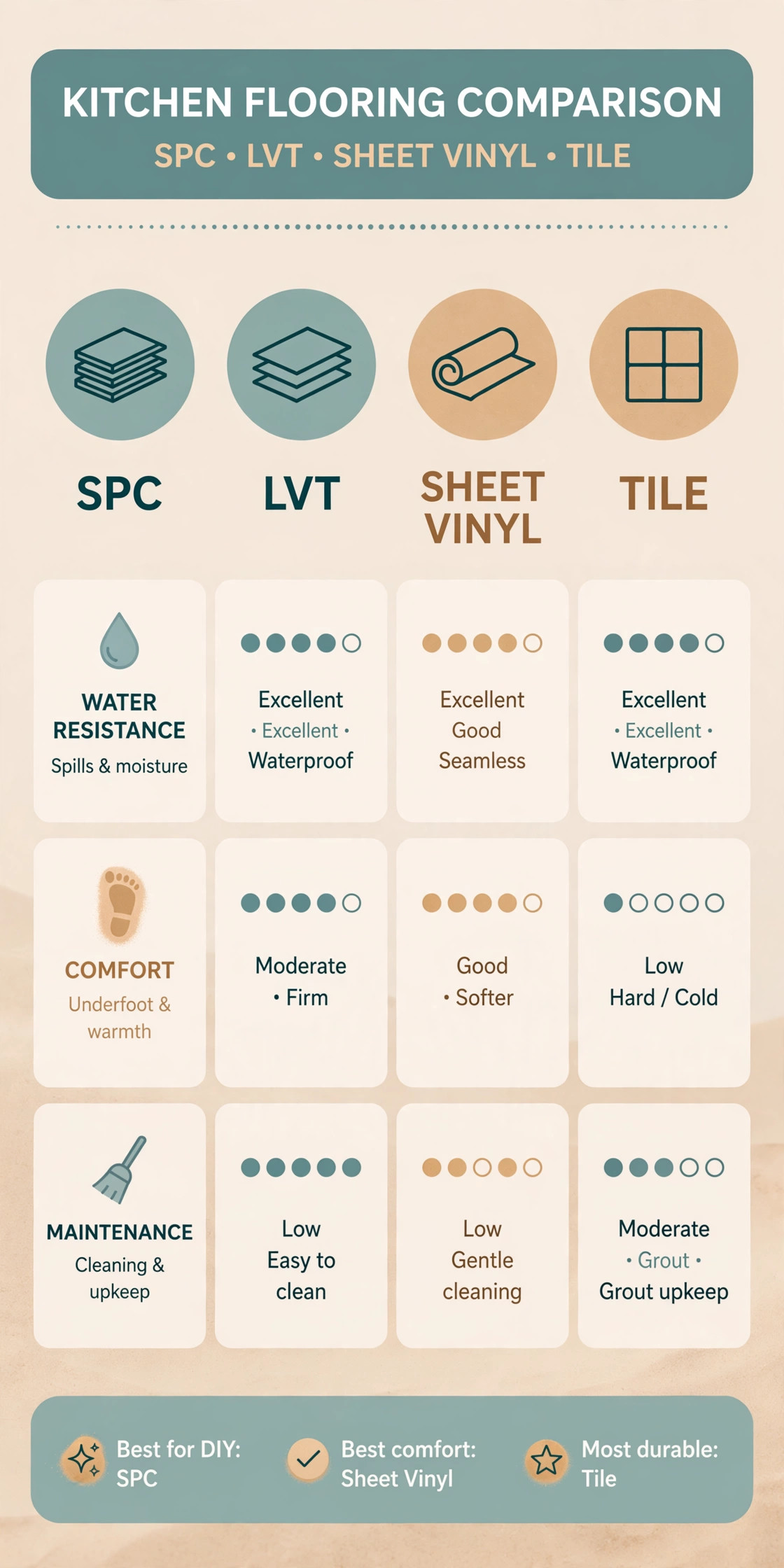
Short answer: The best waterproof flooring for kitchens in the UAE is SPC (stone plastic composite) or quality LVT (luxury vinyl tile), because both stand up to spills, steam, mopping, and humidity without swelling. Sheet vinyl is also fully waterproof and budget-sensible, while porcelain tile works but needs grout maintenance. What matters as much as the material is the installation: sealed edges, a level subfloor, and proper transitions are what keep a kitchen floor watertight for years. Get those right and any of the top options will serve a busy kitchen well.
Waterproof flooring for kitchens in the UAE: what actually matters
Kitchens punish floors more than any other room. Water boils over, the sink splashes, the fridge leaks one day, and in the UAE the room also sits in humid air for months while the AC cycles cold. A floor that is merely water-resistant, like standard laminate, can survive a quick wipe but not a slow leak under the dishwasher. Truly waterproof options do not absorb water at all, so the question shifts from the material to the weak points: seams, edges, and what lies underneath.
That is why installers talk about a waterproof floor as a system, not just a product. The planks or tiles are one part; the subfloor preparation, the sealing around cabinets and appliances, and the transition strips at doorways are the parts that decide whether spilled water stays on top or finds its way down.
SPC flooring: the kitchen workhorse
SPC stands for stone plastic composite. Its core is a rigid mix of limestone powder and stabilizers, which means it does not expand, contract, or swell the way wood-based floors do. For kitchens, that rigidity is the whole story: boiling water, steam from cooking, and daily mopping do not change its shape.
Click-together SPC installs floating over the subfloor, so there is no adhesive to break down if moisture gets near an edge. It feels solid underfoot, handles dropped pots better than tile (it will dent rather than crack, and it is kinder to the pot), and modern wood and stone looks are convincing. If you want one material that covers waterproofing, durability, and looks in a UAE kitchen, SPC is the default recommendation, and our SPC flooring range is built around exactly these demands.
LVT: comfort and style with full waterproofing
LVT, luxury vinyl tile, is the flexible cousin of SPC. It is fully waterproof, warmer and slightly softer underfoot, and comes in the widest range of designs, from oak planks to marble-look tiles. In kitchens where someone stands cooking for long stretches, that slight give is genuinely noticeable.
The trade-off is that flexible LVT shows subfloor imperfections more readily, so it demands a well-leveled base. Glue-down LVT also relies on adhesive, which is fine in kitchens but means the installation quality matters even more around the sink and dishwasher. Done well, LVT flooring is an excellent kitchen choice, especially when you want a softer feel or a specific stone look.
Sheet vinyl: the quiet, fully waterproof option
Sheet vinyl comes in rolls and is heat-welded or glued with minimal seams, which makes it arguably the most waterproof of all: water simply has nowhere to go. It is a single continuous surface, easy to mop, and forgiving of imperfect subfloors.
The compromise is looks and feel. Even good sheet vinyl does not match the realism of SPC or LVT planks, and sharp objects can cut it. For rental kitchens, laundry corners, and anyone who prioritizes function over form, vinyl flooring in sheet form is hard to beat.
Porcelain tile: the traditional UAE kitchen floor
Most Abu Dhabi kitchens were built with porcelain or ceramic tile, and it remains a legitimate option: the tile itself is waterproof and nearly indestructible. The weakness is the grout. Grout lines absorb stains, harbor grease, and in humid conditions can grow mold if not sealed and cleaned. Large-format tiles with tight, sealed grout joints minimize this, but the maintenance never fully goes away. Tile is also cold and unforgiving: dropped glass shatters, and standing on it for long cooking sessions is tiring.
What to avoid in a UAE kitchen
Standard laminate is the main one to be careful with. Its wood-based core swells when water reaches it, and kitchen edges, around the sink, dishwasher, and fridge water line, are exactly where water reaches. So-called water-resistant laminates buy time against spills but not against leaks. Solid hardwood has the same vulnerability plus movement from humidity swings. If you love the wood look, get it from SPC or LVT instead.
Installation details that make or break waterproofing
This is the part homeowners underestimate. A waterproof product installed carelessly is not a waterproof floor.
- Subfloor levelness. Standing water finds low spots and sits there. The base should be flat before anything goes down.
- Sealed perimeters. Silicone where the floor meets cabinets, islands, and appliance recesses stops water running underneath.
- Appliance zones. The areas under dishwashers, fridges with water dispensers, and washing machines deserve extra attention and ideally a leak tray or mat.
- Transitions. Where the kitchen meets the hallway or living room, the transition strip should be sealed, not just laid.
- Expansion gaps. Floating floors need a small gap at walls, hidden under skirting, so seasonal movement does not push planks against cabinets and open seams.
Living with it: kitchen floor maintenance in the UAE
Daily life is simple: sweep or vacuum the sand and grit that blows in (grit is what scratches floors here, more than water), then damp mop with a pH-neutral cleaner. Avoid soaking the floor, skip steam mops on click systems unless the manufacturer allows them, and wipe up spills rather than leaving them. Grease near the stove responds to a degreasing wipe before mopping. With these habits, a quality waterproof floor in a kitchen lasts many years without drama.
Choosing between the options often comes down to feel and look, which is why we wrote a full rundown of kitchen flooring options in Abu Dhabi and a focused guide on SPC flooring for kitchens. If you are still deciding between materials, our article on how SPC handles the UAE climate covers the heat and humidity angle in depth.
Trying to choose between SPC and LVT for your kitchen? WhatsApp us a photo of the space and we will recommend the right option on a free site visit anywhere in Abu Dhabi, with samples you can see in your own light.
Frequently asked questions
Is SPC flooring really 100% waterproof?
The SPC plank itself does not absorb water, so spills, mopping, and steam will not damage it. The installation still needs sealed edges and a dry subfloor, because water can travel underneath any floating floor through unsealed gaps.
Can I install waterproof flooring over my existing kitchen tiles?
Often yes, if the tiles are sound, level, and well bonded. Deep grout lines may need skimming so they do not telegraph through, and the added height at doorways and under appliances must be checked. An installer should assess this on site.
Which is better for kitchens, SPC or LVT?
Both are waterproof. SPC is more rigid, more dent-resistant, and more forgiving of minor subfloor unevenness. LVT is softer underfoot and offers more design variety. For heavy-use family kitchens, SPC usually wins; for comfort and style-first kitchens, LVT is excellent.
Does waterproof kitchen flooring need grout?
No. SPC, LVT, and sheet vinyl are grout-free, which is one of their biggest advantages over tile: no grout lines to stain, seal, or scrub.
How do I protect the floor around the sink and dishwasher?
Keep silicone seals intact where flooring meets cabinetry, use a mat in front of the sink, and check under-sink plumbing for slow drips a couple of times a year. Most kitchen floor failures start with a leak nobody noticed.
Will a waterproof floor stop mold underneath?
The floor surface will not grow mold, but trapped moisture beneath any floor can. A dry subfloor, sealed edges, and fixing leaks promptly are what prevent mold, regardless of the flooring material.
Visit our Abu Dhabi showroom
The best way to choose is to stand on the options. Visit us at Shop No. AA-110, Capital Mall, Khourat Al Heel St, Mohamed Bin Zayed City, open Monday to Sunday 10:00 to 22:00, call +971 55 281 9239, or WhatsApp us to book a free site visit anywhere in Abu Dhabi. Bring your kitchen measurements and we will help you compare SPC, LVT, and vinyl side by side.
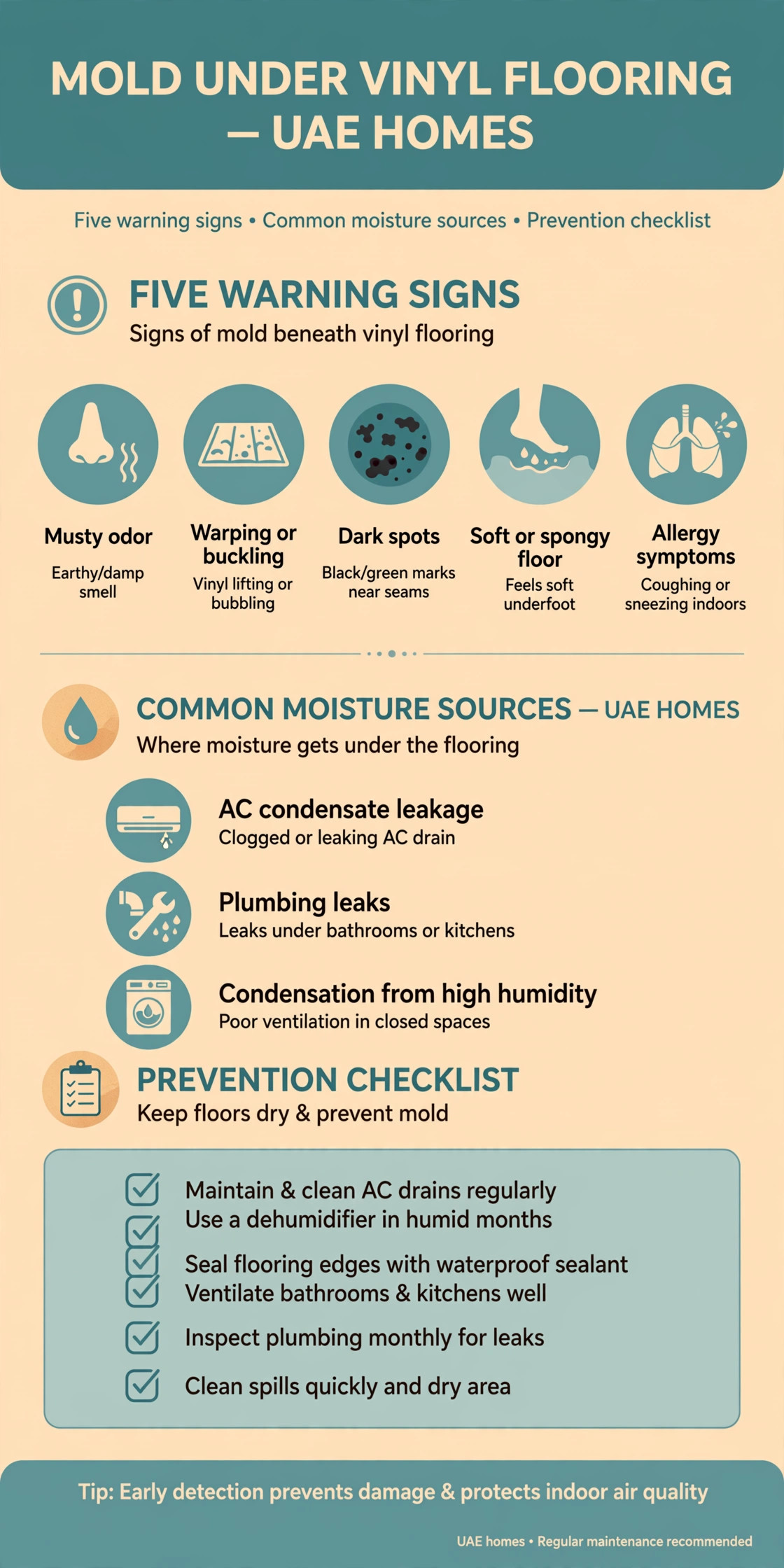
Short answer: Yes, mold under vinyl flooring is a real and fairly common problem in UAE homes, and humidity is usually what starts it. Vinyl keeps water out from above, but any moisture trapped between the vinyl and the concrete underneath has nowhere to escape, and in a hot, humid climate that trapped moisture is exactly what mold needs to grow. The fix is straightforward in principle: find where the moisture is coming from, dry the area fully, remove and treat whatever is affected, then reinstall with a proper moisture barrier. If your home has a musty smell you cannot quite place, do not ignore it.
Mold under vinyl flooring in UAE humidity: how it starts
First, a quick definition so we are talking about the same thing. Vinyl flooring covers several products: sheet vinyl that comes in rolls, luxury vinyl tile (LVT), and click-together vinyl planks. SPC flooring, which stands for stone plastic composite, is a rigid-core plank that is usually sold alongside vinyl because it installs the same way, but its core is limestone-based rather than flexible PVC.
All of these are waterproof from the top down. A spilled glass of water, a mopped floor, even a pet accident will sit on the surface rather than soak in. That is the selling point, and it is true. The problem is what happens underneath. Concrete subfloors, which nearly every UAE villa and apartment is built on, hold and release moisture. Warm, humid air that finds its way under the vinyl through an unsealed edge or a tiny gap at a seam can condense against the cooler surface below. With sheet vinyl and glue-down installations, that moisture is then sealed in with no airflow at all. Click systems breathe a little more, but not enough to dry out a genuinely damp slab.
Mold does not need much. It needs moisture, warmth, and something organic to feed on. The vinyl itself is not food, but the dust, adhesive residue, and leveling compounds underneath it are. In a climate where summer humidity runs high and air conditioning runs cold for months, the underside of a vinyl floor is one of the most condensation-prone places in the house.
What makes UAE homes especially vulnerable
Abu Dhabi’s coastal humidity is the obvious factor, but it is the combination of several local habits and building realities that really sets the stage.
Air conditioning cycles. When the AC runs hard, the slab under your floor gets cold. Humid air trapped or seeping underneath condenses, the same way a cold glass sweats on a humid day. Many residents also switch the AC off completely when traveling in summer, then return to a home that has been sitting warm and damp for weeks. That swing is ideal for mold.
Ground-floor villa slabs. Villas sit directly on grade, and concrete wicks moisture from the soil. Apartments on upper floors have far fewer problems for this reason.
New buildings still curing. Concrete releases moisture for months after construction. Flooring laid too soon over a new slab is a classic cause of trouble that shows up a season later.
Wet zones. Kitchens, bathrooms, and laundry rooms put repeated moisture next to the floor. A slow leak under a sink or around a washing machine can feed mold for months before anyone notices.
Mopping habits. Vinyl tolerates damp mopping, but regularly soaking the floor and letting water pool at the edges pushes moisture into seams it was never meant to handle.
Warning signs there is mold under your vinyl floor
You cannot see under the floor, so you have to read the clues it gives you.
- A musty or earthy smell that gets stronger when the AC kicks on, after mopping, or on particularly humid days. This is the number one sign installers hear about.
- Dark staining or discoloration showing through at seams, or a shadow spreading outward from under a fixed point like a kitchen island.
- Planks lifting, curling at the edges, or a soft and spongy feeling underfoot in spots. Adhesive breaking down from moisture lets go in exactly this way.
- Skirting boards swelling or paint bubbling at the base of the walls near the floor, which suggests moisture is moving through the whole assembly.
- Visible condensation or dampness when you lift a corner, a transition strip, or a plank inside a wardrobe where nobody walks.
One caution: some people notice headaches or allergy-type irritation in a room with hidden mold. That is a matter for a doctor, not a flooring article, but it is another reason not to leave a suspected problem sitting.
How to confirm it before pulling up the whole floor
Start small and discreet. Lift a transition strip where two floors meet, or a plank inside a wardrobe or under a sofa, and look and smell. Flooring installers carry pin-type moisture meters that read the dampness of the subfloor in seconds, which is the fastest way to confirm a suspicion without committing to a full uplift. Check the wall bases too: if the bottom of the drywall or the skirting shows staining, moisture has been there a while. A smell that strengthens on humid days or right after the AC starts is itself strong evidence, because it means something damp is reacting to air movement.
What to do if you find mold: a practical sequence
1. Stop the moisture source first. Nothing else matters until this is done. Check for plumbing leaks, AC drain lines dripping inside walls, seepage at exterior doors, and condensation from poor ventilation. A floor reinstalled over an active leak will mold again.
2. Dry the area completely. This takes days, not hours. Pull back the affected flooring, ventilate the room, and run a dehumidifier if you have one. The subfloor must be genuinely dry before anything goes back down, which your installer can verify with a moisture meter.
3. Remove what is affected. Vinyl that has mold growing beneath it should come up, at least in the affected zone. Small, contained patches can sometimes be handled locally; widespread growth means a full uplift. Bag removed material so spores do not spread through the house.
4. Treat the subfloor. Scrub and treat the concrete following established mold cleanup guidance, such as the EPA’s mold cleanup basics. Porous materials that have absorbed mold, like underlayment or leveling compound in bad shape, should be replaced rather than cleaned.
5. Decide: repair or replace. If the vinyl is old, widespread mold or a damaged subfloor usually makes replacement the sensible call. If the flooring is recent and the problem was caught early and locally, a careful patch repair can work. For homes that keep fighting humidity, many owners switch to SPC flooring at this point, since its rigid mineral core does not support mold growth the way organic underlayments can.
6. Reinstall with a moisture barrier. On concrete slabs, a proper vapor barrier or moisture-rated underlayment is non-negotiable in this climate. Edges in kitchens and bathrooms should be sealed, and silicone at wet-zone transitions keeps water from migrating underneath. Our vinyl flooring installations in Abu Dhabi always include this step on ground floors.
How to stop it coming back
Prevention is mostly about the installation and a few habits:
- Insist on a moisture barrier over concrete, especially on villa ground floors.
- Let new flooring acclimate in the room before installation so it does not move and open gaps later.
- Seal edges and transitions in kitchens, bathrooms, and laundry areas.
- Fix plumbing drips immediately, even small ones under sinks.
- When traveling in summer, do not leave the home sealed and sweltering for weeks. Some airflow or a dehumidifier makes a real difference.
- In bathrooms, pair the floor with moisture-sensible wall finishes like PVC bathroom panels rather than materials that trap dampness.
If you are weighing a full replacement, it is worth reading how SPC performs in the UAE climate and, for bathrooms specifically, our guide to waterproof bathroom flooring options. Laminate owners dealing with moisture damage should see our guide on fixing swollen laminate, since the early warning signs overlap.
Not sure whether that smell is mold or just a damp mop? Message us on WhatsApp and we will come check the moisture readings on a free site visit anywhere in Abu Dhabi, then tell you honestly whether it is a quick fix or a bigger job.
Frequently asked questions
Can mold grow under waterproof vinyl flooring?
Yes. Waterproof means water cannot pass through from above; it says nothing about moisture trapped underneath. Condensation, slab moisture, and leaks can all feed mold beneath a perfectly waterproof surface.
How can I check for mold without removing the whole floor?
Lift a plank or transition strip in a hidden spot and check for smell and dampness, look at skirting boards for swelling, and note whether a musty odor strengthens when the AC runs. A moisture meter reading from an installer gives a definitive answer.
Is mold under flooring harmful to health?
Mold exposure affects people differently, and hidden mold is worth taking seriously, especially for children, elderly family members, and anyone with asthma or allergies. For health questions, speak to a doctor. For the flooring side, get the moisture source fixed and the affected material removed.
Can I just mop with bleach and leave the floor down?
No. Surface cleaning does not reach mold growing underneath the vinyl, and bleach on the surface can mask the smell while the problem continues. The flooring over the affected area needs to come up.
Will switching to SPC flooring stop mold?
SPC’s stone-based core does not provide food for mold the way some underlayments and adhesives can, which removes one part of the equation. But no flooring prevents mold on its own: moisture control, a vapor barrier, and fixing leaks still matter.
How long does a concrete subfloor take to dry in Abu Dhabi?
It depends on how wet it is and on ventilation, but expect several days with fans and a dehumidifier rather than hours. An installer with a moisture meter can tell you when it is genuinely ready for new flooring.
Get your floor checked in Abu Dhabi
A musty smell is your floor asking for attention. Visit our showroom at Shop No. AA-110, Capital Mall, Khourat Al Heel St, Mohamed Bin Zayed City, open Monday to Sunday 10:00 to 22:00, call +971 55 281 9239, or WhatsApp us to book a free site visit anywhere in Abu Dhabi. We will measure the moisture, show you exactly what is going on, and lay out your options with no pressure.
Short answer: To answer does vinyl flooring fade in direct sunlight UAE homeowners worry about: yes, it can, gradually. UAE homes with floor-to-ceiling glass get more intense sun than homes almost anywhere else. Quality products with UV-stable wear layers resist fading far longer than cheap ones, and simple measures like sheer curtains or blinds during peak afternoon sun protect any floor.
Why the UAE is the toughest test for fading
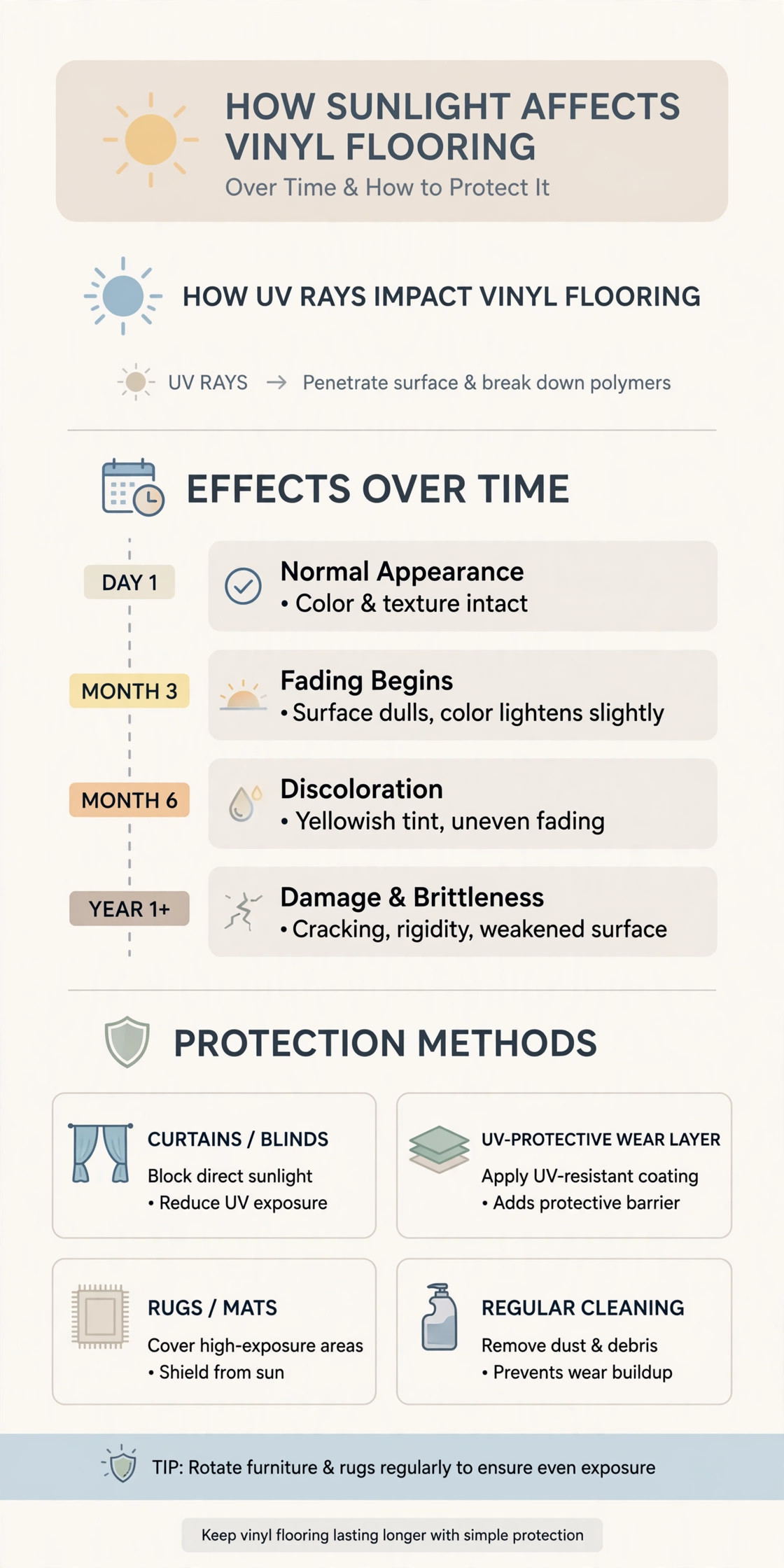
Sunlight fades flooring through ultraviolet radiation, which breaks down the pigments in the printed design layer over time. All vinyl flooring, SPC, LVT, and sheet vinyl alike, has a printed design layer, so all of it is theoretically vulnerable. The question is only how fast.
The UAE accelerates everything about this process. The sun is intense year-round, not just in summer. Modern villas and apartments are built with enormous glass: floor-to-ceiling sliding doors, full-height windows, glass balustrades. A living room with a west-facing glass wall can receive several hours of direct, blazing afternoon sun every single day. And because the glass is often untinted, most of the UV comes straight through.
Compare that with a home in a temperate climate where the sun is weaker, the windows are smaller, and half the year is overcast. The same vinyl product that shows no change in five years there might show noticeable fading in three to four years beside an unprotected west-facing window in Abu Dhabi. This is not a product defect; it is physics plus architecture.
Does vinyl flooring fade in direct sunlight UAE: what it looks like
Vinyl fading is not dramatic. You will not wake up one day to a bleached floor. It is gradual and uneven, which is what makes it noticeable.
The classic sign is the outline effect: the area under a rug or sofa keeps its original colour while the exposed floor around it lightens, leaving a visible silhouette when you move the furniture. Near large windows you may see a gradient, with the floor closest to the glass lighter than the floor deeper in the room. Dark colours and rich wood tones show fading more visibly than light, neutral tones, simply because there is more colour to lose.
It is worth distinguishing fading from other sun-related changes. Heat from direct sun can make some lower quality vinyl slightly more pliable, and in extreme cases prolonged intense heat through glass can affect dimensional stability. But for quality SPC, the rigid core handles the heat; fading of the printed layer is the realistic concern, not structural failure.
Which vinyl products resist fading best
Not all vinyl is equal here, and the differences matter in a sunny UAE home.
UV protection in the wear layer. Better products include UV stabilisers in the wear layer coating. This is the single most important factor. When comparing products, ask specifically about UV resistance, not just scratch resistance. A thick wear layer helps with scratches; UV stabilisers help with sun.
SPC vs standard LVT. The rigid SPC core does not make the printed layer any more fade-proof, so do not assume SPC is automatically better against sun. What matters is the quality of the wear layer and its UV treatment, regardless of the core type. That said, the SPC products aimed at the UAE market often (not always) carry better UV protection precisely because manufacturers know where the product will be installed.
Colour choice. Mid-tone and lighter floors show fading less than very dark floors. If your living room has a wall of west-facing glass and you love a dark walnut look, go in with open eyes: it will need sun protection to keep its colour, while a natural oak tone in the same room will be more forgiving.
Reputable manufacturers. Established manufacturers test for light fastness and publish ratings. Unbranded product of unknown origin may have no UV stabilisation at all, and in a sunny villa that difference shows within a couple of years. This is one of those cases where the product’s origin genuinely matters.
You can explore the ranges and ask us about UV ratings on our vinyl flooring, SPC flooring, and LVT flooring pages.
Practical ways to protect your floor from sun
You do not need to live in darkness to protect your flooring. A few sensible measures make a large difference.
Window coverings during peak sun. Sheer curtains are the unsung hero here. They cut a large portion of UV while keeping the room bright and the view visible. For west-facing glass that takes the brutal afternoon sun, blinds or heavier curtains closed during the 2pm to 6pm window in summer protect both your floor and your furniture. Our curtains page covers options that suit UAE villas.
Window film. UV-blocking window film is nearly invisible, does not change the look of your glass, and blocks the great majority of UV radiation. For a villa with extensive glazing, it is one of the most effective single investments, and it also reduces heat gain, which your AC will appreciate.
Rearrange periodically. Moving rugs and furniture occasionally evens out exposure so no single area fades dramatically while a covered patch stays dark. It sounds trivial, but the rug-outline effect is the most common fading complaint we hear, and rotation prevents it.
Rugs in the sunniest spots. A rug in front of the sliding doors takes the UV beating instead of the floor, and rugs are replaceable. Choose washable rugs so sand and dust do not become a second problem.
If you are still weighing materials for a sunny home, our honest breakdown of whether SPC flooring suits the UAE climate covers heat, humidity, and sun together.
Not sure how much sun your rooms actually get? Message us on WhatsApp. We offer a free site visit anywhere in Abu Dhabi, and we can look at your window orientations, assess the exposure, and recommend products with the right UV protection for the sunniest rooms.
What to do if your floor has already faded
If the fading is mild and even across the room, most homeowners simply live with it; it often reads as a slightly lighter tone rather than damage. If there are sharp outlines where furniture sat, rearranging the furniture to cover the transitions is the immediate fix.
For localised fading that bothers you, individual plank replacement is possible with click-lock SPC and LVT, provided you can get a reasonable colour match. Be aware that a new plank will match the unfaded colour, so in a faded room the new plank can stand out. Sometimes the better answer is replacing the most affected area (for example, the two metres in front of the glass doors) as a defined zone.
Prevention is genuinely easier than correction here, which is why we raise sun exposure during the site visit before the flooring is chosen, not after it fades.
FAQ
Does vinyl flooring fade in direct sunlight in the UAE?
Yes, prolonged direct sunlight can gradually fade vinyl flooring, and the intense year-round sun plus large glass areas in UAE homes accelerate the process. Quality products with UV-stable wear layers resist it far longer, and curtains, blinds, or window film prevent most of it.
How long does it take for vinyl flooring to fade in the sun?
It is gradual, measured in years not months. Beside an unprotected west-facing window, noticeable fading can appear in a few years with lower quality products. With UV-protected flooring and basic sun management, many floors show no visible change for a long time.
Does SPC flooring fade in sunlight?
SPC can fade like any vinyl product because fading affects the printed design layer, not the core. The rigid core handles heat well, but sun protection depends on the UV stabilisers in the wear layer. Ask about UV resistance specifically when choosing SPC for sunny rooms.
Will curtains stop my flooring from fading?
Sheer curtains cut a significant portion of UV while keeping rooms bright, and blinds or curtains closed during peak afternoon sun are very effective. For maximum protection without changing the look of your glass, UV-blocking window film is the strongest option.
Which floor colours fade least in sunny rooms?
Lighter, neutral tones show fading less visibly than dark, rich colours because there is less pigment to lose. If you want a dark floor in a very sunny room, pair it with good window protection.
Can faded vinyl flooring be fixed?
Mild even fading is usually lived with. For sharp outlines or localised fading, individual planks of click-lock flooring can be replaced, though colour matching against the faded surrounding floor can be tricky. Preventing further fading with window film or coverings is always the first step.
Protect the floor before the sun gets to it
Sun damage is one of the few flooring problems that is almost entirely preventable with planning. Chat with us on WhatsApp to book a free site visit anywhere in Abu Dhabi. We will check your rooms’ sun exposure, recommend vinyl products with proper UV protection, and help you plan window coverings that keep your floors looking new. You can also read our SPC flooring maintenance guide for the UAE for day-to-day care, or visit us at Shop No. AA-110, Capital Mall, Mohamed Bin Zayed City, open daily from 10:00 to 22:00.
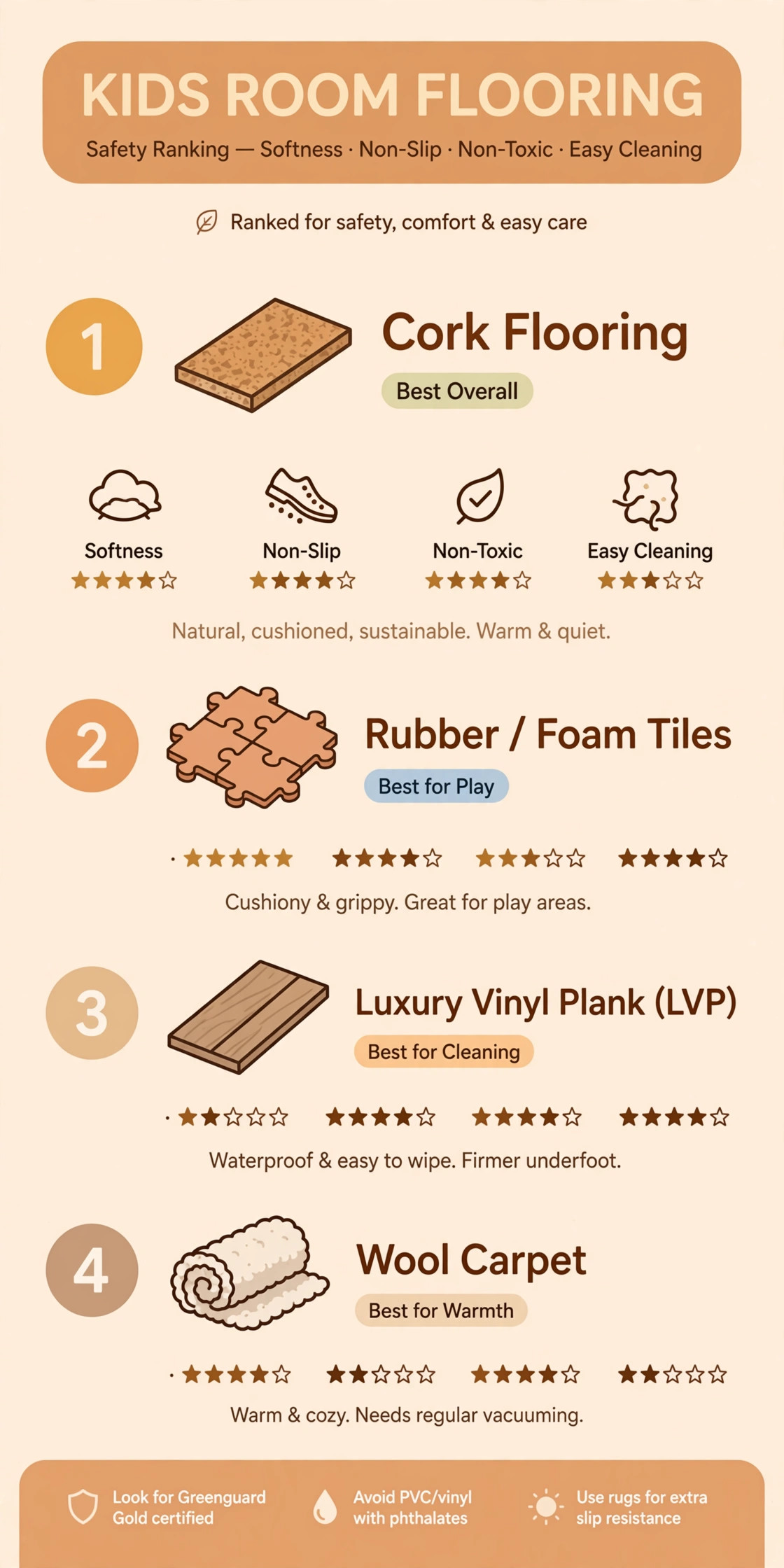
Short answer: This parent’s guide to the best flooring for kids rooms UAE safe options starts with a simple answer: a soft, non-slip, easy-clean surface. Quality LVT or SPC with a textured finish works for the main floor, plus washable rugs or interlocking play mats in the play zone. Wall-to-wall carpet is the softest option but harder to keep hygienic in a humid climate.
What “safe” actually means for a child’s floor
When parents ask for safe flooring, they usually mean several things at once. It is worth separating them, because different materials win on different criteria.
Fall protection. Toddlers fall. They fall learning to walk, they fall off low beds, they fall while running with toys. A floor with some give reduces the impact. This is where softer surfaces have a real advantage over tile or polished concrete.
Slip resistance. UAE kids rooms often have smooth hard floors, and children in socks on a smooth floor is a recipe for spectacular slides into furniture. A textured surface with grip matters more than most parents realise until the first bruised forehead.
Hygiene and allergens. Kids play on the floor. They sit on it, lie on it, and babies put their mouths on it. In the UAE’s humid climate, any flooring that traps moisture or is hard to clean properly becomes a hygiene question. Dust mites, a common concern for children with allergies or asthma, thrive in environments they can hide in.
Non-toxic materials. Children’s rooms deserve flooring from reputable manufacturers with proper certifications for indoor air quality. Cheap unbranded flooring of unknown origin is not worth the risk in a room where a child sleeps eight to ten hours a night.
Easy cleanup. Spills are not a question of if but when: milk, juice, paint, and worse. A floor that wipes clean in minutes saves parental sanity daily.
The best flooring for kids rooms UAE safe options compared
LVT and SPC: the practical winners
Quality luxury vinyl tile and SPC flooring tick more safety boxes than most parents expect. The surface is warm underfoot compared to tile, which matters for kids who play on the floor. Textured finishes provide good slip resistance, far better than the polished tiles common in UAE apartments. Both are waterproof, so spills, potty-training accidents, and art projects gone wrong wipe up without damage. And neither harbours dust mites the way textile flooring can, which allergy-conscious parents appreciate.
For kids rooms specifically, choose a textured matte finish rather than a smooth glossy one, and consider SPC or LVT with an attached underlay for a slightly softer feel underfoot. You can browse the options on our LVT flooring and SPC flooring pages.
Wall-to-wall carpet: softest, with trade-offs
Carpet is the softest landing for falls and the warmest surface for play. Many parents love it for nurseries and young children’s bedrooms for exactly these reasons. The trade-offs in the UAE are hygiene and humidity. Carpet traps dust, allergens, and odours, and in a humid climate it dries slowly after cleaning or spills, which can lead to mustiness. If you choose carpet for a kids room, commit to regular deep cleaning and good ventilation. Our wall-to-wall carpet page has the details.
Carpet tiles: the flexible middle ground
Interlocking carpet tiles deserve more attention than they get. They provide the softness and grip of carpet in the play zone, but individual tiles can be lifted and replaced if one gets ruined, which with kids is a matter of time. They work well as a defined play area over a hard floor: soft where the child plays, easy-clean everywhere else. See our carpet tiles.
Rubber flooring: for serious playrooms
For a dedicated playroom or a home gym corner that doubles as a kids’ activity space, rubber flooring (the kind used in gyms) offers the best impact protection of any hard surface. It is not the prettiest option for a bedroom, but for a villa playroom where climbing, jumping, and rough play happen daily, it is worth considering.
What to avoid in kids rooms
Polished tile and glossy stone are the most common flooring in UAE kids rooms and the least suitable: hard, cold, and slippery. If you are stuck with tile in a rental, large rugs with non-slip underlay are the practical fix.
Laminate is a poor choice for young children’s rooms because spills and accidents cause swelling at the joints, and a swollen, uneven floor is itself a trip hazard. Hardwood looks beautiful but scratches easily under toy traffic and dislikes the humidity.
Whatever the base floor, avoid loose small rugs without non-slip backing. A rug that slides is more dangerous than no rug at all, because children run onto rugs at full speed expecting grip.
UAE-specific considerations parents often miss
The AC factor. Kids rooms in the UAE are air-conditioned most of the year, which keeps humidity down indoors, good news for any flooring. But balcony doors left open let humid air flood in, and condensation can form on cool floors near the door. A quick mop and keeping doors closed solves it, but it is worth knowing the pattern.
Sand. Children bring astonishing quantities of sand indoors on feet, clothes, and toys. Sand grinds into floor finishes and dulls them over time. A doormat, a no-shoes rule for kids rooms, and regular vacuuming protect any floor you choose.
Furniture. Kids furniture gets dragged, not lifted. Felt pads on chair and table legs prevent the scratches that make parents think the floor is failing when it is actually the furniture. This one habit extends the life of any hard floor in a child’s room.
Growth. Children outgrow room designs fast. A floor choice that works from toddler to teenager is worth more than one that is perfect for exactly one age. Neutral, durable flooring with changeable rugs and mats adapts as the child grows, while a themed floor locks you into a phase.
For the very youngest, our guide to child-safe nursery flooring in the UAE covers the baby-specific details like crawling surfaces and cot areas.
Not sure which option fits your child’s age and your room? Message us on WhatsApp and tell us about the space. We offer a free site visit anywhere in Abu Dhabi, and we can show you samples of soft, grippy, easy-clean flooring in your child’s actual room so you can feel the texture yourself.
FAQ
What is the safest flooring for a child’s bedroom?
A textured, matte-finish LVT or SPC floor is the safest practical choice for most families: good slip resistance, warm underfoot, waterproof for spills, and no allergen-trapping fibres. Add washable rugs or play mats in the main play area for extra softness.
Is vinyl flooring safe for kids rooms?
Yes, quality vinyl flooring from reputable manufacturers is safe for children’s rooms. Look for products with recognised indoor air quality certifications, and avoid cheap unbranded flooring of unknown origin in any room where a child sleeps.
Is carpet or hard flooring better for kids in the UAE?
Hard flooring (LVT/SPC) with rugs is better for most UAE families because it stays hygienic in the humidity, cleans up fast after spills, and does not harbour dust mites. Carpet is softer for falls but needs committed maintenance in this climate.
How do I make tile floors safer for kids?
Use large area rugs with proper non-slip underlay in play and traffic zones, add felt pads to all furniture legs, enforce a no-running-in-socks rule if you can, and keep floors dry near balcony doors where condensation forms.
What flooring is best for a playroom?
For a dedicated playroom, rubber flooring gives the best impact protection. For a bedroom that doubles as a play space, SPC or LVT with interlocking foam play mats in the activity zone is the most practical combination.
Are foam play mats safe for babies?
Interlocking EVA foam mats are popular for babies and toddlers because they are soft and warm. Choose mats from reputable brands, keep them clean (they trap spills underneath), and replace them when they start to break down. They work best as a layer over a proper floor, not as the floor itself.
Choose the floor your child will grow up on
The right kids room floor is one you stop thinking about: safe under running feet, forgiving of spills, and still looking good when the toddler becomes a teenager. Chat with us on WhatsApp to book a free site visit anywhere in Abu Dhabi. We will bring samples to your home so you can feel the textures, check the slip resistance, and choose with confidence. You can also explore family-friendly options on our LVT flooring page, read more about grip and fall safety in our anti-slip flooring guide, or visit us at Shop No. AA-110, Capital Mall, Mohamed Bin Zayed City, open daily from 10:00 to 22:00.
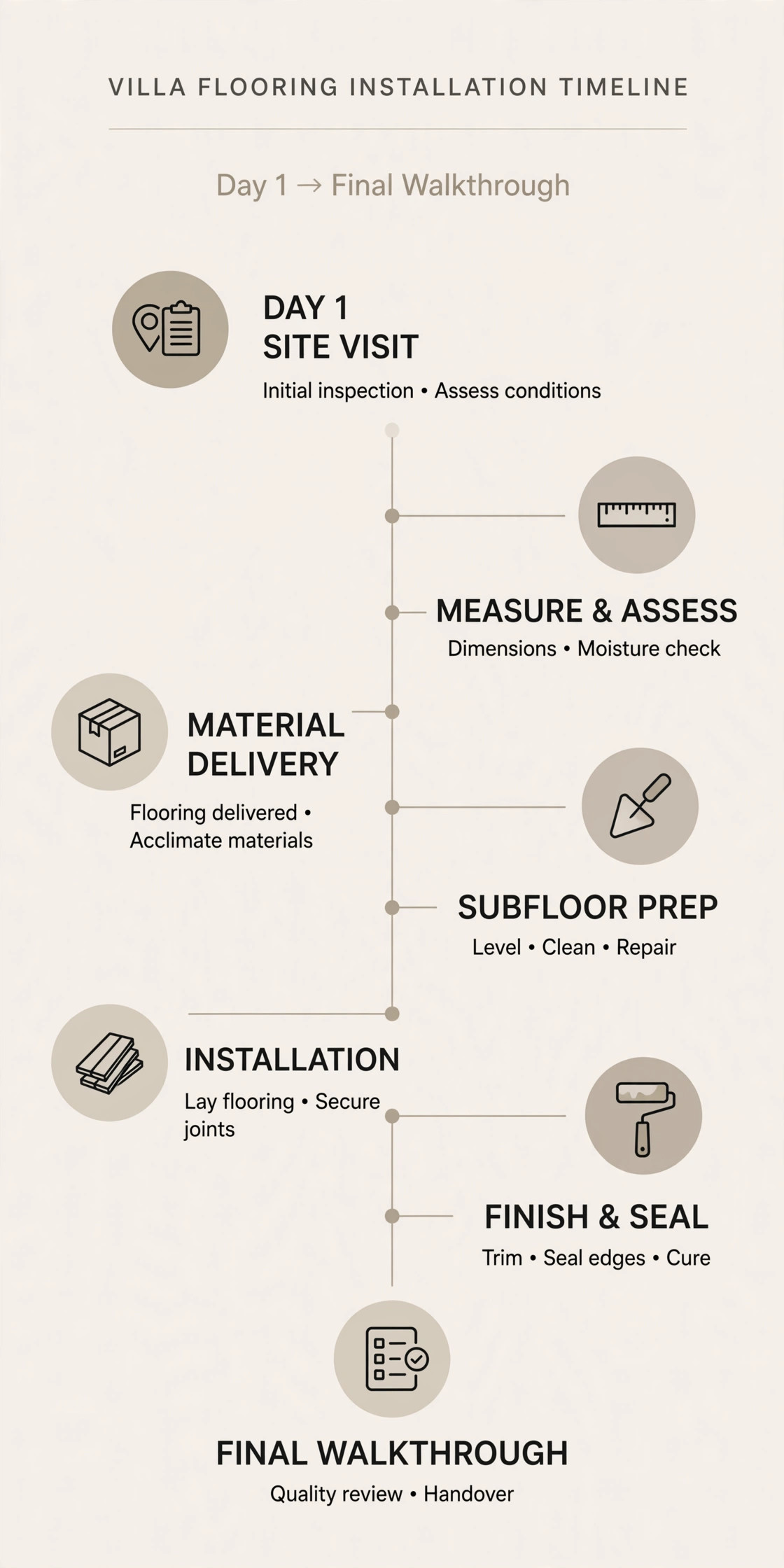
Short answer: So how long does flooring installation take for a villa in real terms? The installation itself usually takes 3 to 7 working days once materials are on site, depending on the villa size, the flooring material, and how much subfloor preparation is needed. The full project timeline, from first site visit to final walkthrough, is more like 2 to 4 weeks when you include material selection, ordering, and delivery.
How long does flooring installation take for a villa: stage by stage
Most villa owners only think about the installation days, but the work starts earlier. Here is the realistic sequence.
Stage 1: Site visit and quotation (1 to 3 days)
Everything starts with someone seeing your villa in person. A proper site visit covers measuring every room, checking the condition of the existing floor and subfloor, noting door clearances and transitions, and discussing materials and finishes. We offer this as a free site visit anywhere in Abu Dhabi.
After the visit, a detailed quotation follows, usually within a day or two. If you are comparing companies, allow a week to get two or three quotes and make a decision. Rushing this stage is a false economy; the site visit is where problems get spotted before they become expensive surprises. Our guide on how to choose a flooring company in Abu Dhabi explains what a good quotation should include.
Stage 2: Material selection and ordering (3 to 14 days)
If your chosen flooring is in stock locally, this stage can be a matter of days. If it needs to be ordered, allow one to two weeks for delivery. Popular SPC colours and standard LVT are usually available quickly in the UAE market; unusual finishes or large quantities for a big villa can take longer.
Use this waiting time well. Clear the rooms that will be floored first, arrange storage for furniture, and plan where the family will live during the work. Villas have the advantage of space: you can usually rotate rooms and stay in the house, unlike an apartment where you might need to move out.
To plan quantities ahead of time, our free villa quantity estimator gives you a rough material estimate from your room measurements.
Stage 3: Subfloor preparation (1 to 4 days)
This is the stage with the most variation, because it depends entirely on what is under your current floor.
Best case: existing tiles are sound and level, and the new SPC goes directly over them. Prep is cleaning, filling grout lines, and laying underlay: usually a single day for most of the villa. Our installer guide on laying SPC over existing tiles explains when this works.
Middle case: the subfloor needs levelling compound in places, a few tiles need repair, or old adhesive needs removing. Add one to two days.
Worst case: old tiles or failed flooring must be removed entirely, or the concrete subfloor needs significant levelling. Tile removal is the slowest prep work: noisy, dusty, and typically two to four days for a full villa before levelling even starts. If your villa needs this, it is worth knowing upfront so you can plan around it.
A proper installer assesses all of this during the site visit, so the prep timeline should be in your quotation, not a surprise on day two. The standards for a good base are covered in our guide on how to prepare a subfloor for SPC flooring.
Stage 4: Installation (2 to 5 days)
For a typical 4 to 5 bedroom Abu Dhabi villa, a professional team lays a floating floor like SPC at a pace of roughly 80 to 150 square metres per day, depending on how cut up the layout is. Open-plan living areas go fast; hallways, small rooms, and lots of doorways slow things down because every doorway means measuring, cutting, and fitting.
Stairs add significant time. Each step needs individual measuring and cutting, and a villa staircase can easily add a full day. If your villa has stairs in the scope, make sure they are in the quotation with their own timeline. We have a dedicated guide to villa staircase flooring if you are planning that part of the project.
Glued-down installations (some LVT, carpet) are slower than floating floors because of adhesive working time and curing. Tile installation is the slowest of all, which is one more reason villa owners switching from tile to SPC are often surprised by how quick the job feels.
Stage 5: Finishing and walkthrough (half to 1 day)
Skirting boards go on, door trims and transition strips are fitted, silicone sealing is done where needed, and the whole floor gets a final clean. Then comes the walkthrough: you walk every room with the installer, check the finishes, and flag anything that needs touching up. A good company fixes snags on the spot or within a day or two.
What speeds things up
A few decisions on your side can noticeably shorten the project.
Choose a floating floor over existing tiles when the base allows it. This single decision can cut a week off the timeline compared to full tile removal. Decide on materials before the site visit, or at least narrow it to two options, so ordering starts immediately. Clear rooms ahead of the team; installers who spend the morning moving furniture lose half a day of laying. And keep decision-makers available during the work, because small questions (which direction for the hallway planks, how to handle an awkward corner) get answered in minutes instead of stalling the job until evening.
If timing is tight, message us on WhatsApp and tell us your deadline. We offer a free site visit anywhere in Abu Dhabi, and we will give you an honest schedule based on your villa’s actual condition, not a generic estimate. You can also reach us via our contact page.
What slows things down
The most common delays are not technical; they are logistical. Materials arriving late because the order was placed after the installation date was set. Additional subfloor problems discovered mid-job that were not caught at the site visit (a sign the visit was rushed). Scope creep, where one more room gets added halfway through and the material quantity no longer covers it. And access issues in compounds with strict move-in and work-permit rules, which can restrict working hours.
In Abu Dhabi’s villa compounds, check the community rules early. Some communities limit noisy work to certain hours or require permits for contractor vehicles. Sorting this before installation day avoids a team standing idle at the gate.
Can you live in the villa during installation?
Usually yes, and this is one of the advantages of a villa over an apartment. A good team works room by room, so the family shifts to the finished side while work continues. The main disruptions are noise during cutting, dust (much less with a tile-over SPC installation than with demolition), and the general inconvenience of furniture stacked in spare rooms.
Plan the room sequence with the installer: bedrooms first so you can sleep properly, then living areas. If anyone in the household works from home, agree on quiet hours for calls. And keep pets away from the work area; curious dogs and open adhesive or sharp tools are a bad combination.
FAQ
How long does flooring installation take for a villa?
The installation itself typically takes 3 to 7 working days for a standard villa once materials are on site. The full project from site visit to final walkthrough is usually 2 to 4 weeks including selection, ordering, and delivery.
What is the fastest flooring option for a villa?
Floating SPC laid over sound existing tiles is the fastest practical option: minimal prep, no demolition, and quick laying. A typical villa can be transformed in under a week of site work.
Does removing old tiles add a lot of time?
Yes. Tile removal typically adds 2 to 4 days of noisy, dusty work for a full villa, plus debris removal and subfloor levelling afterwards. It is worth it when the tile base is failing, but avoiding it when tiles are sound saves the most time in any flooring project.
How long does staircase flooring take in a villa?
A staircase usually adds a full day to the project because each step is measured and cut individually. Complex staircases with winders or curved steps take longer.
Can flooring be installed in a villa while the family lives there?
Yes, in most cases. Installers work room by room so the household can shift to finished areas. Plan the sequence with your installer, starting with bedrooms, and keep pets and small children away from the active work area.
Why do villa flooring projects get delayed?
The usual causes are late material delivery, subfloor problems not spotted at the site visit, extra rooms added mid-project, and compound access or permit restrictions. A thorough site visit and early material ordering prevent most delays.
Get a realistic schedule for your villa
Every villa is different, and a generic timeline is no substitute for someone measuring your rooms and checking your subfloor. Chat with us on WhatsApp to book a free site visit anywhere in Abu Dhabi. We will assess the villa, tell you honestly how long each stage will take, and schedule the work around your family’s routine. You can also explore materials on our SPC flooring page or visit us at Shop No. AA-110, Capital Mall, Mohamed Bin Zayed City, open daily from 10:00 to 22:00.
Short answer: The short version of who pays for flooring replacement landlord or tenant UAE readers ask about: landlords generally pay for replacement caused by normal wear and tear or age, while tenants pay for damage they caused beyond normal use. The tenancy contract and the move-in condition report decide most real disputes. Note: this article is general information only and is not legal advice; for a specific dispute, consult a qualified legal professional in the UAE.

Who pays for flooring replacement landlord or tenant UAE: wear and tear vs damage
Almost every flooring dispute between landlords and tenants in the UAE comes down to one distinction: was this normal wear and tear, or was it damage?
Normal wear and tear is the gradual deterioration that happens through ordinary living. Floor finishes dulling in the main walkway after two years, slight colour fading near sunny windows, small scuffs from normal furniture use. This is the landlord’s responsibility. A floor simply gets older, and replacing a worn-out floor is part of owning a rental property, the same as repainting between tenancies.
Damage is harm beyond what ordinary living causes. Large scratches from dragging furniture without protection, burns, stains from neglected spills, chips from dropped heavy objects, pet damage to a floor in a no-pets unit. When the tenant caused the damage, the cost of repair typically falls on the tenant, often deducted from the security deposit.
The grey area, and where most arguments happen, is in the middle. Is a scratched hallway after three years with two large dogs “normal use” or “damage”? There is no universal answer, which is why documentation matters so much.
What your tenancy contract says
In Abu Dhabi and across the UAE, the tenancy contract is the first document anyone looks at in a dispute. Many contracts include a maintenance clause that divides responsibilities, sometimes with a threshold (for example, minor maintenance under a certain amount being the tenant’s responsibility and major maintenance being the landlord’s).
Read your contract before the dispute, not during it. Look for clauses about flooring, maintenance obligations, and the condition the unit must be returned in. Some contracts state the unit must be returned in the same condition as received, fair wear and tear excepted. That single phrase, “fair wear and tear excepted,” does a lot of work in these disagreements.
If you are a landlord writing a new contract, being specific about flooring helps both sides. State the flooring type, note its condition, and attach dated photos. Vague contracts produce disputes; specific ones prevent them.
The move-in condition report: your best protection
The single most useful document in any flooring dispute is the condition report from move-in day, with dated photos of every room’s floor. In practice, many Abu Dhabi tenancies start without one, and that absence hurts whoever needs to prove the floor’s original condition.
Tenants: photograph every room’s flooring on the day you receive the keys, including close-ups of any existing scratches, stains, or damage. Send the photos to the landlord or agent by email so there is a timestamp. If the floor is already worn, say so in writing. Without this, you can be blamed at move-out for damage that was there before you arrived.
Landlords: do the same from your side, and have the tenant sign the report. A signed, photo-documented condition report turns most deposit disputes into five-minute conversations instead of five-week arguments.
Common scenarios and how they usually play out
The floor was already old at move-in. If laminate was curling at the edges or tile was cracked when the tenant arrived, its eventual replacement is the landlord’s cost. A tenant cannot be charged for the natural end of a floor’s life.
The tenant’s washing machine leaked and ruined the laminate. Water damage from the tenant’s appliance or negligence is typically the tenant’s responsibility. This is one reason landlords increasingly choose waterproof flooring for rentals; it removes an entire category of dispute. See our guide to the best flooring for rental apartments in Abu Dhabi.
Scratches from normal furniture over two years. Usually classed as wear and tear, hence the landlord’s responsibility, unless the contract says otherwise or the damage is clearly excessive.
Pet damage in a pet-friendly unit. This depends on the contract. If pets were allowed, some level of pet wear is arguably part of the agreed use, but severe damage (deep scratches across every room, urine damage to subfloors) is generally treated as tenant damage. Landlords who allow pets often take a higher deposit or specify pet clauses for exactly this reason.
The tenant wants an upgrade, not a repair. If the floor is fine but the tenant simply wants a nicer one, that is the tenant’s project and the tenant’s cost, and it needs the landlord’s written permission first. Unauthorised alterations can lead to the tenant paying for restoration at move-out.
The security deposit angle
In Abu Dhabi, the security deposit (commonly 5 percent of annual rent for unfurnished units) is where flooring deductions usually appear. Landlords may deduct the cost of repairing tenant-caused damage, but deductions must be reasonable and related to actual damage beyond wear and tear. Tenants who disagree with a deduction can raise it through the relevant rental dispute channels.
Keep every receipt and quote. Whether you are a landlord deducting or a tenant disputing, the side with dated photos, the condition report, and written quotes usually prevails. A professional assessment of the floor’s condition carries more weight than either party’s opinion, which is one reason to get an installer to document damage properly.
How landlords avoid this problem entirely
The landlords with the fewest flooring disputes are the ones who made disputes unlikely from the start. They install durable, waterproof flooring like SPC that survives tenants without drama. They document condition with photos at every handover. They write clear contracts. And they give tenants a short care sheet so that preventable damage, like mopping laminate with a soaking mop, does not happen in the first place. Our SPC flooring maintenance guide for the UAE works well as the basis for one.
Choosing the right installer matters too, because a poorly installed floor fails early and nobody can agree on whose fault it is. Our guide on how to choose a flooring company in Abu Dhabi covers what to check before hiring.
If a flooring disagreement is brewing and you need an independent look at the floor’s condition, message us on WhatsApp. We offer a free site visit anywhere in Abu Dhabi and can document what we find in plain terms. You can also reach us through our contact page.
FAQ
Who pays for flooring replacement in the UAE, landlord or tenant?
Generally, the landlord pays for replacement due to normal wear and tear or age, and the tenant pays for damage beyond normal use. The tenancy contract and the move-in condition report decide most cases. This is general information, not legal advice.
Can a landlord deduct flooring damage from the security deposit?
A landlord can generally deduct the reasonable cost of repairing damage the tenant caused beyond normal wear and tear. Deductions should relate to actual damage and be supported by evidence such as photos and quotes. Tenants who disagree can dispute through the proper rental channels.
What counts as normal wear and tear on floors?
Gradual dulling of the finish in walkways, minor scuffs from ordinary furniture use, and slight fading near windows over a tenancy of a year or more. Damage like deep scratches, burns, stains from neglect, or water damage from tenant negligence goes beyond wear and tear.
Should tenants photograph floors at move-in?
Yes, absolutely. Dated photos of every room’s flooring, sent to the landlord or agent by email on move-in day, are the tenant’s best protection against being charged for pre-existing damage at move-out.
Can a tenant replace flooring without landlord permission?
No. Any permanent change to the flooring needs the landlord’s written permission. Verbal permission is not enough if there is a later dispute. Unauthorised alterations can leave the tenant paying for restoration.
Does pet damage count as wear and tear?
It depends on the contract and the severity. Minor wear in a pet-friendly unit may be treated as part of agreed use, but significant damage such as deep scratching throughout or urine damage is generally treated as tenant damage. Clear pet clauses in the contract prevent most arguments.
Get an independent assessment of the floor
When a landlord and tenant disagree about a floor, an independent professional opinion often settles it faster than arguing. Chat with us on WhatsApp to book a free site visit anywhere in Abu Dhabi. We will inspect the flooring, document its condition honestly, and explain what we find in straightforward terms. Remember that this article is general information only and not legal advice; for legal questions about your specific tenancy, consult a qualified legal professional. You can also reach us at Shop No. AA-110, Capital Mall, Mohamed Bin Zayed City, open daily from 10:00 to 22:00.
Short answer: The best flooring for rental apartments in Abu Dhabi is rigid SPC flooring or quality LVT: tough enough to survive tenant turnover, waterproof against spills, and attractive enough to help a unit rent faster. This guide to the best flooring for rental apartments Abu Dhabi tenants and landlords actually choose covers both sides of the decision.

Why rental flooring is a different decision
Flooring in your own villa is a choice you live with for years. Flooring in a rental unit has to survive people who did not choose it and may not treat it gently. Abu Dhabi’s rental market moves fast, with many apartments turning over every one to two years, and each turnover brings movers dragging furniture, kids, pets, and the general wear of strangers living their lives on your floor.
For landlords, the calculation is simple. A floor that looks tired after one tenancy means either a discount on the rent or a refit before the next tenant. A floor that still looks good after three tenancies is one of the quietest money savers in property management. For tenants, the question is different: what can I do to make this place feel like home without breaching my tenancy contract or losing my deposit?
What landlords should look for
If you own the unit, choose flooring the way a hotel chooses flooring: for durability, cleanability, and broad appeal.
Durability first. Tenant turnover is brutal on floors. Furniture gets dragged, things get dropped, and maintenance between tenancies is often rushed. SPC with a thick wear layer (0.5 mm or more) is the standout choice because it resists scratches, dents, and moisture all at once. It also handles the empty-unit problem: an apartment sitting vacant through the summer with the AC on low will not damage SPC the way heat and humidity damage laminate or wood.
Waterproof matters. Kitchens, entrance areas, and bathrooms see the most tenant damage, and most of it is water. Overflowing sinks, washing machine leaks, and mopping with too much water are everyday rental realities. A waterproof floor turns these from emergencies into non-events. See the full range on our SPC flooring page.
Neutral and broadly appealing. Bold floors narrow your tenant pool. Mid-tone wood looks in oak or walnut tones photograph well for listings, suit both modern and traditional furniture, and hide wear better than very dark or very light finishes. Remember that listing photos sell the viewing, and floors cover the largest visible surface in every photo.
Fast installation between tenancies. Every week a unit sits empty is lost rent. SPC can often be laid directly over existing tiles, which means a full apartment refit can be done in days rather than weeks, with minimal dust and no demolition. Read our installer guide on laying SPC over existing tiles for the details.
What tenants can (and cannot) do
Tenants in Abu Dhabi often ask us what they are allowed to change. The honest answer starts with your tenancy contract and your landlord.
Anything permanent, like replacing the flooring, needs the landlord’s written agreement. Verbal permission is not enough; if there is a dispute at move-out, only written approval protects you. Some landlords will agree to a flooring upgrade, especially if you offer to share the improvement or if the existing floor is already in poor condition. Get the agreement in writing, including who pays and what happens at move-out.
For most tenants, the practical upgrades are reversible. Large area rugs transform a cold tile apartment completely and you take them with you when you leave. Interlocking carpet tiles are another option for bedrooms: they sit loose on the floor, add warmth and sound insulation, and lift up without a trace. Our carpet tiles work well for this because individual tiles can be replaced if one gets stained.
What you should not do is glue anything down, nail anything into the existing floor, or install a floating floor over the landlord’s tiles without permission. Even though a floating floor does not damage what is underneath, an unauthorised installation can still become a deposit dispute.
If you are a tenant dealing with damaged flooring that was already in bad shape when you moved in, document it with photos and raise it with the landlord or property manager in writing. Our article on who pays for flooring replacement, landlord or tenant, in the UAE explains the general principles (general information only, not legal advice).
Best flooring for rental apartments Abu Dhabi tenants and landlords: room by room
Living room and hallways: SPC or quality LVT in a mid-tone wood look. These areas take the most traffic and need the toughest surface. Textured matte finishes hide wear best. Our vinyl flooring range covers the flexible options if you prefer them over rigid SPC.
Bedrooms: SPC throughout keeps maintenance simple and consistent, which many landlords prefer. If you want extra warmth in a unit you plan to hold long term, carpet in bedrooms photographs beautifully and tenants love it, but budget for more frequent replacement between tenancies.
Kitchen: Waterproof is non-negotiable here. SPC handles the splashes, spills, and mopping of rental kitchen life without swelling. Avoid laminate in rental kitchens; it is the number one source of swelling callbacks.
Bathrooms: Most Abu Dhabi rentals keep tile in bathrooms, and that is fine. If the bathroom floor is being redone, waterproof vinyl options work, but wet-area detailing needs professional installation.
Balconies: Do not put interior flooring on balconies. Outdoor spaces need outdoor-rated materials. Tenants often ask about this, and the answer is always the same: interior SPC and laminate will fail outdoors in UAE sun and rain.
The turnover routine that protects your investment
Landlords who keep floors looking good between tenancies follow a simple routine. Inspect the floor at move-out with photos, the same way you documented it at move-in. Deep clean before listing: a professional clean makes SPC and LVT look nearly new. Replace individual damaged planks rather than the whole floor; one advantage of click-lock SPC is that a damaged plank in the middle of a room can be swapped without redoing everything. And keep a box of spare planks from the original batch for exactly this purpose, because batch colours vary.
A small maintenance note for property managers: give tenants a one-page care sheet. Most flooring damage in rentals comes from tenants mopping with soaking mops or dragging furniture without pads. A short guide prevents most of it. Our SPC flooring maintenance guide for the UAE can serve as the template.
Are you a landlord planning a refit between tenancies? Message us on WhatsApp. We offer a free site visit anywhere in Abu Dhabi, can assess the unit and the existing floor, and plan an installation in the gap between your tenants so you lose minimal rental days.
FAQ
What is the best flooring for a rental apartment in Abu Dhabi?
SPC flooring with a thick wear layer is the best all-round choice for rental apartments. It is scratch resistant, waterproof, handles vacant summer months without damage, and installs quickly over existing tiles. Quality LVT is a strong alternative.
Can a tenant change the flooring in a rented apartment in Abu Dhabi?
Only with the landlord’s written permission. Verbal agreement is not enough protection at move-out. Reversible options like large rugs and loose-lay carpet tiles are the safest upgrades for tenants who want a change without touching the existing floor.
Is laminate flooring good for rental properties?
Laminate is risky for rentals in the UAE. Tenant mopping habits and the humidity cycle cause swelling at the joints, which is the most common laminate failure we see. Waterproof SPC or LVT avoids this problem and usually lasts longer in rental conditions.
How do landlords protect flooring between tenants?
Document the floor condition with photos at move-in and move-out, deep clean before listing, keep spare planks from the original batch for quick repairs, and give tenants a short care sheet covering mopping and furniture pads. Quick plank swaps beat full refits.
Does new flooring help rent an apartment faster?
Well-presented units photograph better and view better, and floors are the largest visible surface in every room. Landlords consistently find that a clean, modern floor shortens vacancy periods, though the exact effect depends on the area and the unit.
Can SPC be installed over the existing tiles in a rental apartment?
Yes, in most cases. Firmly bonded tiles make a good base for floating SPC, which means no demolition, minimal dust, and a fast installation between tenancies. Our guide to installing SPC over existing tiles explains the conditions.
Plan your rental refit around the tenancy gap
The best time to redo rental flooring is the empty week between tenants, and the best material is one that installs fast and then survives the next three tenancies without drama. Chat with us on WhatsApp to book a free site visit anywhere in Abu Dhabi. We will assess the unit, check whether the existing tiles can stay, and schedule the work to fit your timeline. You can also browse tenant-proof options on our SPC flooring and LVT flooring pages, or visit us at Shop No. AA-110, Capital Mall, Mohamed Bin Zayed City, open daily from 10:00 to 22:00.