
Wall Panels & Decor - Clad and Craft Tradding LLC
Short answer: PVC sheets are flat panels made from polyvinyl chloride, a waterproof plastic used across the UAE for signage, wall cladding, bathrooms, and commercial fit-outs. They come in three main forms: thin rigid sheets for signs and displays, lightweight foam boards for cladding and furniture, and decorative cladding panels for walls. Choosing the right one comes down to thickness, whether it faces sun or water, and the finish you want. This guide walks through each PVC sheet type, the common thicknesses, and where each is used in the Emirates.


What PVC sheets are
PVC, short for polyvinyl chloride, is one of the most widely produced plastics in the world. In sheet form it becomes a rigid or semi-rigid panel that is waterproof, lightweight, and easy to cut, drill, and fix with ordinary woodworking tools. Unlike timber or MDF, it never swells in humidity, never rots, and does not support mould growth on its surface. Those three traits alone explain why it is everywhere in UAE construction and interiors.
Sheets are manufactured in standard sizes, most commonly 1220 by 2440 mm, and cut down on site. The material’s momentum in the region is measurable: the UAE PVC market is growing at 7.17% per year between 2025 and 2030, according to Bonafide Research, and ReportLinker projects UAE PVC imports of around 300 million kg by 2026, with demand growing 6.4% per year since 2012. Construction, signage, and interior fit-outs are driving that demand, which are exactly the sectors where PVC sheets do their daily work.
The three PVC sheet types you will meet in the UAE
When suppliers in the Emirates say “PVC sheets”, they usually mean one of three products. They can look similar stacked on a shelf, but they are built for different jobs.
1. Rigid PVC sheets
Rigid PVC, sometimes called solid PVC, is a dense, hard sheet with a smooth surface on both faces. It is the thinnest of the three types, commonly 1 to 3 mm, and it takes printing, vinyl graphics, and paint beautifully. Because the surface is non-porous and perfectly flat, colours reproduce crisply, which is why sign makers reach for it first.
Typical uses include shop signs, wayfinding boards, display stands, menu boards, and electrical enclosures. If you have seen a sharp printed sign screwed to a wall inside a mall, there is a good chance it is rigid PVC doing the job.
2. PVC foam boards
Foam board, also called expanded or foamed PVC, has a foamed core sandwiched between solid skins. It is the most versatile of the three: rigid enough to hold its shape, light enough to handle and hang easily, and available in the widest thickness range, commonly 3, 5, 6, 9, 12, and 18 mm. It cuts, drills, screws, and glues cleanly, and it can even be gently heat-formed into curves for shaped displays.
Typical uses include interior wall cladding, partition panels, exhibition stands, retail displays, furniture carcasses, and ceiling panels. Across the UAE it is a workhorse of retail fit-outs and exhibition builds, where panels need to look sharp, install fast, and come down again without drama.
3. PVC cladding panels
Cladding panels are the decorative branch of the family. They are wide boards, often with tongue-and-groove or click edges, finished with printed marble, wood, or solid-colour surfaces sealed under a protective layer. They are designed to cover walls rather than be cut into signs, with thicknesses usually between 5 and 12 mm and generous widths so large walls need few joints.
Typical uses include bathroom and kitchen walls, feature walls in offices and clinics, and corridor cladding. Our PVC bathroom panels are exactly this type, chosen because the sealed surface wipes clean and never absorbs a drop of water. You can see the broader decorative range on our PVC and acrylic sheet page.
PVC sheet thickness guide: what each range is for
Thickness is the fastest way to narrow your choice. As a rule of thumb, thinner sheets suit printing and light-duty covering, while thicker boards suit cladding, furniture, and anything that must stand on its own.
| Thickness | Type | Best for |
|---|---|---|
| 1-3 mm | Rigid sheet | Printed signs, displays, menu boards, thin protective covers |
| 3-5 mm | Rigid sheet or thin foam | Mounted signs, directional boards, light wall covering |
| 5-12 mm | Foam board or cladding panels | Wall cladding, partitions, bathroom walls, furniture panels |
| 12-18 mm | Foam board | Freestanding displays, shelving, thick decorative panels |
Two practical notes. First, thicker is not automatically better: a 12 mm board on a small sign is needless weight and harder fixing. Second, the fixing method follows the thickness. Thin rigid sheets screw or bond flat to a backing, mid-range foam boards take screws and adhesive equally well, and cladding panels usually go up with adhesive over a sound surface, which is how full bathroom walls get covered without demolition.
Where PVC sheets are used across the UAE
Signage
The Emirates run on signage: shopfronts, mall directories, office name boards, exhibition graphics. Rigid PVC and thin foam boards dominate indoor and sheltered signage because they print crisply, cut into any shape, and handle large production runs without fuss. For outdoor signs in direct sun, the grade matters: standard PVC can yellow and fade under the UAE sun, so exterior work calls for UV-stabilized sheets. Ask your supplier specifically for exterior grade if the sign faces the street.
Interiors and feature walls
Foam boards and cladding panels have become a staple of commercial interiors: office corridors, clinic walls, restaurant back-of-house areas, and retail back walls. They go up fast over imperfect substrates, need no painting, and wipe clean. In homes they appear as TV wall backdrops, laundry wall coverings, and anywhere a durable, low-maintenance surface beats paint. If the wall needs a warmer, more textured designer finish instead, compare with WPC wall panels before deciding.
Bathrooms and wet areas
This is PVC’s home turf. Shower surrounds, full bathroom walls, and laundry areas stay permanently damp in UAE homes, and PVC simply does not care. Sealed cladding panels with proper trims create a watertight surface that never needs regrouting. Tiles still win on prestige, but for rental apartments, staff accommodation, and fast bathroom refreshes, PVC panels are the practical answer.
Commercial fit-outs
Retail units, kiosks, pharmacies, and food outlets use foam boards for counters, display plinths, back-wall cladding, and hygienic wall linings. The material’s chemical resistance means cleaning agents do not damage it, and damaged sections can be cut out and replaced without redoing the whole wall. For food preparation areas, confirm the specific product’s suitability with your supplier, since grades vary.
How to choose the right PVC sheet
Work through these five questions and the choice mostly makes itself.
Indoor or outdoor? Outdoor or sun-exposed work needs UV-stabilized grades. Indoor work can use standard sheets.
Wet or dry? Bathrooms, kitchens, and laundries call for sealed cladding panels with proper joint trims, not plain foam board.
How will it be fixed? Adhesive suits flat walls and cladding panels. Screws suit signs and foam boards on battens. If the panel must be removable later, mechanical fixing wins.
Which finish? Gloss white for clean commercial looks, printed marble or wood effects for decorative walls, plain colours for signage that will carry vinyl graphics.
Does the project need a fire rating? Corridors, stairwells, and many commercial spaces require rated materials. Ask for the product’s fire classification before specifying it, and keep the certificate on file.
UAE-specific considerations
Heat is the background factor. PVC softens at high temperatures, so sheets should never sit against uninsulated metal cladding baking in afternoon sun, and dark-coloured exterior sheets deserve extra caution. In normal shaded or indoor conditions, UAE heat is a non-issue.
Humidity is where PVC quietly outperforms timber, MDF, and plasterboard. It absorbs effectively no water, so the swelling, edge breakdown, and mould staining that ruin wood-based boards in UAE bathrooms never start.
Dust is the maintenance factor. Abu Dhabi’s fine dust settles on everything, but PVC’s smooth sealed surfaces wipe clean with a damp cloth in seconds, which is part of why facility managers like it for corridors and service areas.
Frequently asked questions
What is the difference between PVC sheets and PVC foam boards?
Rigid PVC sheets are dense, thin (usually 1-3 mm), and solid all the way through, ideal for printed signs and displays. PVC foam boards have a foamed core between solid skins, come in 3-18 mm thicknesses, and suit cladding, partitions, and furniture. Think of rigid sheets as the sign maker’s material and foam boards as the builder’s material.
Are PVC sheets fully waterproof?
Yes. PVC does not absorb water, so sheets will not swell, rot, or delaminate in wet conditions. For bathrooms and showers, use sealed cladding panels with proper joint trims, since waterproofing the wall is about the whole system, not just the sheet.
Can PVC sheets be used outdoors in the UAE?
Yes, with the right grade. Standard PVC can yellow and become brittle under intense sun, so exterior applications need UV-stabilized sheets. For shaded outdoor areas the requirement is less strict, but always confirm the grade with your supplier for anything facing direct sun.
What thickness of PVC sheet is best for wall cladding?
For most interior wall cladding, 5-12 mm foam boards or cladding panels are the sweet spot: rigid enough to span minor wall imperfections, light enough for adhesive fixing. Thin 1-3 mm rigid sheets are for signs, not walls.
Can PVC cladding panels go over existing tiles?
Often yes. Sealed PVC panels are frequently bonded straight over old bathroom or kitchen tiles, which avoids demolition, dust, and days of downtime. The existing tiles must be sound and firmly attached. We assess every wall during the site visit before recommending this route.
Do PVC sheets need painting or sealing?
No. Sheets and panels come with their finished surface, printed or solid colour, already sealed. That is the point: no painting, no varnishing, no regrouting. Cleaning is a wipe with a damp cloth and mild detergent.
Visit our showroom at Shop No. AA-110, Capital Mall, Khourat Al Heel St, Mohamed Bin Zayed City (open daily 10:00 AM to 10:00 PM) to see full-size PVC sheets, foam boards, and cladding panels side by side, or message us on WhatsApp at +971 55 281 9239 to book a free site visit anywhere in Abu Dhabi. Tell us what you are building and we will match the right sheet type and thickness to the job.
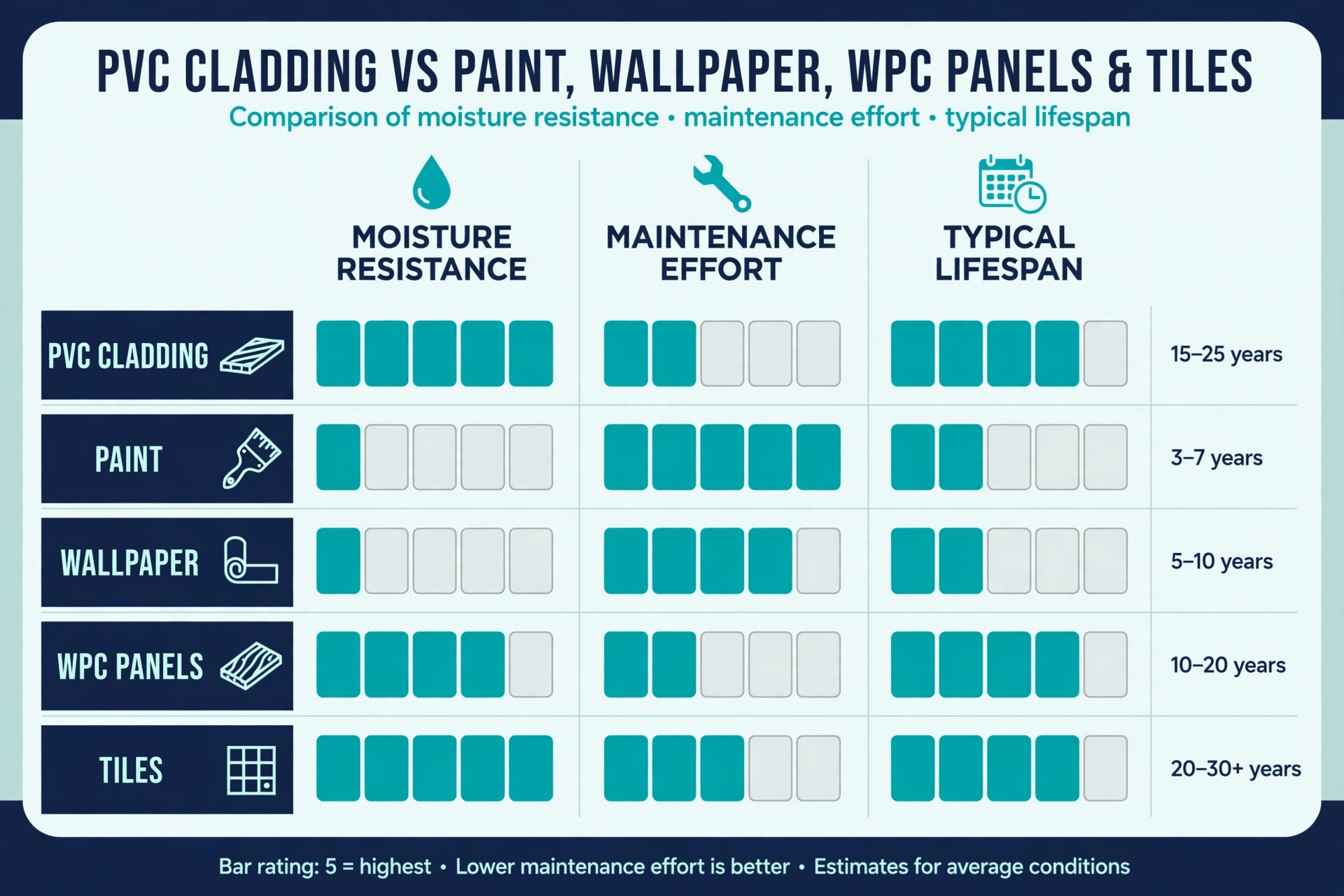
Short answer: There is no single best wall finish for UAE interiors, only the right one for each room. PVC cladding beats paint and wallpaper on moisture resistance and maintenance, but paint is cheaper to refresh, wallpaper offers more patterns, WPC panels feel more premium, and tiles still rule the wettest areas. The honest answer depends on your room, your budget, and how long you plan to stay.

How to compare wall finishes fairly in the UAE
Our climate changes the maths. Humidity sits high for much of the year, bathrooms and kitchens deal with constant moisture, and floor-to-ceiling glass means many walls get serious sun. A finish that performs beautifully in a dry climate can struggle here.
So let us judge each option on the five things that actually matter in a UAE home or office: moisture resistance, heat and sun tolerance, maintenance effort, looks, and realistic lifespan. No finish wins all five. Anyone who tells you otherwise is selling you something.
It is worth noting the direction of the market. The GCC PVC wall panels market is projected to grow at about 7.2% a year from 2026 to 2033, and the wider UAE PVC market at roughly 7.17% a year from 2025 to 2030 according to Bonafide Research. ReportLinker puts UAE PVC demand growth at 6.4% a year since 2012. Growth like that does not happen unless a material is solving real problems for real buyers. But popularity is not the same as suitability, so let us go finish by finish.
PVC cladding vs paint
Paint is the default wall finish in the UAE, and for good reason. It is the cheapest option, any colour is possible, and refreshing a room is a weekend job. For bedrooms and living rooms with normal humidity, good quality washable paint is genuinely hard to beat on value.
Where paint loses to PVC cladding is moisture and durability. In bathrooms, kitchens, and laundry areas, paint bubbles, peels, and grows mould spots over time, even the bathroom-grade formulas. Cladding simply does not absorb water, so those problems never start. Cladding also survives knocks and scuffs better; a painted wall in a corridor with kids or office chairs shows every mark, while a PVC panel wipes clean.
The honest trade: choose paint for dry rooms where you might want to change colours every few years. Choose cladding for wet or high-traffic areas where you want to fit it once and forget about it. If you are still deciding on cladding itself, our PVC cladding sheets buyer’s guide walks through what to check before buying.
PVC cladding vs wallpaper
Wallpaper wins on design variety, full stop. No cladding sheet matches the range of patterns, textures, and mural prints a good wallpaper collection offers. For a statement bedroom wall or a boutique hotel lobby, wallpaper gives you looks that cladding cannot.
But the UAE is rough on wallpaper. Humidity loosens seams, especially in bathrooms and kitchens, and once an edge lifts, the whole strip starts to go. Direct sun fades prints over time. PVC cladding has none of these weaknesses: no seams to lift, no fading if the sheets are UV stabilised, and it handles steam without complaint.
Maintenance is the other divider. A marked wallpaper panel usually means replacing the whole strip and hoping the batch matches. A marked cladding sheet wipes clean, and a damaged one can be swapped individually.
So the rule of thumb: wallpaper for dry feature walls where the pattern is the whole point, cladding for anywhere moisture, steam, or heavy use is part of daily life.
PVC cladding vs WPC wall panels
This is the closest contest, because the two products often sit side by side in showrooms and look similar at first glance. WPC, wood plastic composite, blends wood fibre with plastic, which gives it a slightly more natural feel and better rigidity than pure PVC.
On looks and feel, WPC usually has the edge. It reads as more premium, particularly in wood grains and fluted designs, and designers tend to specify it for high-end residential and hospitality projects. On moisture resistance, both perform well, though PVC has a slight advantage in genuinely wet areas since it contains no wood fibre at all. On installation speed and weight, PVC sheets are lighter and cover large areas faster.
We have covered this matchup in detail in our WPC versus PVC wall panels comparison, but the short version is: WPC when the premium feel matters most and the budget allows it, PVC when you want maximum moisture protection and value, especially in bathrooms and kitchens.
PVC cladding vs tiles
Tiles are the heavyweight champion of wet areas, and nothing here dethrones them on raw durability. A properly installed porcelain tile wall will outlast everything else in a shower or a commercial kitchen. Tiles also handle heat better than any plastic, so behind a cooker or near heat sources, tiles win clearly.
PVC cladding fights back on three fronts: speed, grout, and comfort. A tiled bathroom takes days of wet work, mess, and curing time. Cladding goes up in a fraction of the time with far less disruption. Then there is grout, the eternal enemy. Grout lines stain, harbour mould, and need regular scrubbing or resealing in UAE humidity. Cladding has minimal joints and no grout at all. Finally, tiles feel cold and hard; cladding feels slightly warmer to the touch, which some people prefer in living areas.
For a full wet room or shower enclosure, tiles remain the safer choice. For bathroom walls outside the direct splash zone, kitchen backsplashes, and anywhere you want the tiled look without the grout maintenance, cladding is a legitimate alternative. Marble-finish PVC sheets exist precisely because people love the look of marble tiles but not the upkeep.
The honest verdict: which finish for which room
Here is how we would actually spec it, room by room, for a typical Abu Dhabi villa or apartment:
Bathrooms: Tiles inside the shower, PVC cladding on the remaining walls. You get durability where water hits hardest and zero grout maintenance everywhere else.
Kitchens: PVC cladding as the backsplash and on the cooking wall, washable paint elsewhere. Grease wipes off cladding in seconds.
Living rooms and bedrooms: Paint for flexibility, or a single cladding or WPC feature wall if you want a focal point. Wallpaper only on dry interior walls away from windows.
TV and media walls: PVC or WPC panels. This is the signature use case: fast, dramatic, and cables hide behind the panels.
Offices and retail: PVC cladding in corridors, receptions, and washrooms. It takes abuse and still looks sharp, and individual panels can be replaced.
Outdoor or semi-outdoor walls: Neither PVC cladding nor wallpaper. Heat and UV will age any plastic faster, and this is where tiles, proper exterior paint systems, or stone make sense.
If you want to browse the actual materials, our PVC and acrylic sheet range is on display at our Capital Mall showroom in Mohamed Bin Zayed City, open daily from 10 AM to 10 PM.
Common questions about PVC cladding versus other finishes
Is PVC cladding better than paint?
It is better in wet and high-traffic areas because it resists moisture and wipes clean. It is not better everywhere; paint is cheaper, easier to change, and perfectly fine for dry bedrooms and living rooms.
Does PVC cladding last longer than wallpaper in the UAE?
Generally yes, especially in humid rooms. Wallpaper seams lift in UAE humidity and prints fade in sun, while properly installed cladding is unaffected by either. In a dry, shaded room the gap narrows.
Which looks more premium, WPC or PVC panels?
WPC usually looks and feels more premium, particularly in wood and fluted designs. PVC wins on moisture protection and value. Many projects mix them: WPC for the showpiece wall, PVC for bathrooms and kitchens.
Can PVC cladding replace tiles in a bathroom?
Outside the shower enclosure, yes, and many people prefer it for the lack of grout. Inside a shower with constant direct water, tiles remain the safer long-term choice.
What is the lowest maintenance wall finish for the UAE?
PVC cladding, by a clear margin. No repainting, no grout scrubbing, no seam repairs. A damp cloth handles almost everything.
Which finish adds the most value to a rental property?
For landlords, PVC cladding in bathrooms and kitchens tends to pay back best. It photographs well for listings, survives tenant turnover, and refreshes a tired flat far faster than retiling.
Still weighing your options? Message us on WhatsApp at +971 55 281 9239, tell us which rooms you are renovating, and we will give you a straight recommendation, even if the answer turns out to be paint.
Short answer: PVC cladding sheets are rigid panels made from polyvinyl chloride that fix directly onto your walls to give you a finished surface in hours instead of days. They are popular in the UAE because they handle humidity well, come in finishes like marble and wood, and need very little upkeep. Before you buy, check the panel thickness, the quality of the printed finish, and whether the sheets are rated for UV stability if they will sit near strong sunlight.
What PVC cladding sheets actually are
A PVC cladding sheet is a flat, rigid panel made from polyvinyl chloride, the same family of plastic used in pipes and window frames, but manufactured here as a decorative wall covering. Standard sheets are large, often around 1.2 metres wide and 2.4 to 3 metres long, which means a single sheet can cover a big stretch of wall with very few joints.
The decorative side is a printed film, usually protected by a clear wear layer. That is how you get marble looks, wood grains, concrete effects, and solid colours out of a plastic sheet. The back is plain and bonds to the wall with adhesive, and in some systems the sheets also slot together with tongue and groove edges.
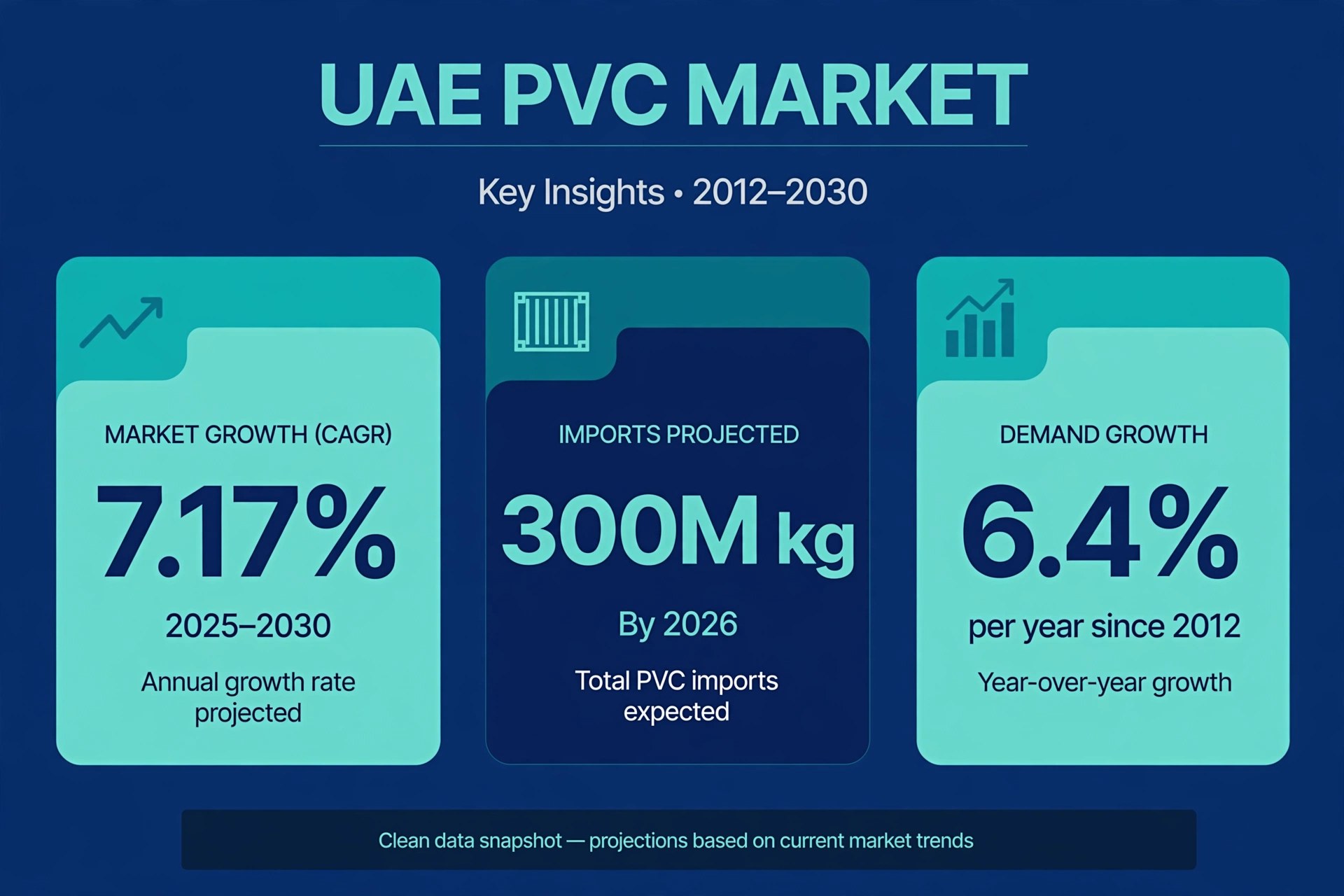
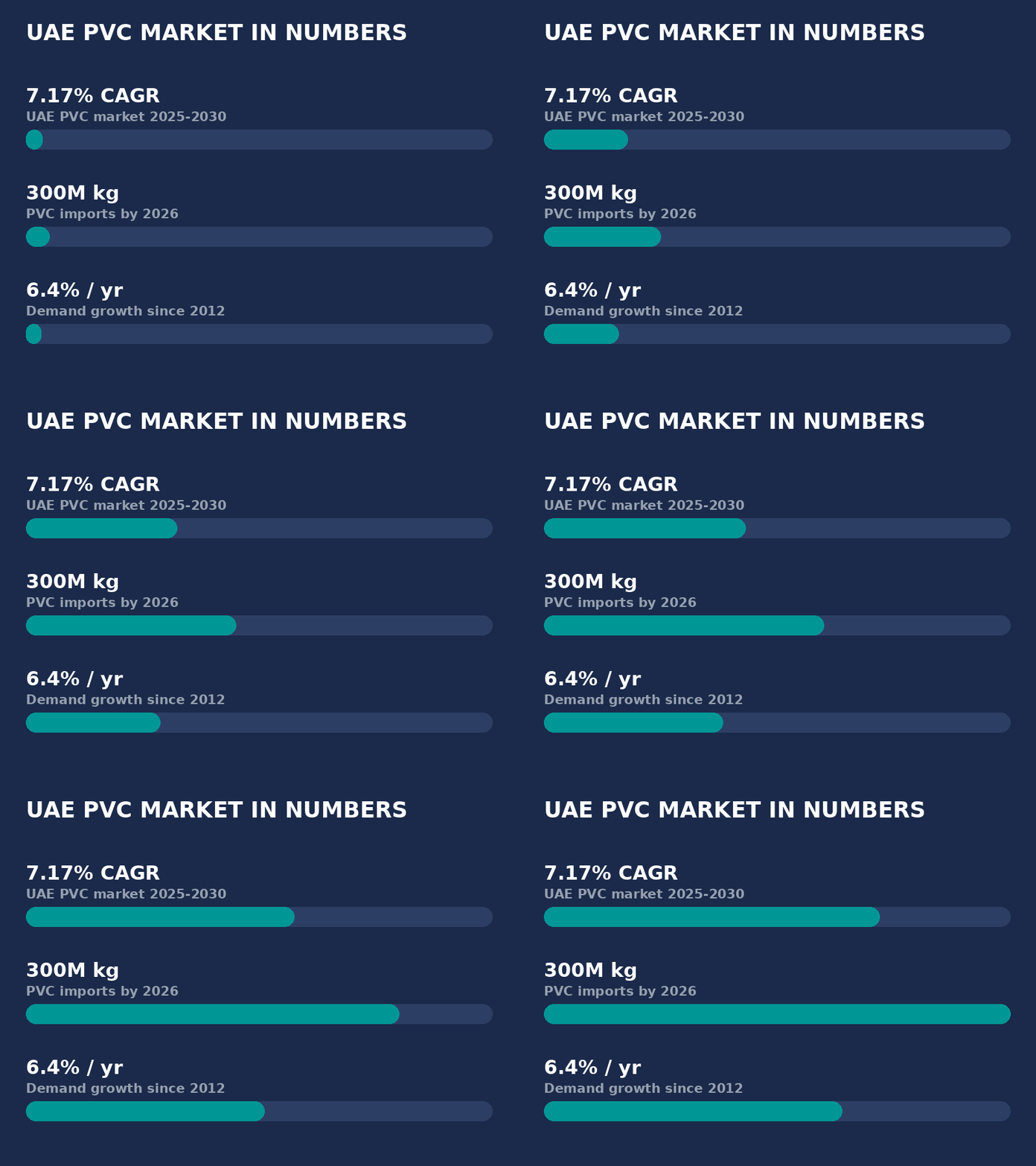
Demand for this material in the region is real and measurable. The UAE PVC market is growing at about 7.17% a year between 2025 and 2030, according to Bonafide Research. ReportLinker projects UAE imports of polyvinyl chloride at around 300 million kilograms by 2026, with local demand growing 6.4% a year since 2012. A lot of that material ends up in construction and interiors, including wall cladding.
The types and finishes you will find in the UAE
Walk into the market here and you will mostly see four categories.
Marble-finish sheets are the best sellers. They mimic Carrara, Calacatta, and darker marbles with a printed vein pattern. From a normal viewing distance they look convincing, and they are a fraction of the weight of real stone, which matters when you are cladding a full wall.
Wood-finish sheets copy oak, walnut, teak, and similar grains. They suit majlis areas, bedrooms, and office cabins where people want warmth without the maintenance of real timber in our humidity.
Solid colour and high-gloss sheets come in whites, greys, beiges, and bolder colours. High-gloss white is common in kitchens and clinics because it bounces light around and wipes clean.
3D and textured sheets have fluted, slatted, or geometric relief patterns. These are popular for TV walls and reception backdrops where you want shadow and depth rather than a flat print.
If you want to see how these compare with the WPC alternative, we have a separate piece on WPC versus PVC wall panels in the UAE.
Where PVC cladding sheets make sense in UAE homes and offices
PVC cladding earns its place in specific spots.
Bathrooms and kitchens are the natural home for it. Steam, splashes, and cooking humidity do not bother PVC the way they bother paint or wallpaper. A full-height clad wall behind a vanity or a cooker backsplash wipes down in seconds.
TV and media walls are probably the most common residential use we see in Abu Dhabi. A marble-finish sheet behind the television gives you a luxury look in a single day, and cables can run behind the panels.
Offices, clinics, and retail use cladding for reception walls and corridors. It takes knocks better than painted drywall, and a scuffed section can be replaced without repainting a whole wall.
Rental properties are another strong case. Landlords like that cladding refreshes a tired flat quickly between tenants, and tenants like that it looks far better than the flat white paint most rentals come with.
Where it makes less sense: exterior facades in direct UAE sun all day (heat and UV are brutal on any plastic over years), and rooms where you want a genuinely premium natural material feel, like a formal majlis with real stone. For a broader look at how PVC stacks up against paint, wallpaper, WPC, and tiles, read our honest comparison of wall finishes for UAE interiors.
What to check before you buy: thickness, finish quality, UV stability
This is the part most buyers skip, and it is the part that decides whether your walls still look good in five years.
Thickness. Cladding sheets generally range from about 3mm to 8mm or more. Thinner sheets are cheaper and fine for a perfectly flat wall, but they show every bump underneath and can feel flimsy. Thicker sheets sit flatter, hide minor wall imperfections, and resist dents better. Ask for the actual thickness in millimetres and compare like with like.
Finish quality. Look at the print up close, not just from across the showroom. Cheap sheets have visible pixelation, repeating patterns that are easy to spot, and colours that look flat. Good ones have sharp veining, natural colour variation, and a protective top layer you can feel. Run your fingernail lightly across a sample; a proper wear layer resists scratching.
UV stability. This matters in the UAE more than almost anywhere else. Ask whether the sheets are UV stabilised, especially for walls near floor-to-ceiling windows or glass doors. Non-stabilised PVC can yellow or fade with sustained sun exposure. If a supplier cannot answer this question clearly, treat that as your answer.
Fire rating and certifications. For commercial spaces, ask about fire ratings. Reputable sheets carry test certificates; if you are cladding an office or shop, your fit-out contractor or building management may require them.
The substrate behind it. PVC cladding hides a lot, but it cannot fix a damp wall. If the wall has active moisture ingress, solve that first. Cladding over a leaking wall just traps the problem.
How installation usually works
Installation is one of the main reasons people choose cladding over tiles or wet trades.
First the wall is checked for flatness and any loose paint or plaster is dealt with. Then the sheets are measured and cut to size, usually with a fine-toothed saw or a scoring knife for thinner panels. A strong construction adhesive is applied to the back in beads or dabs, the sheet is pressed onto the wall, and the edges are finished with matching trims or silicone where they meet floors, ceilings, and corners.
A single feature wall in a living room is typically a one-day job. A full bathroom reclad takes a couple of days. There is no wet cement, no grout lines to seal, and far less dust than tiling, which is why families often choose it when they cannot empty the house for a renovation.
That said, cutting around sockets, AC vents, and curved details takes a practiced hand. The sheets themselves are affordable; the finish you see at the end depends heavily on the installer. If you are in Abu Dhabi, you can see the range of PVC and acrylic sheet options at our Capital Mall showroom in Mohamed Bin Zayed City before deciding.
Looking after your PVC cladding
Maintenance is refreshingly boring, which is the point.
Dust the panels with a dry or slightly damp microfibre cloth. For kitchen grease or bathroom residue, warm water with a drop of mild dish soap does the job. Avoid abrasive pads, scouring powders, and harsh solvents like acetone; they will dull the protective layer. Do not use steam cleaners directly on the sheets.
Check the silicone beading around edges once a year, especially in bathrooms. If a bead lifts, water can get behind the panel, so reseal it promptly. Individual damaged sheets can usually be replaced without disturbing the rest of the wall, which is a genuine advantage over repainting or retiling.
Common questions about PVC cladding sheets in the UAE
Are PVC cladding sheets waterproof?
The sheets themselves do not absorb water, which is why they work well in bathrooms and kitchens. The weak points are the joints and edges, so proper sealing with silicone during installation is what makes the whole job waterproof in practice.
How long do PVC cladding sheets last?
Indoors, away from constant direct sun, good quality sheets last many years without visible change. Lifespan depends most on the quality of the sheet and the installation. Cheap thin sheets in a sunny spot will age fastest.
Can PVC cladding go over existing tiles?
Often yes, provided the tiles are firmly fixed and the surface is flat. The adhesive bonds well to glazed tile. Loose or hollow-sounding tiles should be fixed or removed first, because anything moving underneath will eventually show through.
Do PVC cladding sheets look cheap?
Cheap ones can. The difference between a convincing marble-finish wall and an obviously plastic one comes down to print quality, thickness, and installation. This is one product where seeing full-size samples in person, rather than judging from phone photos, really pays off.
Is PVC cladding safe indoors?
Reputable cladding sheets are manufactured for interior use and are widely used in homes, offices, and clinics across the UAE. For commercial projects, ask the supplier for fire test certificates, as building management often requires them.
Can I install PVC cladding sheets myself?
A confident DIYer can handle a simple flat wall, but cutting around sockets, getting joints tight, and finishing edges neatly is skilled work. Most people find the professional finish is worth it for any wall they will look at every day.
Thinking about cladding for your home or office? Message us on WhatsApp at +971 55 281 9239 and tell us which room you have in mind. We will talk you through the finishes that suit it. Our showroom at Capital Mall, Mohamed Bin Zayed City, Abu Dhabi is open daily from 10 AM to 10 PM if you would rather see the sheets in person.
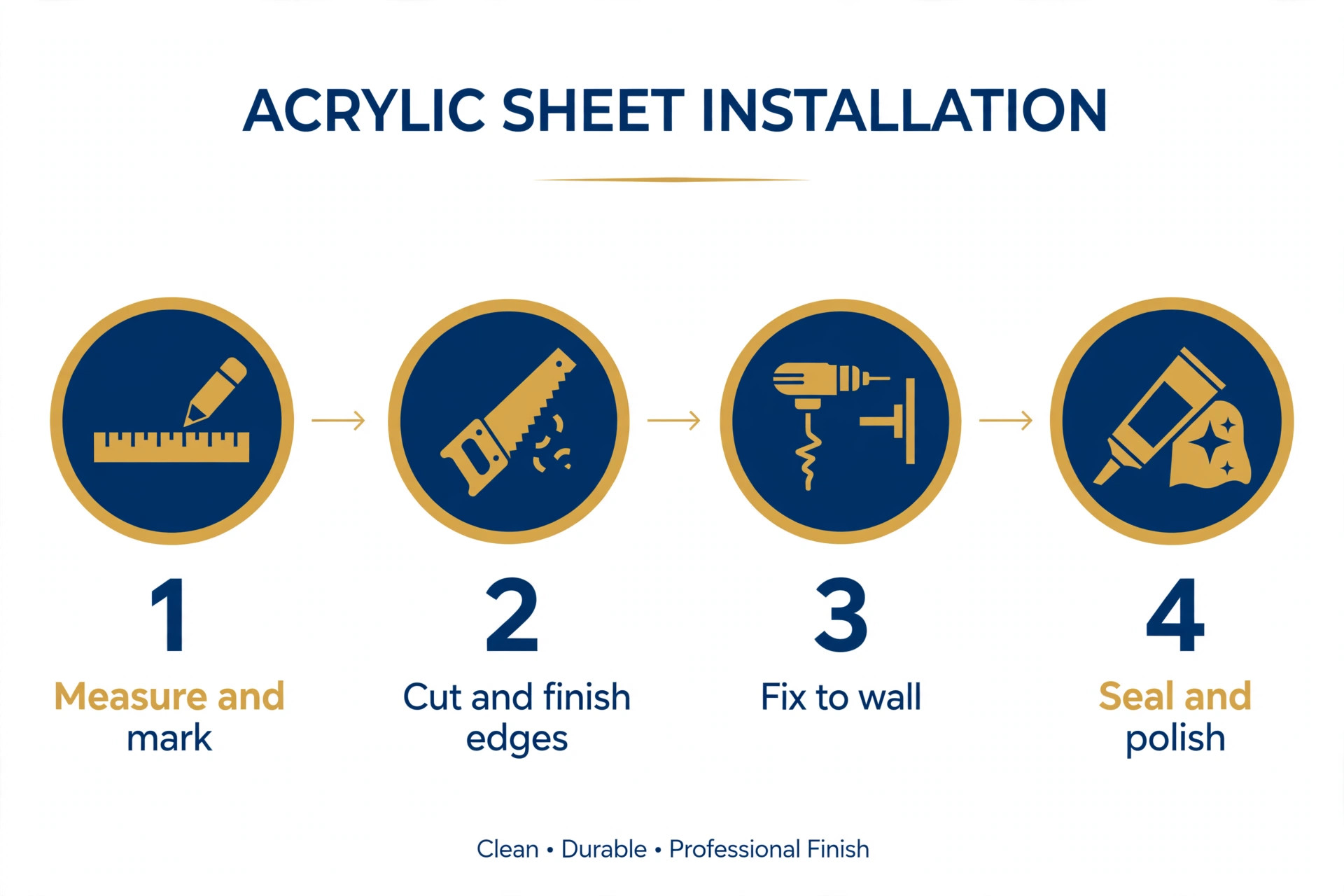
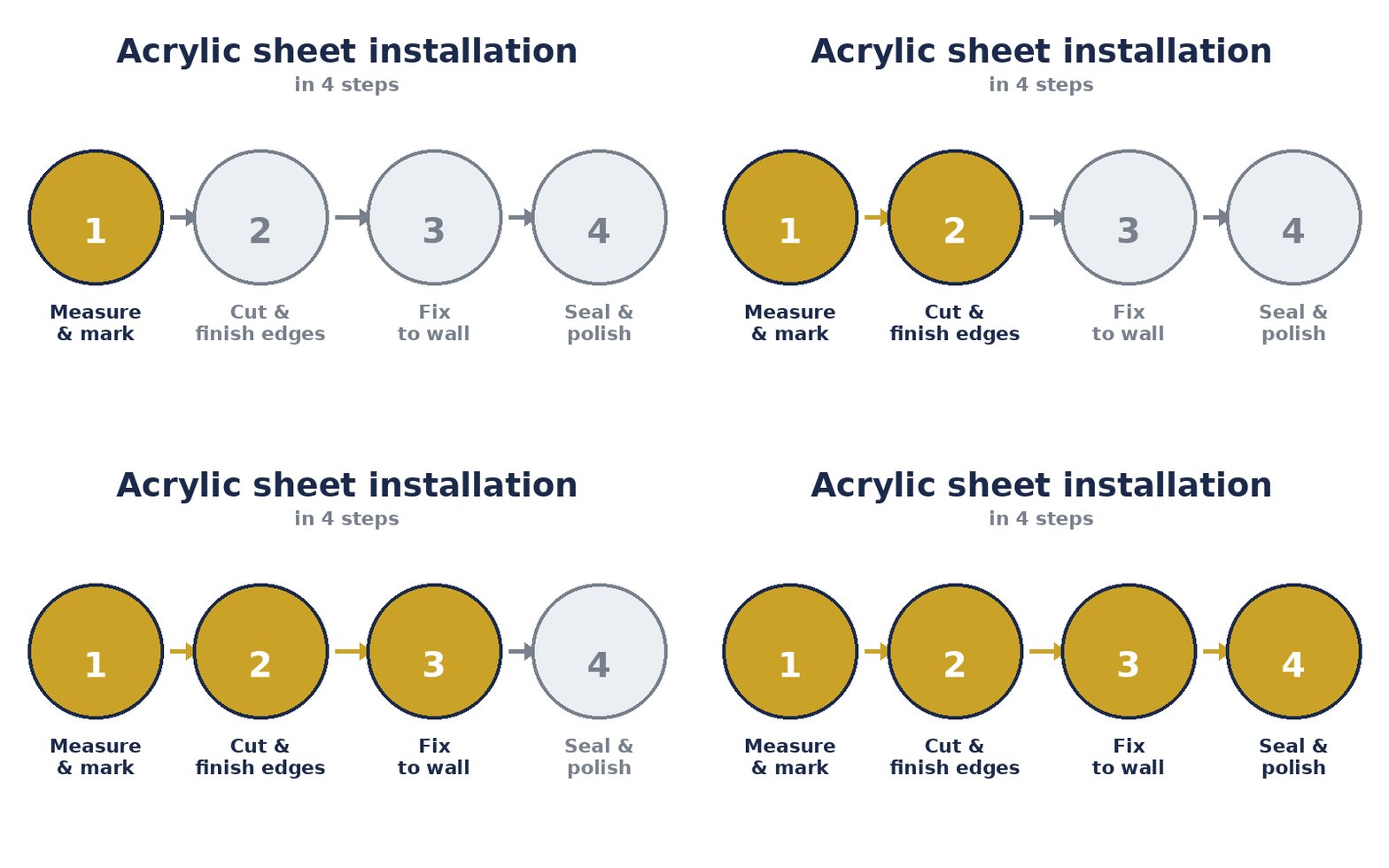
Short answer: Acrylic sheet installation in a UAE home usually takes a single day for a feature wall: the installer measures and marks the wall, cuts the sheets to size with polished edges, fixes them with adhesive or mechanical fixings, then seals, polishes and cleans up. Good site prep matters as much as the fixing itself, and most problems come from rushed measuring or the wrong adhesive, not from the material. After install, gentle cleaning with soap and water keeps the finish looking new.
Before acrylic sheet installation: getting the site ready
A smooth installation starts before the installer arrives. The wall needs to be clean, dry and as flat as reasonably possible. Acrylic is unforgiving of bumps: on a high-gloss sheet, even a small ridge in the plaster underneath will show as a distortion in the reflection. If the wall has loose paint, flaking plaster or old wallpaper, that should be dealt with first.
Clear the room. Furniture should be moved at least a couple of metres from the wall, and anything valuable covered, because cutting and polishing create fine dust. In UAE villas this is usually straightforward, but in apartments with tight access, check that full-size sheets can actually get through the doorways and corridors. Sheet sizes are generous, and a sheet that does not fit around a stairwell turn is a problem you want to discover before install day, not during it.
If you live in a rented apartment, check with your landlord or building management about fixing anything to the walls. Most are fine with adhesive-fixed cladding since it can be removed with far less damage than drilling, but getting the okay in writing avoids arguments later.
Step 1: measure and mark
Everything good about the finished wall comes from this step. The installer measures the wall in several places, not just once, because few walls are perfectly square. In older Abu Dhabi villas especially, a wall can be a centimetre or two out from one end to the other, and the layout has to absorb that difference gracefully.
The sheet layout is planned on the wall with light pencil or tape marks: where each sheet lands, where the seams fall, and how edges meet corners, sockets and switches. Good planning puts seams in natural breaks or in symmetrical positions, never randomly across the middle of the wall. Electrical points get marked so cutouts land exactly right. This is also when the installer confirms the sheets on site match what was ordered: correct color, correct finish, UV-stabilized grade if the wall sees sun.
Step 2: cut and finish the edges
Acrylic sheets are cut with fine-toothed saws or CNC equipment for complex shapes. The key detail is the edge finish. A freshly cut acrylic edge looks cloudy and rough, so each cut edge is polished back to clarity or to a clean satin finish depending on the design. This is skilled, unhurried work: rushing it leaves visible flaws along every seam.
Cutouts for sockets and switches are made now, slightly oversized so faceplates sit cleanly over them. If the design includes curves, for example around a column, the sheet is gently heat-formed. Acrylic becomes pliable when warmed, which is one of its real advantages over glass, but it takes experience to heat it evenly without scorching or distorting the surface.
Protective film stays on the face of every sheet through all of this. It only comes off at the very end. If you ever watch an installer peel film off early for a quick look, that is a small red flag: one stray scratch during handling and the gloss is marked before the job is even finished.
Step 3: fix the sheets to the wall
There are two main fixing methods, and the right one depends on the wall and the sheet size.
Adhesive fixing is the most common for interior feature walls. A high-quality neutral-cure adhesive is applied to the back of the sheet in a pattern that allows air to escape, the sheet is offered up to the wall, leveled, and held until the adhesive grabs. The adhesive choice matters enormously: the wrong product can craze or discolor acrylic over time, which is one of the classic failures of rushed low-quality installations.
Mechanical fixing uses screws with decorative caps or a slim framing system. It suits heavier sheets, uneven walls that needed battens, or commercial settings where panels may need to come off for maintenance access behind them. The caps become part of the design, so they are usually color-matched.
Whichever method is used, the installer works sheet by sheet, checking level and alignment constantly. Acrylic shows misalignment mercilessly: a sheet that is a degree off at the bottom is visibly off at the top. Spacers keep seam gaps consistent, and any expansion gap at the perimeter is planned in, because even stable materials move slightly with temperature.
Step 4: seal, polish and clean up
Once all sheets are fixed, seams are sealed where needed, edges get a final polish, and the protective film finally comes off. This is the moment the wall transforms: the gloss appears all at once and the room changes character.
Then comes cleanup. Acrylic dust from cutting is fine and clings to everything, so a thorough wipe-down of the room is part of a professional job, not an extra. The installer should walk you through the finished wall, pointing out seam positions and explaining the cleaning routine: soft cloth, soap and water, nothing abrasive. That two-minute handover prevents most of the damage we hear about later, because many scratches happen when someone cleans a new glossy wall like it was ceramic tile.
How long does acrylic sheet installation take
For a single feature wall in a villa living room, a professional team usually completes the job in one working day, assuming the wall was prepped and the sheets were cut or pre-cut correctly. Larger projects, a full restaurant interior or several rooms, run over multiple days, but the rhythm is the same: measure, cut, fix, finish.
What stretches timelines is almost never the fixing itself. It is waiting on wall prep, discovering the wall is badly out of true, or sheets arriving in the wrong finish and needing replacement. A good installer flags these risks at the site visit stage, before install day is even booked. If your installer wants to start work the same day as the first site visit, without measuring twice, be cautious.
What goes wrong with bad installation
Most acrylic failures trace back to installation, not the material. The common ones:
Wrong adhesive. Solvent-heavy or acidic adhesives can craze the back of the sheet, showing as fine cracks or cloudy patches months later. Neutral-cure products made for plastics are the safe choice.
No expansion gaps. Butted tight with zero room to move, sheets can bow or pop adhesive bonds when temperatures swing. The UAE’s indoor-outdoor temperature difference makes this more relevant than in milder climates.
Fixing over an uneven wall. Every bump telegraphs through gloss acrylic as a visible distortion. Skimming or battening the wall first is not optional on wavy plaster.
Sloppy seams. Uneven gaps and cloudy unpolished edges are the visual signature of a rushed job. They cannot be fixed after the fact without replacing sheets.
Peeling film too early. Scratches picked up during handling, before the final clean, stay forever.
None of these are mysterious. They are all avoided by an installer who measures carefully, uses the right consumables and does not rush the finishing.
Aftercare in the first few weeks
The first month sets the pattern. Keep abrasive cleaners far away: no scouring pads, no harsh chemicals, no alcohol-heavy sprays on colored sheets. A microfiber cloth with mild soap and water handles everything from dust to fingerprints.
Watch the seams and edges as the room goes through its first hot weeks. Tiny settling is normal; anything opening up visibly deserves a call back to the installer while the work is fresh. Reputable installers expect this and would rather adjust a sheet early than have an unhappy client later.
If the wall is in direct sun, this is also when you confirm the UV-stabilized grade is doing its job. There should be no color shift in the first season. Fading or yellowing in the early months points to the wrong grade being supplied, which is a supply problem to take up with whoever provided the sheets.
DIY or professional acrylic sheet installation
Acrylic looks deceptively simple: flat sheets, stick them on the wall. In practice, the cutting, edge polishing and layout planning are where the skill lives, and the tools for clean fabrication are not typical DIY kit. A confident DIYer can manage small panels, like a kitchen backsplash, with careful measuring and the right adhesive.
For feature walls, large sheets, cutouts around electrics, or anything in direct sun where the grade specification matters, professional installation pays for itself. The material itself performs impressively, about 92% light transmission, roughly 17 times the impact resistance of glass at about half the weight (QUANDA Plastic), but those properties only shine when the sheets are cut cleanly and fixed correctly.
Frequently asked questions
How long does acrylic sheet installation take?
A single feature wall typically takes one working day for a professional team, provided the wall is prepped and sheets are ready. Multi-room or commercial projects take longer, but the per-wall rhythm stays the same.
Can acrylic sheets be installed over existing tiles?
It depends on the tiles. If they are firmly bonded, flat and clean, adhesive fixing over them is often possible. Loose, cracked or heavily textured tiles should come off first, because movement underneath will telegraph through the acrylic.
What adhesive is used for acrylic sheets?
A neutral-cure adhesive formulated for plastics. Solvent-based or acidic products can craze and discolor acrylic over time, so the adhesive specification is one of the most important details to get right.
Do acrylic walls need expansion gaps?
Yes, small ones at the perimeter. Even dimensionally stable materials move slightly with temperature, and the gap prevents bowing or popped bonds. A good installer plans these into the layout invisibly.
How soon can I clean the wall after installation?
Once the adhesive has cured, usually within a day or two, gentle cleaning with a soft cloth and soap and water is fine. Avoid any abrasive products from the start and the finish will stay glossy.
What should I check before the installer leaves?
Walk the wall together. Check seams are even, edges are polished, sockets and switches sit cleanly in their cutouts, and the room is wiped down. Ask for the cleaning routine in plain words: soft cloth, soap and water, nothing abrasive.
Planning an acrylic feature wall, kitchen backsplash or office branding wall? Start with our complete guide to acrylic cladding in the UAE to pick your finish, then see the full material range on our PVC and acrylic sheet page. Message us on WhatsApp at +971 55 281 9239 for a free site visit and quote. Our showroom at Capital Mall, Mohamed Bin Zayed City is open daily from 10 AM to 10 PM.
PU stone wall panels have become one of the most popular ways to add the look of natural stone to UAE homes without the weight, mess, and long timelines of real masonry. They are lightweight polyurethane panels moulded and coloured to look like slate, limestone, brick, and stacked stone, and they install directly over existing walls.
Below are 25 PU stone design ideas, each matched to the way people actually live in the UAE, from villa majlis walls and TV feature walls to full exterior facades that stand up to the Gulf sun. All images are design concepts to help you visualise the look in your own space.
Short answer: PU stone panels give UAE homes the look of natural stone at a fraction of the weight and installation time. The most popular designs here are grey slate living room walls, beige limestone majlis walls, white stacked stone TV walls, and sandstone villa facades. They suit both interiors and exteriors, handle heat and humidity well, and install over existing walls. See PU stone installation in the UAE or get a free quote on WhatsApp.
1. Classic Grey Slate Living Room Wall

Grey slate is the safest first choice for a villa living room in the UAE, and the most requested. The cool grey tones balance the warm natural light that floods most UAE living rooms, and the layered slate texture hides everyday dust far better than a flat painted wall. It pairs naturally with beige sofas, wooden consoles, and the marble or tile flooring common in Emirates villas. Because PU panels are light, this full wall can usually be completed without the structural checks real stone would need. If your living room doubles as the family gathering space, this design gives it a finished, hotel-like feel in a single weekend project. PU stone for living rooms.
2. Beige Limestone Majlis Wall

The majlis deserves a wall with presence, and beige limestone delivers it while staying true to regional tastes. The soft sandy tones echo traditional Gulf architecture, so the room feels rooted rather than themed. Limestone-effect PU works beautifully behind low majlis seating because the texture reads well at sitting eye level, where guests spend most of their time. It also photographs well, which matters in a room built for hospitality. For homes in Abu Dhabi and Al Ain where the majlis is a separate building or annex, the same panels can run inside and out for a continuous look.
3. White Stacked Stone TV Wall
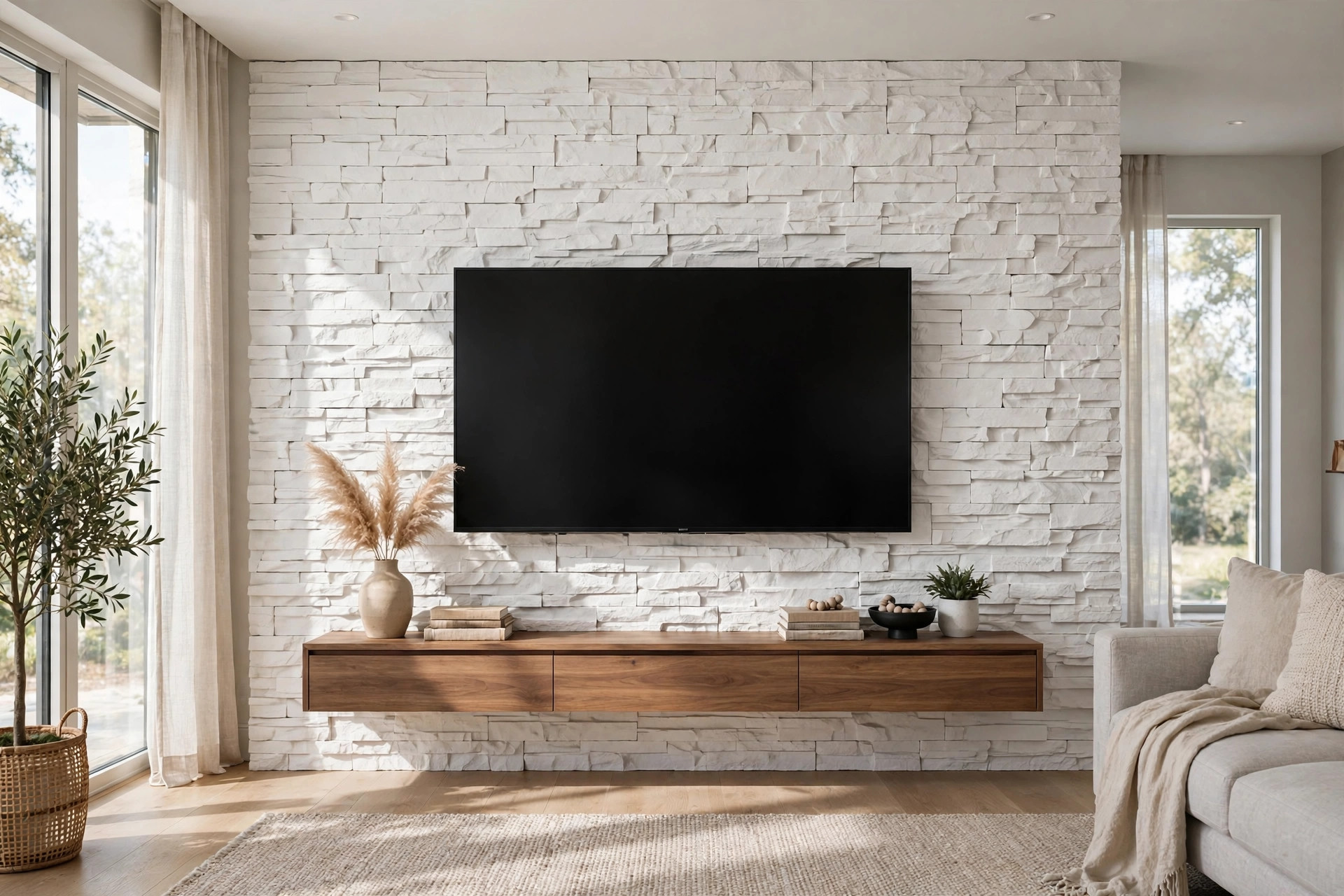
A white stacked stone TV wall is one of the smartest upgrades for an apartment or villa living room. The horizontal ledgestone lines draw the eye to the screen and make the wall feel wider, which helps in the compact living rooms of many UAE apartments. White reflects light, so the room feels brighter even with the curtains drawn against the afternoon sun. PU panels are ideal here because a TV bracket mounts securely through them into the wall behind, and cables can be concealed in the panel joints. It is a clean, modern look that suits everything from JVC apartments to Dubai Hills villas.
4. Charcoal Slate Bedroom Accent Wall

Dark feature walls are growing fast in UAE bedrooms, and charcoal slate is the most forgiving way to do it. The near-black stone makes white bedding and warm bedside lamps pop, giving a boutique hotel feel that suits the master bedrooms of new UAE developments. A practical UAE note: dark walls show dust more readily, so plan a quick wipe-down in your weekly cleaning routine, something PU’s smooth sealed surface makes easy. Keep the other three walls light and let this one carry the drama. It works especially well in bedrooms with large windows, where daylight keeps the dark stone from feeling heavy.
5. Desert Sandstone Villa Facade

Cladding a villa facade in desert sandstone PU panels gives you the classic Gulf villa look without quarrying, cutting, and craning real stone. The sandy tones blend with the landscape from Mohamed Bin Zayed City to the outer suburbs, and the panels’ UV-resistant coating is made for the relentless UAE sun. Because PU is a fraction of the weight of natural stone, it suits facade upgrades on existing villas where the structure was never designed to carry stone cladding. Pair it with simple landscaping and warm exterior lighting and the whole front elevation transforms. Exterior PU stone cladding in the UAE.
6. Rustic Brick-Effect Restaurant Wall

Cafes and restaurants across the UAE use brick-effect PU stone to create atmosphere fast, because a full fit-out cannot always wait for real brickwork. The rustic red tones warm up a dining room instantly and sit well with wooden furniture and hanging pendant lights. For commercial spaces, the speed of PU installation is the real advantage: walls go up with adhesive and screws, with no wet trades and no curing time, so a restaurant can refresh its look between tenancies. The panels also wipe clean, which matters in any food setting. If you run a cafe in Abu Dhabi or Dubai, this is one of the highest-impact changes per square metre you can make.
7. Travertine Hotel Lobby Wall

Travertine has a natural place in UAE hospitality design, and PU travertine panels bring that look to lobbies, reception areas, and hotel corridors at a practical weight. The pitted, linear texture of travertine reads as luxury without shouting, which is why it sits so well behind a reception desk. In the UAE’s hotel-heavy market, from city business hotels to resort properties, this finish signals quality the moment guests walk in. PU’s moisture resistance is a bonus in lobbies where the entrance doors open constantly to humid outside air. For boutique hotels and serviced apartments, it delivers a five-star backdrop on a sensible budget and timeline.
8. River Rock Garden Boundary Wall

Villa boundary and garden walls take a beating in the UAE: sun, dust, irrigation splash, and the occasional football. River rock PU panels turn a plain block wall into a landscape feature while shrugging off that abuse. The rounded stone shapes suit gardens with pools and palms, giving a resort feel that matches how UAE families actually use their outdoor space in the cooler months. Because the panels are waterproof, they handle irrigation overspray and pool humidity without the staining and flaking that painted block walls develop. Add a few outdoor wall lights and the garden wall becomes a feature after dark too.
9. Dark Slate Office Reception Backdrop
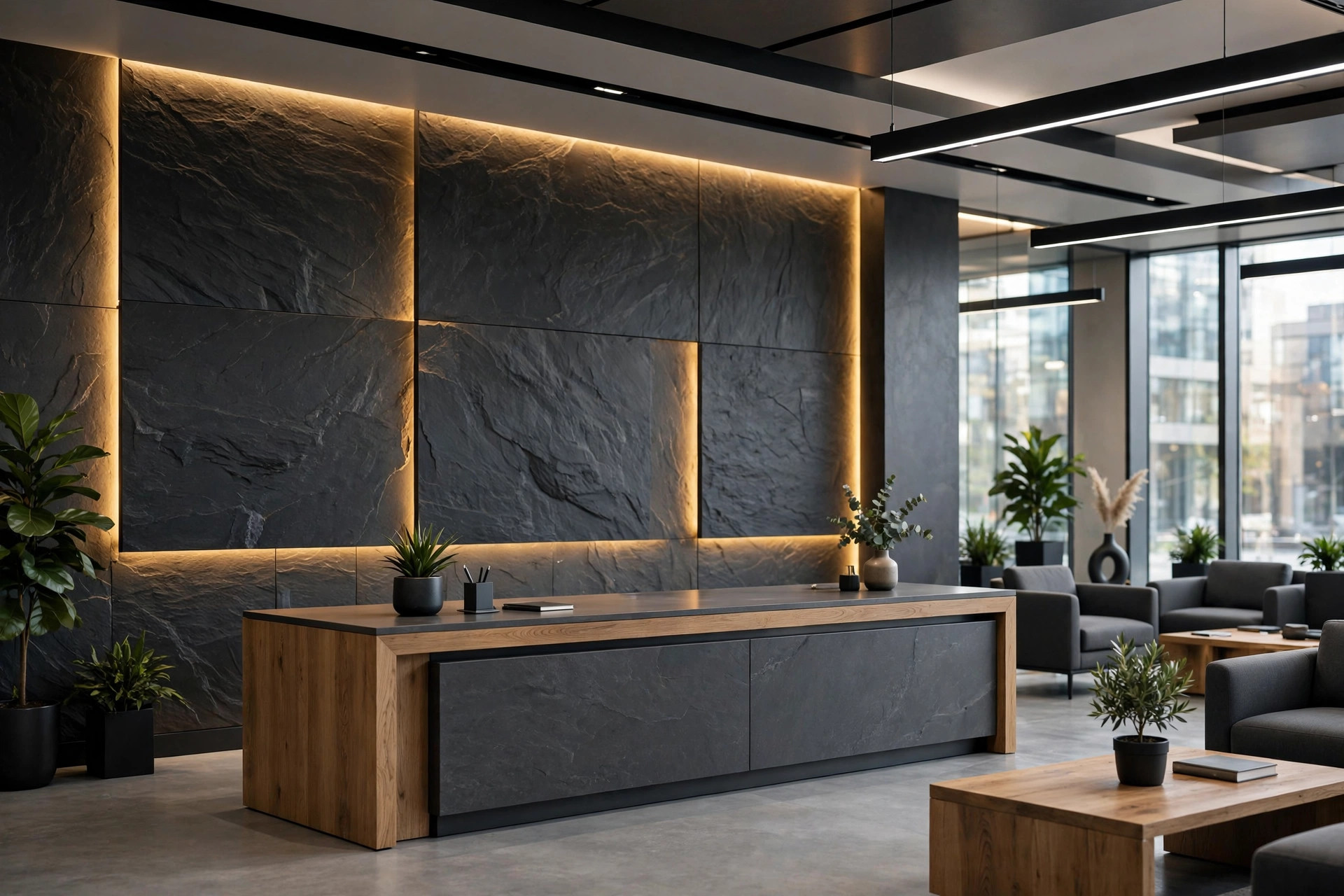
First impressions matter for UAE businesses, and a dark slate reception wall with backlighting gives an office instant authority. The deep texture looks premium on camera too, which helps for the video calls that dominate Gulf business life. PU panels are a natural fit for office fit-outs because they install quickly over existing drywall, so a reception upgrade can happen over a weekend without disrupting the working week. The stone backdrop also hides scuffs and marks far better than paint in a high-traffic reception. Pair it with a backlit company logo and the entrance tells your story before anyone says a word.
10. Cream Limestone Staircase Wall

Staircase walls are often the most neglected surface in a UAE villa, even though they are visible from multiple floors. Cream limestone PU panels turn that vertical expanse into a design feature. The light stone keeps stairwells bright, which matters in villas where the staircase sits in the core of the plan away from windows. The panels’ light weight is a genuine advantage on stair walls, where fixing heavy natural stone overhead or on tall drops gets complicated. Run the panels the full double height of the stairwell and add a simple picture light or two. It is a small area in square metres but a huge visual return. More wall panel ideas.
11. Mushroom Stone Entrance Foyer
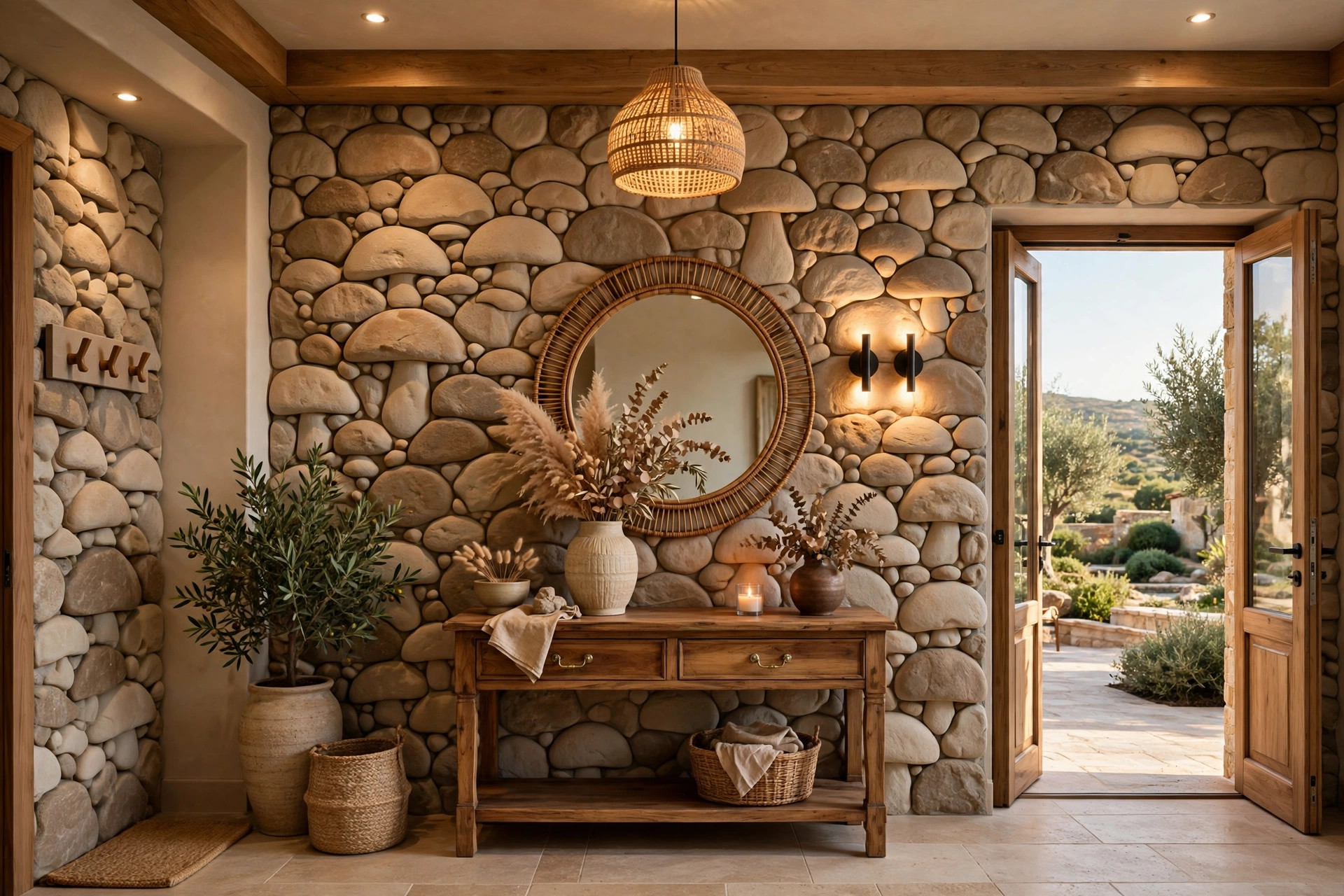
Mushroom stone, with its puffy, irregular rounded shapes, makes a villa entrance feel welcoming the moment the door opens. The bumpy texture catches light and shadow beautifully, so even a simple console table and mirror look styled against it. In UAE villas where the entrance opens directly into the living space, this wall creates a sense of arrival and separation without building anything. The deep texture is also practical: it disguises the small knocks and scuffs that entrance walls collect. Choose warm grey or beige tones to keep the foyer bright, and let one good light fixture do the rest.
12. Grey Quartzite Bathroom Feature Wall

PU stone works in UAE bathrooms because the panels are waterproof and moisture-proof, two non-negotiables where humidity runs high most of the year. A grey quartzite feature wall behind the vanity or in the shower zone gives a spa-like feel that plain tiles rarely achieve. The large panel format means fewer grout lines than tile, so there is less grout to discolour in hard-water areas. Stick to the vanity or WC wall rather than inside the shower cubicle itself, and seal the panel edges properly. For guest bathrooms, this single wall is often all it takes to lift the whole room.
13. Rust Slate Outdoor Patio Wall

The outdoor majlis and BBQ patio is where UAE families spend the best months of the year, and a rust-toned slate wall gives that space a proper backdrop. The copper and amber tones glow under evening lighting, which is when these spaces get used most. PU’s UV-resistant coating matters here more than anywhere: this wall faces the sun daily, and quality panels are made to hold their colour. The stone texture also hides the dust that settles on every outdoor surface in the Emirates. Build the BBQ counter against it, add string lights, and the patio becomes the favourite room of the house from October to April.
14. Whitewash Brick Retail Shop Wall

Retail shops in UAE malls and high streets need walls that look good and survive constant footfall. Whitewash brick-effect PU panels do both: the pale finish keeps small shops feeling open and bright, while the brick texture adds character that flat paint cannot. For shop owners, the installation speed is decisive. A full feature wall can be fitted overnight, so there is no lost trading day. The panels also come off cleanly compared with real brickwork, which matters when mall tenancies turn over. Fashion boutiques, phone shops, and cafes in particular suit this fresh, airy take on brick.
15. Black Stacked Stone Home Cinema Wall
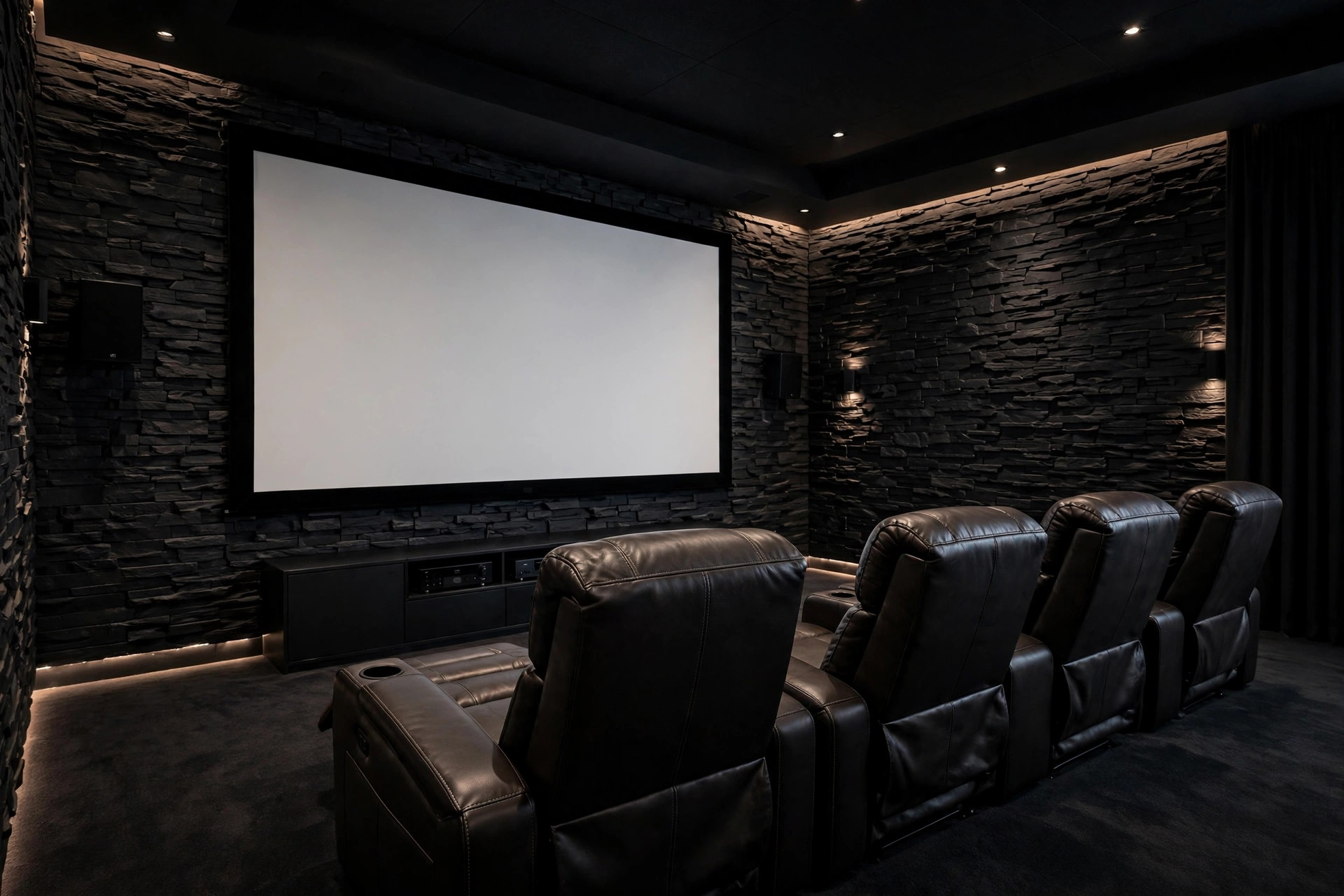
Dedicated cinema rooms are increasingly common in UAE villas, and black stacked stone is the ideal wall for them. The dark, textured surface absorbs stray light instead of reflecting it back at the screen, which genuinely improves the viewing experience. It also gives the room a dramatic, cocooned feel that flat black paint cannot match. PU panels add a small acoustic benefit too, breaking up flat reflective surfaces. Run the stone on the screen wall and keep seating and carpet dark, then let LED strip lighting trace the stone texture. The result feels like a private theatre, not a spare room with a projector.
16. Honey Sandstone Porch Columns

Porch columns are the handshake of a UAE villa, and cladding them in honey sandstone PU panels makes that handshake warm. The golden tones suit the local light beautifully, glowing at sunrise and sunset. Columns are actually one of the trickiest shapes for real stone, with all the cutting and mitring involved. PU panels bend around the job far more simply, wrapping square or round columns with clean joints. Because the panels are light, there is no structural worry about loading the porch structure. It is a focused upgrade: two or four columns, one weekend, and the whole entrance feels rebuilt.
17. Strip Stone Kitchen Backsplash Wall

A full strip-stone mosaic wall behind the kitchen counters gives a UAE kitchen real character, especially in open-plan villa kitchens where the cooking zone is always on show. The narrow stone strips create a fine, tailored texture that suits both modern handleless kitchens and warmer traditional ones. PU’s wipeable surface handles cooking splashes, and the panels stand up to kitchen humidity. Keep the stone to the backsplash zone and one adjacent wall rather than wrapping the whole kitchen, so the texture stays a feature rather than overwhelming the space. Under-cabinet lighting raking across the stone strips looks superb in the evening.
18. Coral Stone Beach Chalet Wall

For chalets and holiday homes along the UAE coast, from Saadiyat to the northern emirates, coral stone effect PU panels capture the beach house feel without importing a single real coral block. The pale, porous-looking texture pairs perfectly with rattan furniture, linen curtains, and sea views. Coastal air is salty and humid, exactly the environment PU’s moisture and salt-spray resistance is designed for. Use it on the main living wall of the chalet and keep furnishings light and natural. Guests will assume it is real stone, and you will never have to seal or repoint it.
19. Graphite 3D Geometric Apartment Wall
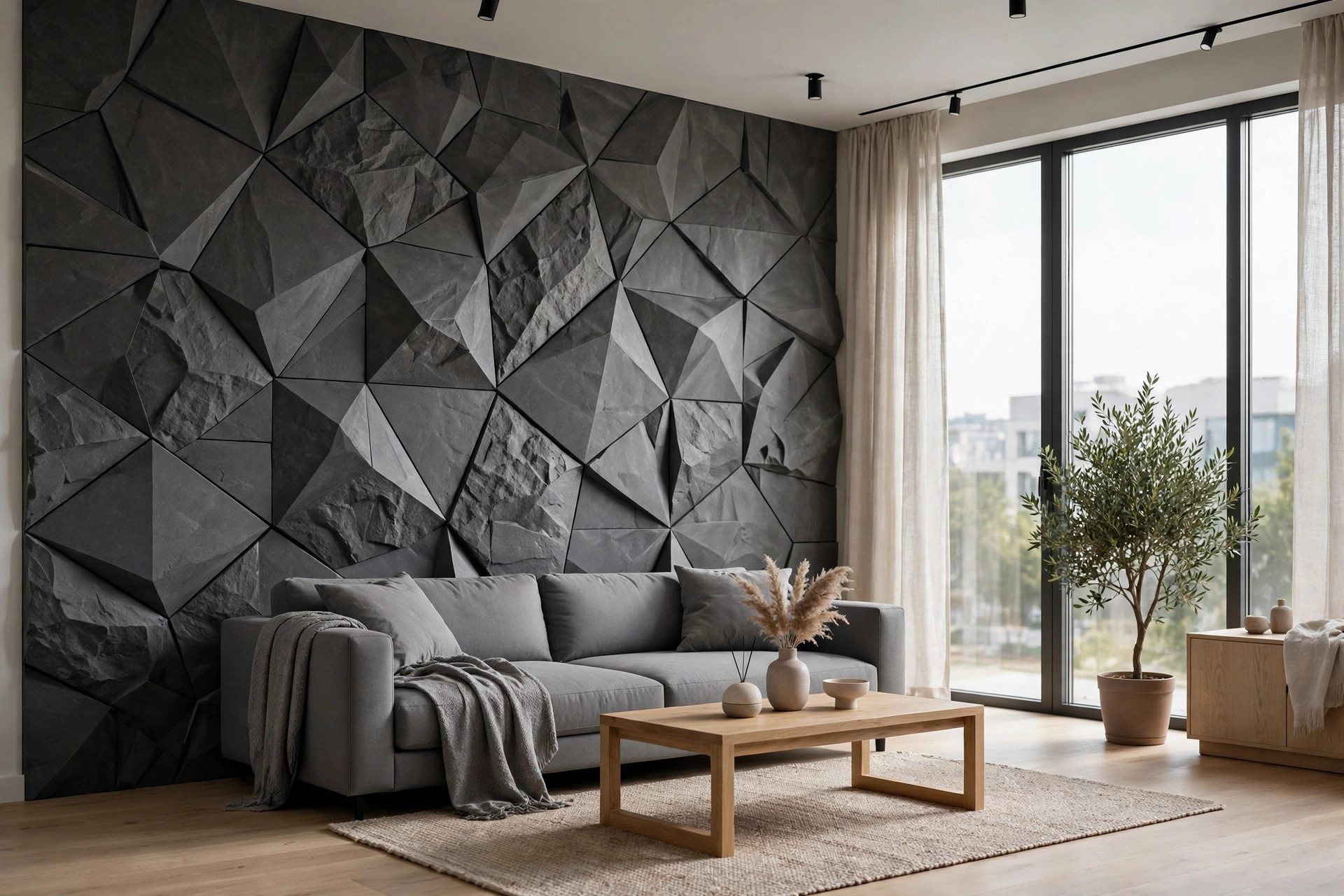
For a modern Abu Dhabi or Dubai apartment, graphite 3D geometric PU panels are the contemporary answer to the feature wall. The faceted surface plays with daylight through the apartment’s windows, so the wall changes character from morning to evening. Darker geometric designs are also very forgiving in rental apartments: they make a strong statement on a single wall and can be installed with minimal disruption. Just confirm with your landlord before fixing anything to the walls, as most UAE tenancies require written permission for alterations. One wall is enough; let the geometry be the art.
20. Beige Ledgestone Hallway Wall
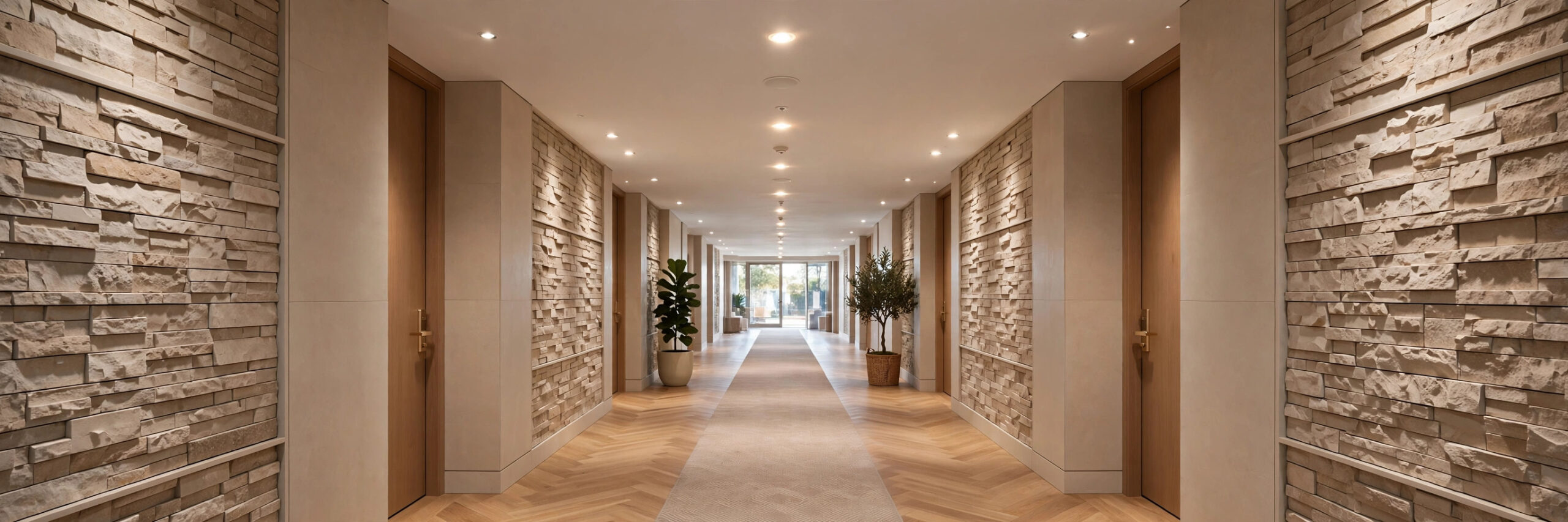
Long hallways and corridors in UAE villas and offices are hard to decorate, and beige ledgestone PU panels solve them elegantly. The horizontal stone courses give the corridor rhythm and draw the eye forward, making it feel intentional rather than leftover. The mixed beige tones work with almost any flooring, from marble to wood-effect tile. Add recessed spotlights washing down the stone and a plain corridor becomes a gallery-like transition space. Because hallways take constant passing traffic, the panels’ scuff resistance is a genuine practical win over paint, which marks within months.
21. Red Sandstone Outdoor Majlis Wall

A standalone outdoor majlis clad in reddish sandstone PU panels looks like it has stood there for decades, in the best way. The warm red-brown tones reference traditional Gulf building materials while the panels themselves handle modern weather: UV, heat, and the occasional sandstorm. For the many UAE homes with a separate majlis building in the garden, cladding its exterior in stone-effect panels ties it visually to the main villa. Arched windows and traditional lanterns complete the picture. It is a distinctly Emirati design move, and PU makes it achievable without a stonemason on site for weeks.
22. Light Grey Brick Office Partition Wall

Light grey brick-effect PU panels give an office partition wall texture and character while keeping the space bright enough for work. The pale brick suits the clean, professional look most UAE companies want, with just enough industrial edge to feel contemporary. For offices, PU wins on logistics: panels fix to drywall partitions quickly, add almost no weight, and create no dust, so teams can keep working around the installation. It is a popular choice for meeting room backdrops and breakout areas, where a plain white wall would feel unfinished on video calls with clients.
23. Dark Basalt Pool Surround Wall

The wall around a villa pool has the hardest job of any surface in a UAE home: full sun, chlorinated splash water, and constant humidity. Dark basalt PU panels are made for it. The near-black volcanic stone look makes pool water appear an even richer blue by contrast, a trick high-end resorts use deliberately. PU’s waterproof and chemical-resistant surface handles pool chemicals far better than painted render, which blisters and peels within a couple of seasons. Clad the equipment enclosure and boundary walls in the same panels and the whole pool area reads as one designed space.
24. Ivory Onyx Prayer Room Wall

A prayer room calls for calm, and ivory onyx-effect PU panels deliver it with quiet luxury. The soft, translucent-looking stone glows gently under warm lighting, creating a serene focal wall without any visual noise. In UAE villas where the prayer room is a dedicated space, this finish honours its importance. The smooth sealed surface stays clean with minimal effort, and the light colour keeps the room feeling peaceful even in a small footprint. Keep furnishings minimal and let the stone wall carry the room’s character.
25. Mixed Stone Full Villa Elevation

For the ultimate transformation, mixed natural stone PU panels across the full villa front elevation deliver the prestige of a stone-clad villa at a practical weight and timeline. Blending stone types and tones, slate with sandstone, or limestone with rock face, creates a rich, layered facade that looks designed rather than decorated. This is the flagship PU stone application in the UAE: it changes the entire street presence of the property. Done well, with considered lighting and landscaping, a mixed stone elevation makes a standard developer villa look like a custom build. Get a PU stone facade quote.
Choosing the Right PU Stone Design for Your UAE Home
A few practical rules will help you pick from these 25 ideas. Match the stone colour to your light: north-facing or shaded rooms suit lighter stones, while sun-drenched spaces can carry darker designs. For exteriors, always confirm the panels are UV-rated for Gulf sun exposure. For bathrooms, kitchens, and pool areas, check waterproof rating and edge sealing. And for rented apartments, get your landlord’s written permission before any wall fixing, as most UAE tenancies require it.
If you are torn between PU stone and other wall finishes, our honest comparison of PVC cladding versus other wall finishes covers how these materials stack up on durability, maintenance, and looks.
Frequently Asked Questions
Is PU stone suitable for UAE weather?
Yes. Quality PU stone panels are made with UV-resistant coatings and waterproof cores, so they handle the UAE’s heat, sun, and humidity. They are used on both interiors and exteriors across the Emirates. For full-sun facades, ask your installer to confirm the panels’ UV rating.
Can PU stone panels be installed over existing tiles or painted walls?
In most cases, yes. PU panels fix with adhesive and screws directly over sound existing surfaces, which is why installations are so much faster than real stone. Your installer will check the wall is solid and level first.
How do you clean PU stone walls in the UAE?
Dust is the main issue here rather than staining. A soft dry cloth or a light wipe with a damp cloth is usually enough. The sealed surface does not absorb dirt the way porous natural stone can.
Can PU stone be used in bathrooms?
Yes, PU panels are waterproof and moisture-proof, which makes them suitable for bathroom feature walls. Keep them to the vanity or WC wall and make sure edges are sealed properly rather than placing them inside the shower cubicle.
How long does PU stone installation take?
A single feature wall is typically completed within a day or two, and even a full villa facade takes a fraction of the time of natural stone masonry. There are no wet trades and no curing time.
Does PU stone look like real stone?
Modern PU panels are moulded from real stone and use multi-layer colour printing, so the texture, grain, and colour variation are very convincing. Most visitors cannot tell the difference once installed, especially with good lighting.
Like one of these designs? Message us on WhatsApp with the design number, and we will arrange a free consultation and quote anywhere in the UAE.
Short answer: Acrylic cladding in the UAE is a lightweight, glossy sheet material used to cover walls in homes and commercial spaces, giving a sleek glass-like finish without the weight or fragility of real glass. It handles the local climate well when you choose UV-stabilized sheets, it comes in a wide range of colors and finishes, and it is easy to keep clean with just soap and water. For feature walls, kitchens, offices and retail spaces across Abu Dhabi and the wider UAE, it is one of the most practical ways to get a premium look.

What acrylic cladding actually is
Acrylic cladding is made from polymethyl methacrylate, usually just called acrylic or PMMA. It is the same family of material as the clear sheets used for shop displays and aquariums, but for wall cladding it comes in solid colors, mirror finishes and textured designs rather than just clear.
The sheets are manufactured flat and smooth, then fixed onto walls with adhesive, screws with decorative caps, or a framing system depending on the surface and the look you want. Because the material is a thermoplastic, it can also be heat-formed around gentle curves, which opens up design options that rigid materials cannot match.
If you have seen a glossy, almost liquid-looking feature wall in a new villa or a shiny branded wall in a cafe, there is a good chance it was acrylic. It has become a familiar sight in newer interiors across the Emirates because it photographs beautifully and suits the clean, modern style that dominates local design.
Where acrylic cladding works in UAE homes
In villas and apartments, acrylic cladding is mostly a feature-wall material. The living room wall behind the TV or sofa is the classic spot. A high-gloss sheet in a deep color turns a plain wall into the focal point of the room, and it bounces light around in a way that makes the space feel bigger.
Kitchens are another natural fit. Acrylic sheets work well as a backsplash or as cladding on a breakfast bar front, because the surface wipes clean and does not absorb cooking grease the way painted walls do. Bedrooms use it more sparingly, often as a headboard wall or inside wardrobes with mirrored acrylic to add depth. Bathrooms and kitchens are covered in the FAQ below.
Commercial uses across the UAE
Walk through any new mall, clinic or restaurant fit-out in Abu Dhabi and you will see acrylic cladding doing heavy lifting. Retailers love it for branded walls and display backdrops because colors stay vivid and logos can be printed or inlaid directly. Clinics and salons use it because the seamless glossy surface looks hygienic and wipes down fast between clients.
Offices use acrylic for reception walls, meeting room accents and writable glossy surfaces that double as whiteboards. Restaurants and cafes use it behind counters and bars, where the shine reads as premium under warm lighting. Because the sheets are light, they can go up on partition walls that could never carry the weight of glass or stone.
Why it suits the UAE climate
The local climate is the real test for any interior material, and acrylic passes it well with one condition: the sheets need to be UV-stabilized if they will see direct sunlight. Standard acrylic can yellow over time under strong UV, but UV-stabilized grades are made to resist that, which matters in a country where sun streams through glass facades most of the year. That UV resistance is confirmed by material comparisons from glazing specialists (FGD Glass).
Heat itself is not a problem for interior applications. Acrylic is dimensionally stable in normal indoor temperatures, and unlike some wall coverings it does not peel or bubble in humidity. That makes it a safe choice for kitchens and bathrooms where steam is a daily reality.
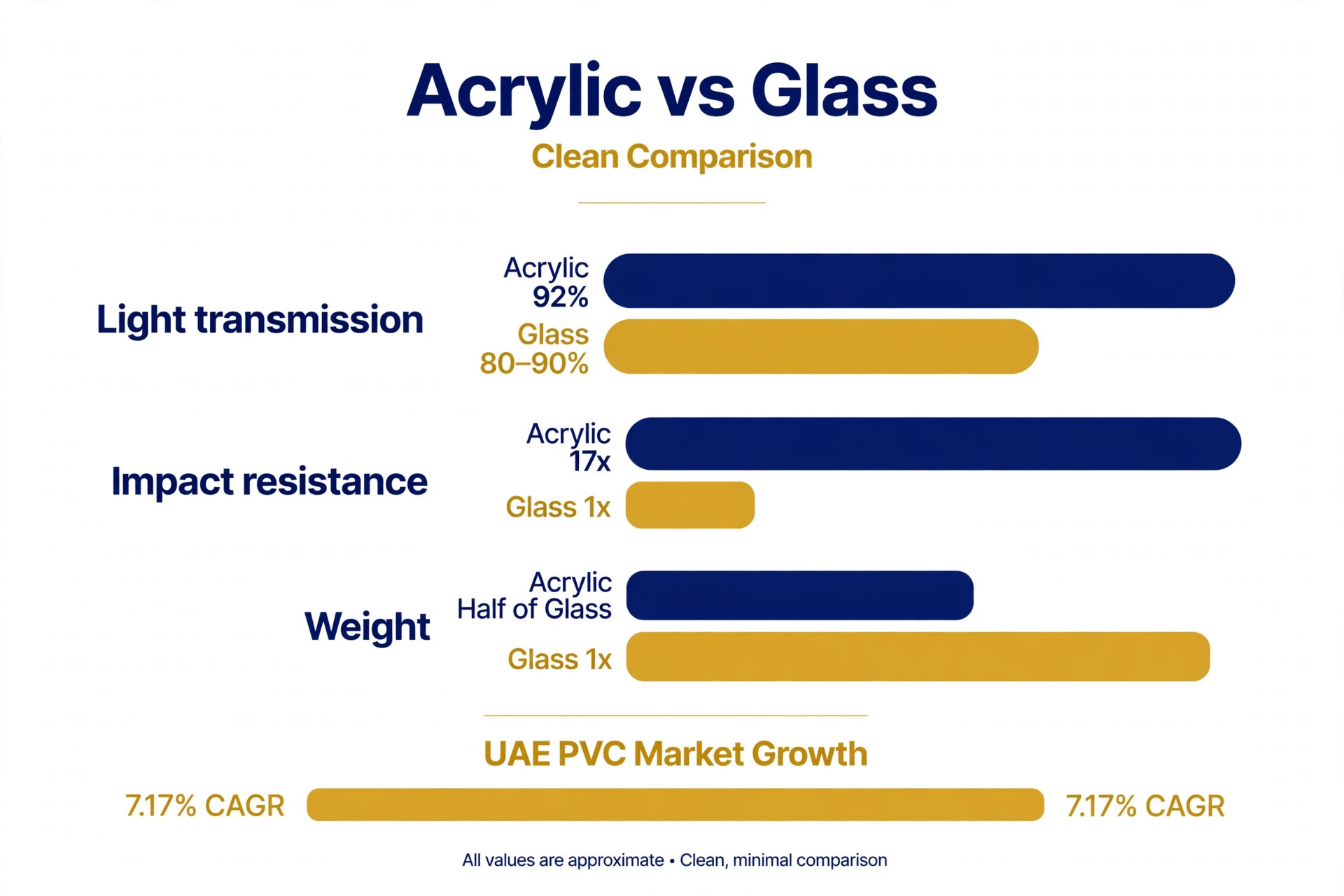
There are also measurable performance reasons designers keep choosing it. Acrylic transmits about 92% of light, compared with 80 to 90% for glass, it is roughly 17 times more impact resistant than glass, and it weighs about half as much (QUANDA Plastic). In practice that means brighter rooms, far less worry about accidental knocks, and simpler fixing on ordinary walls.
Finishes and looks you can choose
The range is wider than most people expect:
High gloss solid colors. The signature look. Deep navy, emerald, charcoal or crisp white with a mirror-like shine. This is the finish that makes feature walls glow.
Mirror acrylic. A lightweight alternative to real mirror, popular inside wardrobes, in salons and behind bar counters. It gives the reflective effect at a fraction of the weight.
Matte and frosted. For anyone who loves the color range but not the shine, matte finishes give a soft, contemporary surface that hides fingerprints better.
Textured and patterned. Fluted, brushed and stone-effect textures add depth and are more forgiving of the fine scratches that glossy sheets can show over time.
Backlit and translucent. Opal and frosted sheets can be lit from behind for a glowing wall effect, a favorite in restaurant and hotel lobbies.
When choosing, think about the room first and the color second. A busy family living room will be kinder to a textured or mid-tone finish than to piano-black gloss, which shows every fingerprint. A formal majlis or reception wall, touched less often, can carry the full mirror shine.
Acrylic cladding vs the alternatives
The honest comparison most buyers want is acrylic against glass and against PVC wall panels.
Against glass, acrylic wins on weight, safety and ease of installation. Glass gives a harder surface that resists scratches better, so for a tabletop or a splash zone that takes daily abrasion, glass still has an edge. For wall cladding, where nothing rubs against the surface all day, acrylic’s advantages usually win.
Against PVC wall panels, the difference is mostly about the look. PVC panels are excellent value and come in plenty of designs, including marble and wood effects, which is why they are so popular in the UAE. Acrylic sits a step above in gloss and depth of color. Many projects use both: PVC panels for large wall areas and acrylic as the accent. Our comparison of WPC vs PVC wall panels goes deeper into how the panel family fits together.
How to choose the right sheets
A few practical checks separate a good result from a disappointing one:
Check the thickness. Thicker sheets (within the standard cladding range) feel more solid and resist flexing on the wall. Your installer can advise what suits your wall type.
Ask for UV-stabilized grade if the wall gets direct sun, for example opposite full-height windows or in a sunroom. This is the single most important specification in the UAE.
Look at the edges. Good fabrication means polished, clean edges. Rough or cloudy edges are a sign of rushed cutting and they catch the eye on every seam.
Plan the seams. Acrylic sheets come in set sizes, so a good installer plans the layout so seams fall in natural breaks or symmetrical lines rather than randomly across the wall.
Match the fixing to the wall. Smooth concrete or plasterboard takes adhesive well. Uneven walls may need battens or a frame first, otherwise the gloss will telegraph every bump underneath.
Looking after it day to day
Maintenance is one of acrylic’s genuine strengths. Day to day, a soft cloth with soap and water is all it needs, and abrasive cleaners or scouring pads should never touch it (FGD Glass). That is worth repeating because the most common damage we hear about comes from someone cleaning a glossy wall the way they would clean tiles.
Dust with a microfiber cloth first so grit does not get dragged across the surface. For fingerprints on high-gloss sheets, a slightly damp microfiber cloth followed by a dry one brings back the shine. Avoid alcohol-heavy glass cleaners on colored acrylic, as they can dull some finishes over time.
The market is moving this way
The growth of synthetic wall materials in the region is not just anecdotal. The UAE market for PVC, the close cousin of acrylic in wall applications, is growing at 7.17% a year from 2025 to 2030 (Bonafide Research), and the wider GCC market for PVC wall panels is projected to grow at 7.2% a year through 2033 (market analysis). Underneath that, the raw material flow is strong too: UAE imports of PVC are projected at around 300 million kilograms by 2026, with demand growing 6.4% a year since 2012 (ReportLinker).
What that means for a homeowner or business owner is simple: this is a mature, well-supplied market. Sheets, colors and skilled installers are all readily available in the UAE, so you are not buying into something exotic that will be hard to maintain or extend later.
Frequently asked questions
Is acrylic cladding good for UAE homes?
Yes, with one condition: choose UV-stabilized sheets for any wall that gets direct sunlight. Indoors, acrylic handles heat, humidity and AC cycles without peeling or warping, which makes it reliable across villas and apartments in the Emirates.
How long does acrylic cladding last on a wall?
Lifespan depends on grade, sun exposure and care, but well-installed UV-stabilized acrylic on an interior wall is a long-term finish. The main threat is surface scratching from harsh cleaning, not the material breaking down, so gentle care matters more than anything else.
Can acrylic cladding go in bathrooms and kitchens?
Yes. It is non-porous, so steam and splashes do not stain it. In kitchens it works well as a backsplash, and in bathrooms it suits feature walls outside the direct shower spray. For fully wet zones, PVC panels are often paired alongside it.
Does acrylic cladding turn yellow in the sun?
Standard acrylic can yellow under prolonged strong UV, which is why UV-stabilized grades exist. For sun-facing walls in the UAE, always specify the UV-stabilized version and the color will stay true.
How do you clean acrylic wall cladding?
With a soft microfiber cloth, mild soap and water. Dust first, wipe gently, and never use abrasive pads or harsh chemical cleaners. That simple routine keeps the gloss intact for years.
Is acrylic cladding better than glass for walls?
For most wall applications, yes. It is about half the weight of glass, far more impact resistant, and easier to install on standard walls. Glass still wins where the surface takes constant abrasion, but walls rarely do.
Thinking about acrylic cladding for your villa, office or shop? See the full range on our PVC and acrylic sheet page, and if you want to know exactly what install day looks like, read our guide to acrylic sheet installation in the UAE. Message us on WhatsApp at +971 55 281 9239 and we will talk through the finishes that suit your space. Our showroom at Capital Mall, Mohamed Bin Zayed City is open daily from 10 AM to 10 PM.
If you are planning a TV wall design in Abu Dhabi or anywhere in the UAE, this gallery is your starting point. We have put together 50 original media wall designs, from warm backlit timber walls to marble showpieces and family-friendly builds, each one explained so you know exactly what you are looking at and which rooms it suits.
A media wall is one of the highest-impact upgrades for a living room or majlis: it hides every cable, frames the screen properly, and turns a black rectangle on a flat wall into the designed centerpiece of the room. Browse the ideas below, save the ones you love, then send us a photo of your wall on WhatsApp and we will tell you honestly what is possible on it. You can also read about our custom media and TV wall service in Abu Dhabi.
Backlit LED TV Wall Designs
Backlit TV walls are the most requested media wall style in Abu Dhabi right now. Hidden LED strips wash warm light across panels or slats, which makes the wall glow softly in the evening and takes the harsh edge off a dark screen. These five designs show how different materials behave under backlighting.
1. Walnut Fluted Wall with Warm Cove Lighting

Full-height dark walnut fluted panels glow from warm LED cove lighting hidden behind them, with the TV floating at the center over a low wooden console. The evening mood makes the wood grain come alive and turns the wall into the room’s light source.
Best for: villa living rooms.
2. Travertine Panel with LED Halo Glow

A large travertine-look stone panel framed by a soft LED halo, flanked by symmetrical floating shelves styled with vases and books. The halo light gives the stone depth after dark and keeps the whole composition balanced.
Best for: apartment living rooms.
3. Oak Slats with Champagne LED Strips
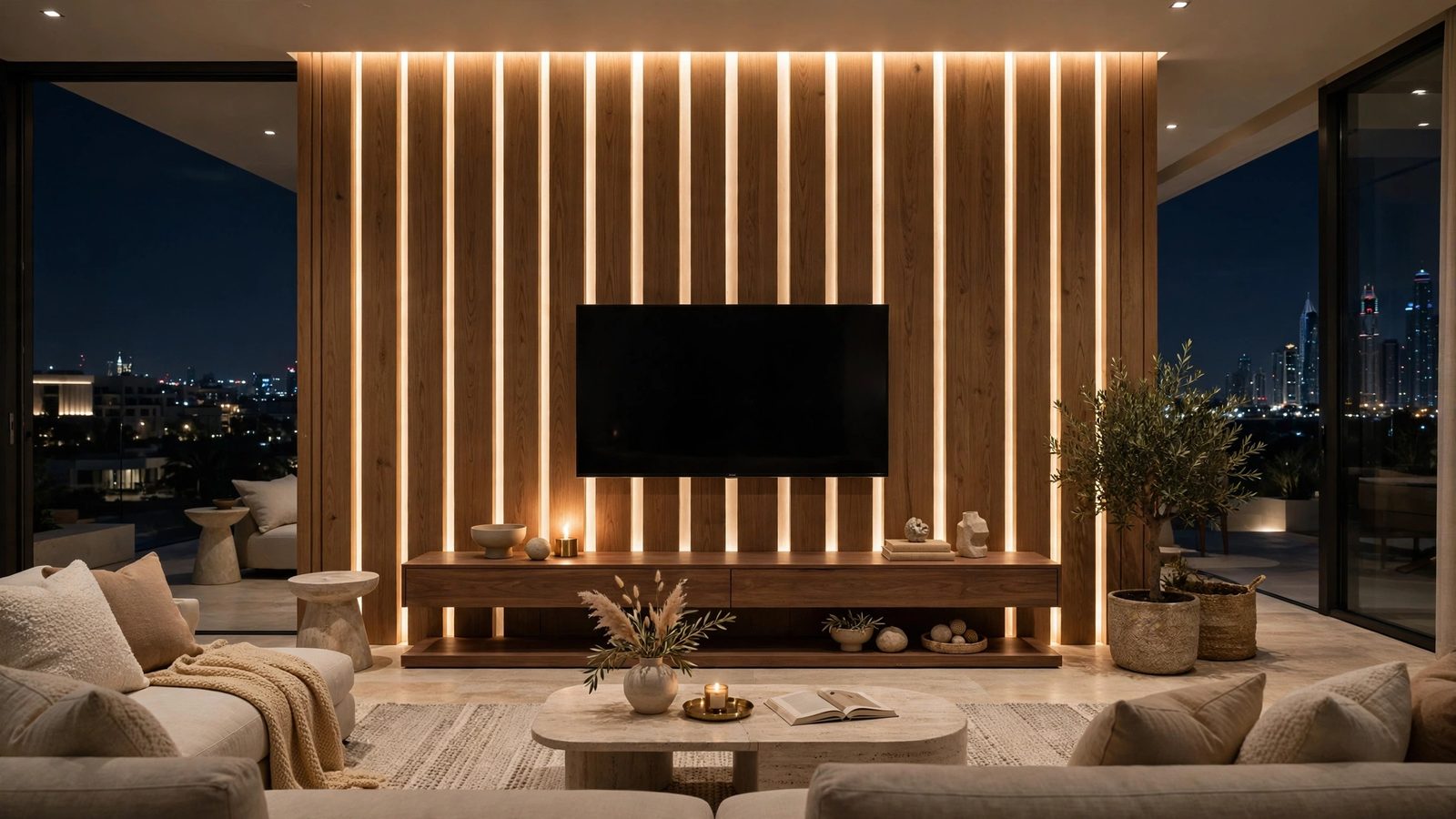
Vertical oak slats with warm LED strips glowing between each one, TV mounted in the middle over a low walnut console. The champagne light softens the wood and adds a quiet luxury feel to evening viewing.
Best for: modern villa lounges.
4. Backlit Onyx-Look Statement Panel
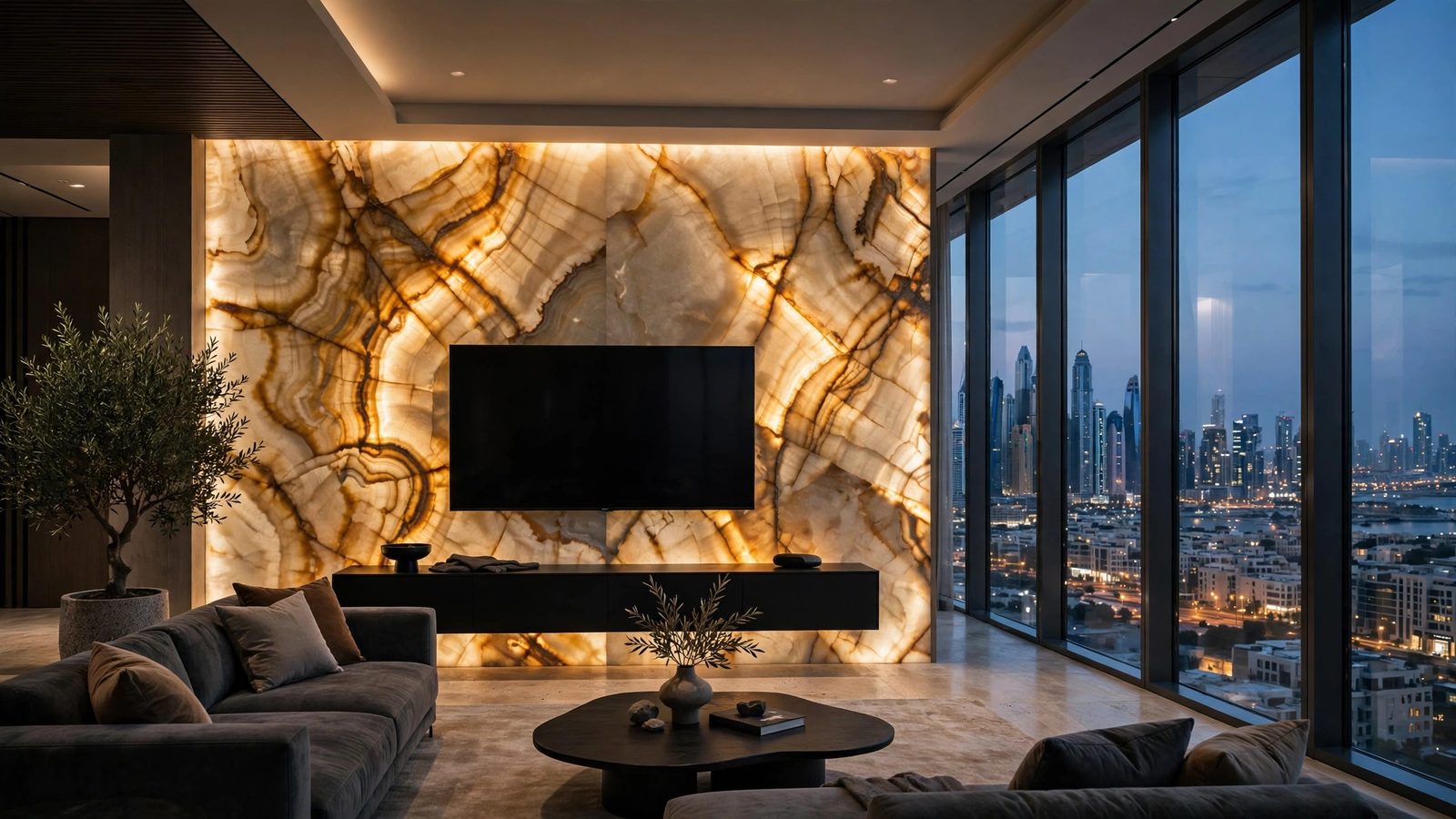
A translucent onyx-look stone panel glows warm amber from within behind the TV, paired with a minimal black floating console. It is the most dramatic option in the set and works best where the wall can be the single hero.
Best for: penthouse living rooms.
5. Recessed Niche with LED Perimeter Glow
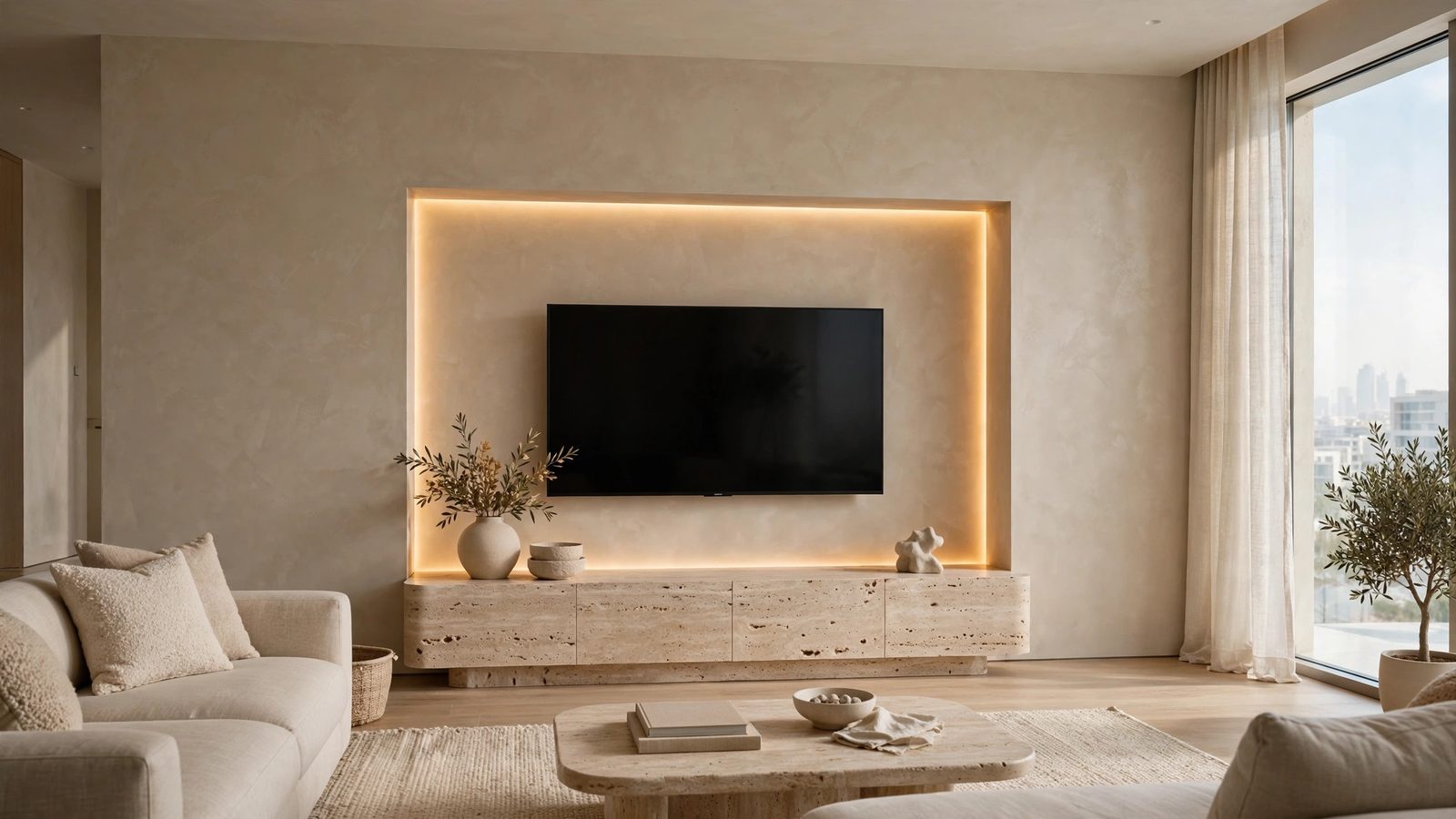
The TV sits inside a large recessed niche in a beige microcement wall, with LED light tracing the niche edge. The floating effect makes even a modest TV look built in and architectural.
Best for: minimalist apartments.
Wooden Slat TV Wall Designs
Wooden slat TV walls bring warmth and texture that flat paint cannot match. Vertical fluted panels in walnut, oak, or teak turn the TV into part of a crafted timber feature, and they pair beautifully with the neutral palettes common in UAE villas and apartments.
6. Full-Height Walnut Slat Wall
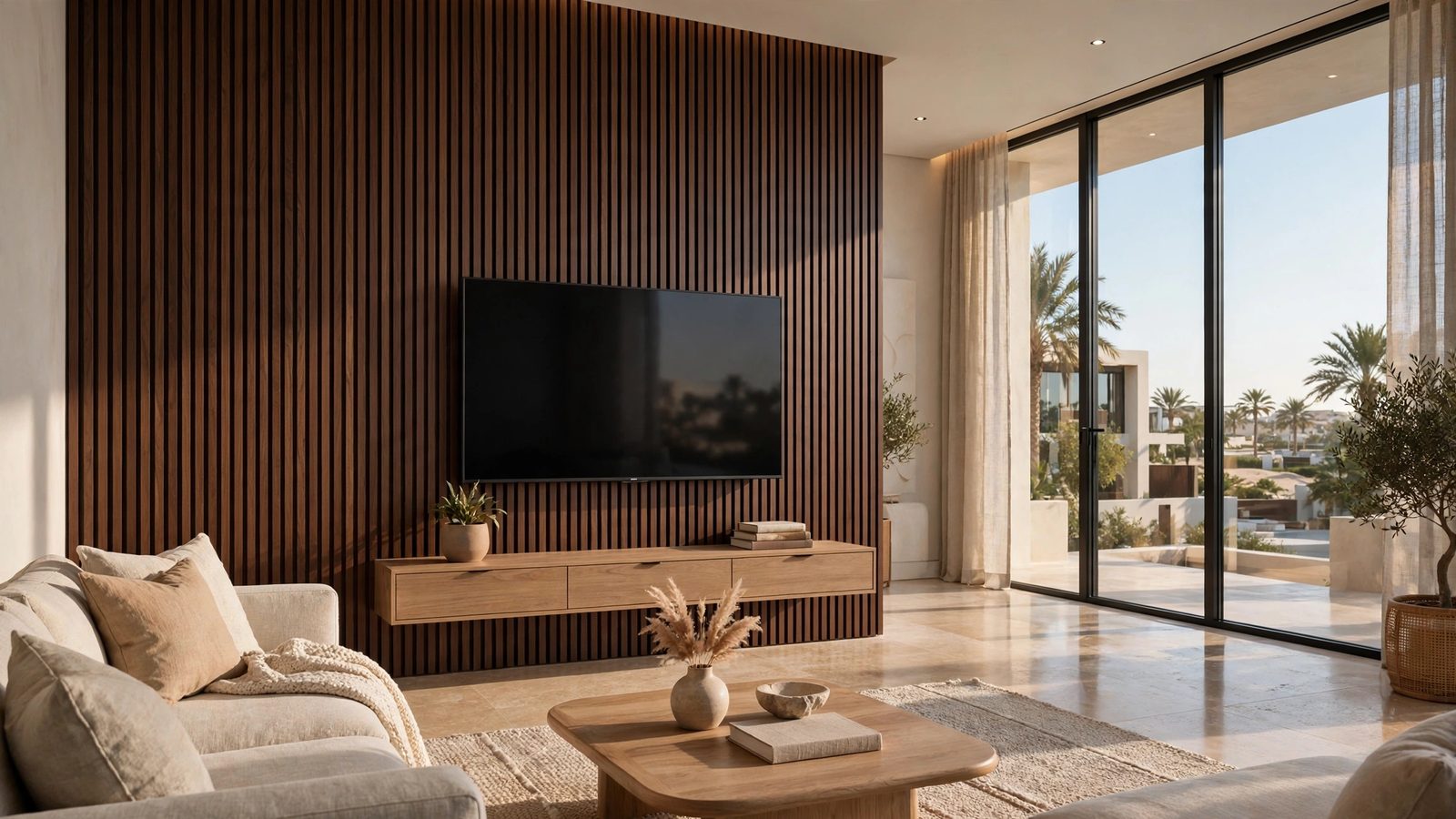
Floor-to-ceiling dark walnut slats give strong vertical rhythm, with the TV centered over a floating light-oak console. Daylight keeps the dark wood from feeling heavy, and the contrast with pale oak feels tailored.
Best for: villa living rooms.
7. Oak Slats with Brass Accent Strips

Light oak slats frame a smooth central panel where the TV mounts, with slim brushed-brass strips adding quiet jewelry. The mix of pale wood and brass keeps the wall light but dressed up.
Best for: elegant apartments.
8. Teak Slats over Hidden Storage

Teak slats run across the upper wall while handleless cream cabinets below hide everything, TV mounted on the slatted section. A smart two-in-one for rooms that need storage without visual clutter.
Best for: family apartments.
9. Dark Slats with Lit Display Niches

Dark stained slats with two recessed backlit niches for ceramics and books flanking the TV. The niches break the dark rhythm and give the wall a gallery feel after dark.
Best for: moody villa lounges.
10. Light Ash Slats with Open Niches

Pale ash slats with three open niches styled with plants and art objects around the TV. Bright, airy and Scandinavian in spirit, it keeps a small room feeling open.
Best for: bright apartments.
Marble and Stone TV Wall Designs
Stone-look TV walls give instant luxury. Real marble is heavy and costly, so most UAE media walls use PU stone panels or large-format marble-look sheets that deliver the same veined drama at a fraction of the weight. These five designs range from classic Calacatta to bold Emperador.
11. Calacatta Marble-Look Panel with Gold Trim

A dramatic Calacatta marble-look porcelain panel with grey veining, edged in brushed-gold trim around the TV zone. White marble console with gold legs completes the high-end hotel feel.
Best for: luxury villa living rooms.
12. Travertine Full-Wall Cladding
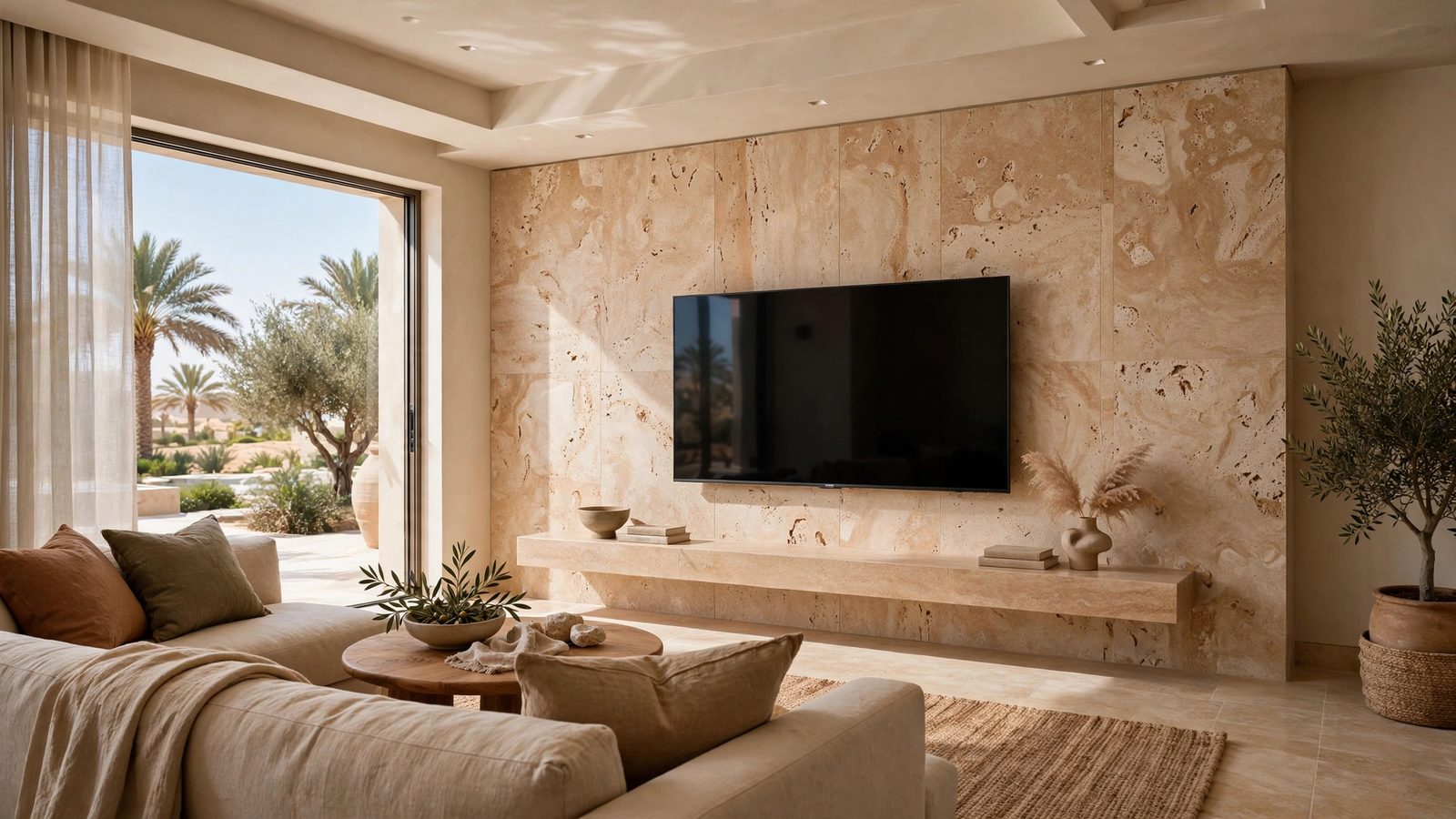
Warm beige travertine-look stone runs floor to ceiling behind the TV, with a floating travertine console below. Earthy and Mediterranean, it suits homes with natural textures like jute and linen.
Best for: warm modern villas.
13. Emperador Marble-Look with Brass Grid

Dark Emperador marble-look panels with rich brown veining, crossed by thin brass inlay lines in a geometric grid. Bold and masculine, it anchors a large living room.
Best for: statement villa lounges.
14. Stacked PU Stone Feature Wall
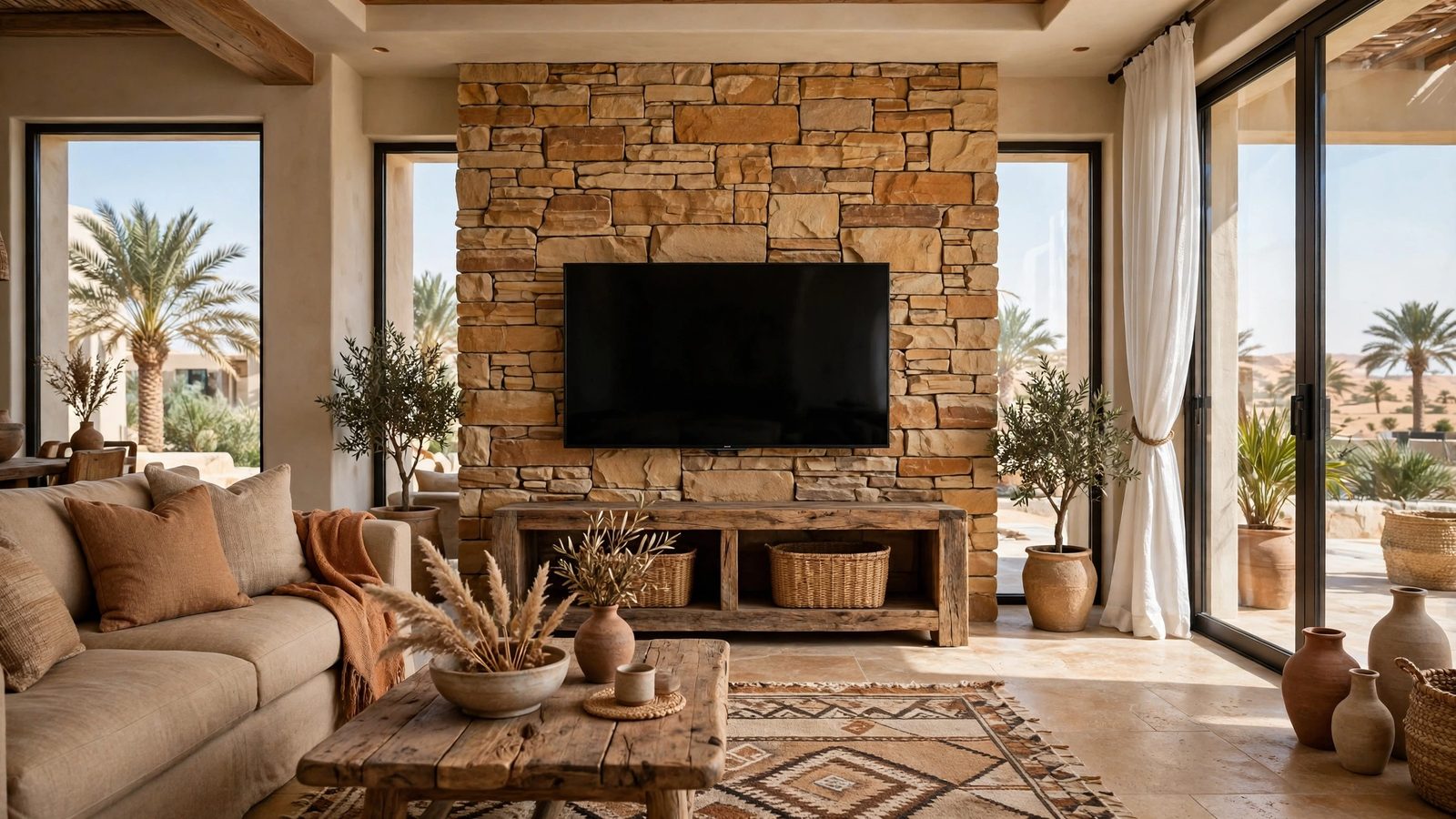
PU stone cladding with a stacked natural stone texture in warm sandstone tones brings rustic character behind the TV. A reclaimed wood console and woven baskets keep it grounded and casual.
Best for: rustic-modern villas.
15. White Marble-Look with Brass Inlay Strips

Soft white marble-look panels with slim vertical brass inlays, TV centered over a cream lacquer console with brass legs. Refined and timeless without shouting.
Best for: elegant apartments.
Minimalist TV Wall Designs
Not every TV wall needs to shout. Microcement, limewash, and clay plasters create a calm, seamless backdrop that lets the screen sit quietly in the room. This Japandi-inspired look suits apartments and owners who want texture without pattern.
16. Warm Beige Microcement Minimal Wall

A seamless warm-beige microcement wall with the TV floating at center, one oak shelf with a single vase, and a low oak console. Pure Japandi calm for people who want less, not more.
Best for: minimalist apartments.
17. Limewash Arch Niche TV Wall

Soft-white limewash plaster with a large gentle arch niche holding the TV, light oak bench below and a paper lantern pendant alongside. The arch softens the rectangle of the screen beautifully.
Best for: serene living rooms.
18. Greige Plaster with Floating Oak Cabinet
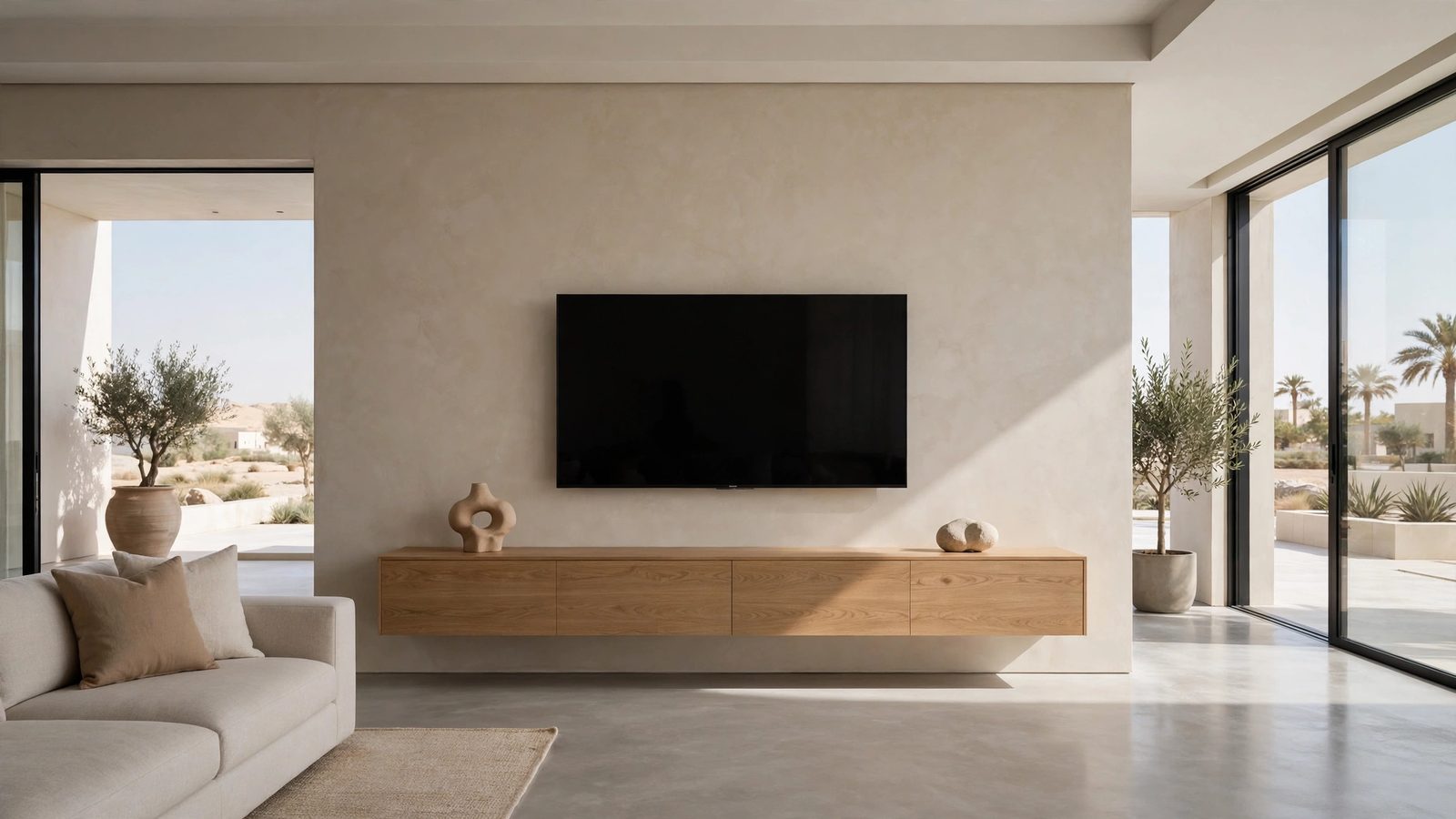
Warm greige polished plaster with a long floating oak cabinet and two small sculptural objects, nothing else. Architectural and quiet, it lets the room’s proportions do the talking.
Best for: design-led villas.
19. Terracotta Clay Plaster Accent Wall

Textured clay plaster in soft terracotta wraps the TV wall, with a walnut console and handmade ceramics below. Artisanal and warm, it suits homes with natural materials.
Best for: character apartments.
20. Grey Plaster with Shadow-Gap Recess

Soft grey polished plaster with the TV set into a shallow recess edged by a crisp shadow gap, over a dark steel and oak console. Gallery-like restraint for concrete-floor lofts.
Best for: modern lofts.
Luxury Gold Accent TV Walls
For a more glamorous living room, brass and gold accents lift a TV wall from simple to striking. Champagne metal inlays, antique mirror, and gold-leaf textures catch the light and suit the luxury interiors seen across Emirates Hills-style villas.
21. Champagne Brass Grid on Charcoal Panels

Dark charcoal lacquered panels crossed by a champagne-brass inlay grid, TV centered, black console with brass trim below. Evening picture lights make the brass glow.
Best for: luxury penthouses.
22. Gold Leaf-Look Textured Wall

Hand-textured gold-leaf-look plaster shimmers softly behind the TV, paired with an ivory console on brass legs and an emerald velvet chair nearby. Artistic and glamorous without being cold.
Best for: statement living rooms.
23. Brass Slats with Marble-Look Panels
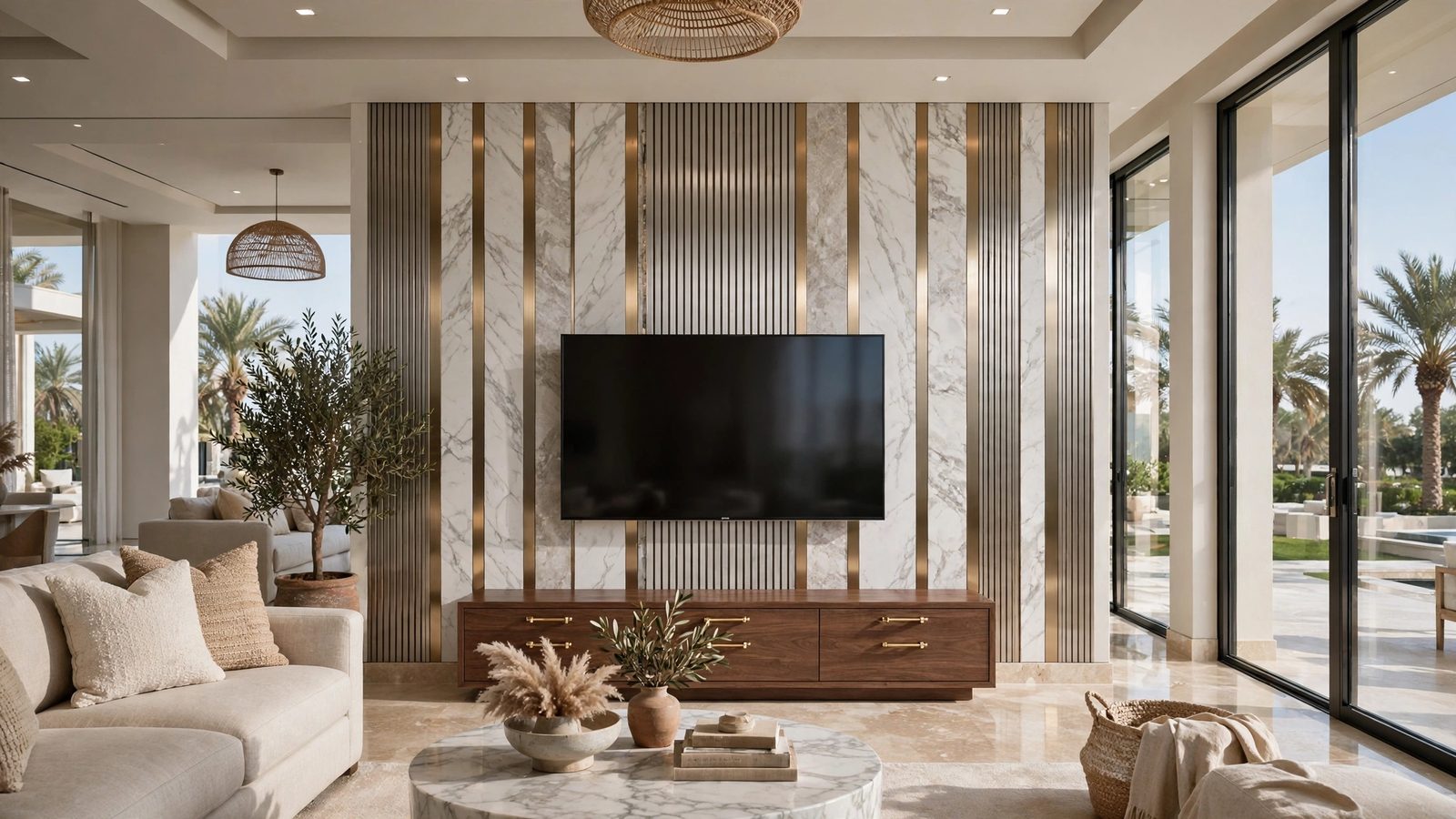
Vertical brushed-brass slats alternate with white marble-look panels around the TV, walnut console with brass handles below. Bright, rhythmic and elegant.
Best for: upscale apartments.
24. Antique Mirror Panels with Brass Trim

Antique mirror panels with slim brass trim make the TV appear to float, with a mirrored brass-frame console below. Mirrors bounce light and double the sense of space.
Best for: glamorous apartments.
25. Emerald Lacquer with Brass Picture Molding
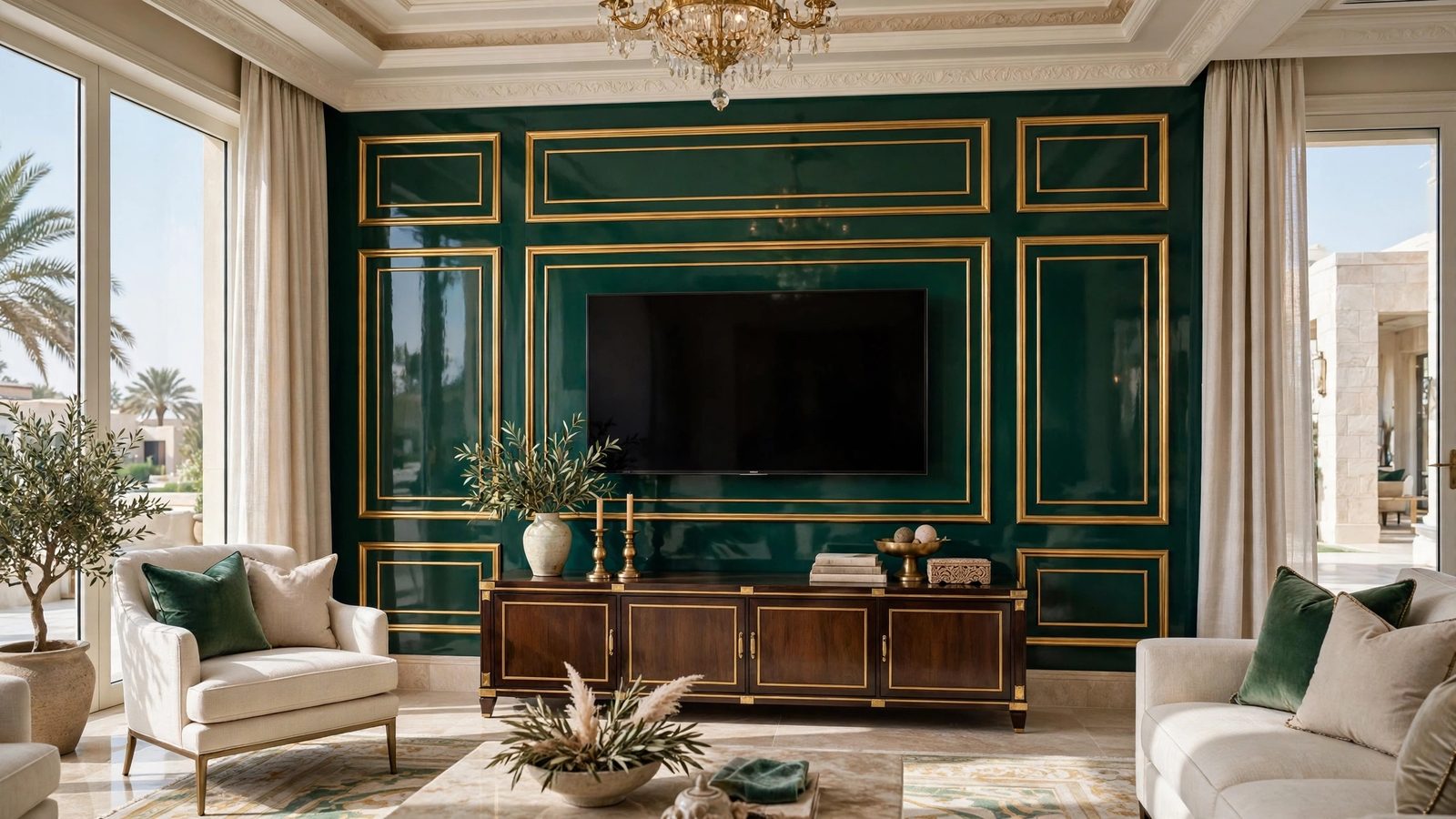
Deep emerald-green lacquered wall with brass picture-frame molding panels, TV mounted like framed art, dark wood console with brass details below. Classic luxe with a jewel-tone twist.
Best for: formal villa lounges.
TV Walls with Floating Shelves and Storage
A media wall earns its keep when it also solves storage. Floating shelves, handleless cabinets, and lit display niches frame the TV while hiding consoles, routers, and everyday clutter. These five designs balance display and discipline.
26. Symmetrical Floating Oak Shelves

Perfectly symmetrical floating oak shelves flank the TV, styled with books, plants and ceramics over a low oak console. Balanced and homely, it suits collectors.
Best for: cozy apartments.
27. Handleless Storage Wall in Light Oak

A floor-to-ceiling run of handleless light-oak cabinets below the TV, with a hidden LED strip under the wall-hung section. Everything disappears behind clean fronts.
Best for: clutter-free family homes.
28. Asymmetric Walnut Shelves in Black Metal

Rich walnut panels with asymmetric black-metal-and-walnut floating shelves at varied heights around the TV, styled with art books and sculpture. Dynamic and designer-led.
Best for: modern villa lounges.
29. Walnut Wall with Lit Display Niches

A full walnut wall unit with illuminated display niches on both sides of the TV showcasing ceramics and art glass. Evening lighting turns it into a private gallery.
Best for: art-loving homeowners.
30. Floor-to-Ceiling Storage with Oak-Framed TV Opening
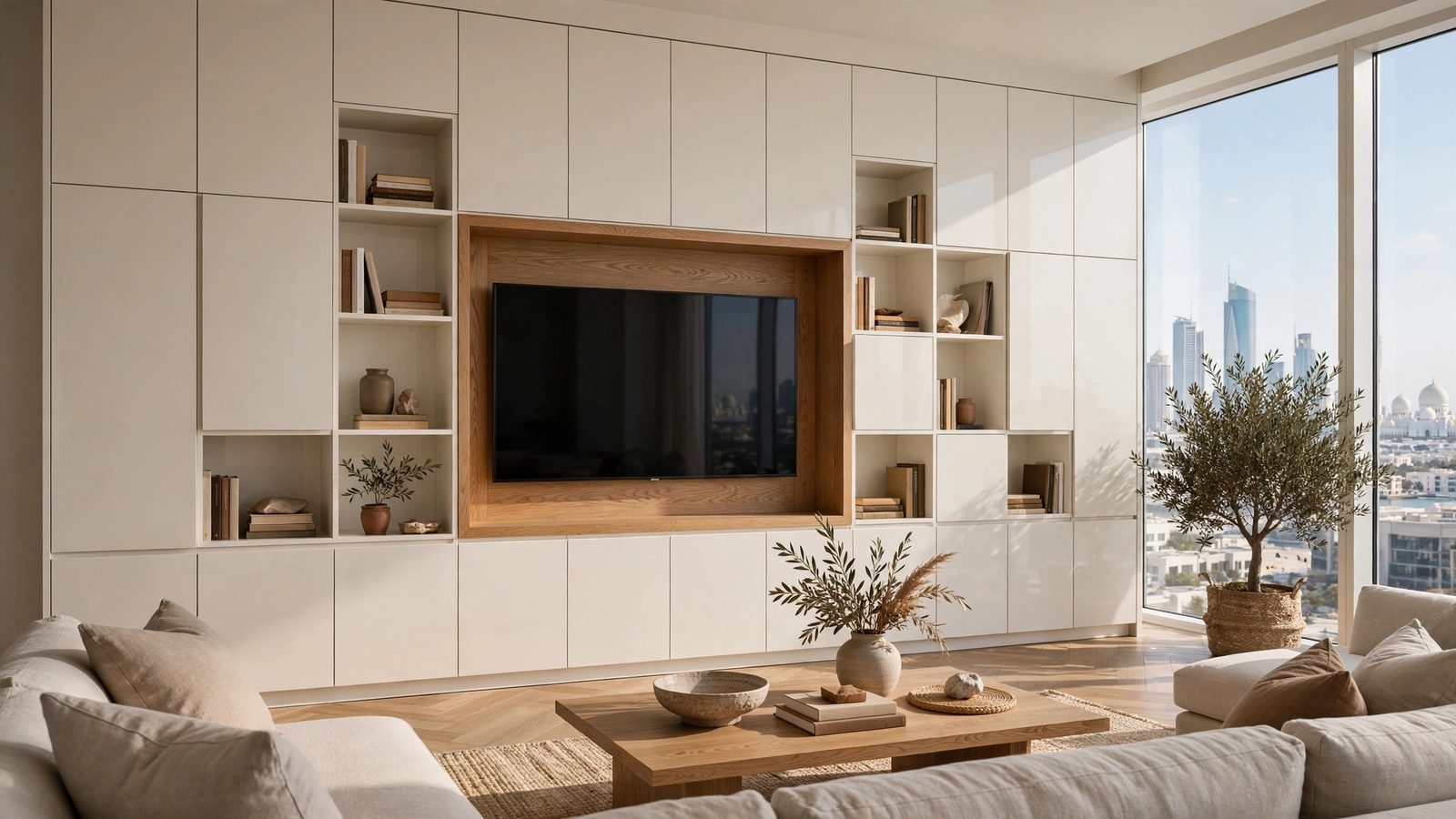
Warm-white lacquer cabinets run floor to ceiling with the TV inset in a central oak-framed opening, plus styled open cubbies. Maximum storage that still looks architectural.
Best for: apartments needing storage.
TV Wall with Fireplace Designs
Pairing a linear electric fireplace with the TV creates the ultimate cosy focal wall. The fire sits below the screen in one continuous design, and modern electric units are safe, clean, and easy to run in UAE homes.
31. Marble-Look Wall with Linear Fireplace
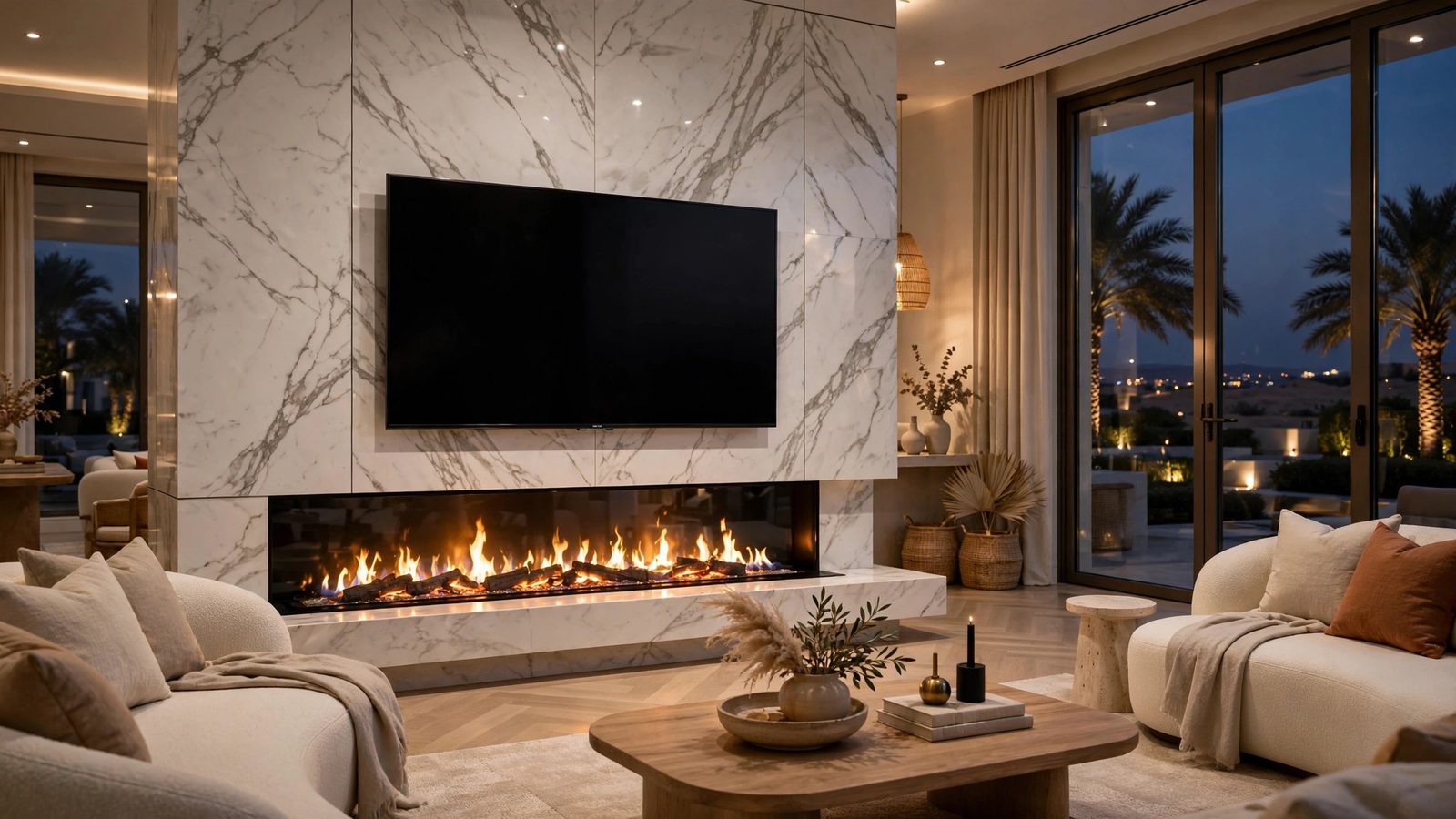
White marble-look panels with a long linear electric fireplace glowing below the TV, over a marble hearth bench. Fire and screen share one calm axis.
Best for: luxury villa living rooms.
32. Teak Slats with Recessed Fireplace
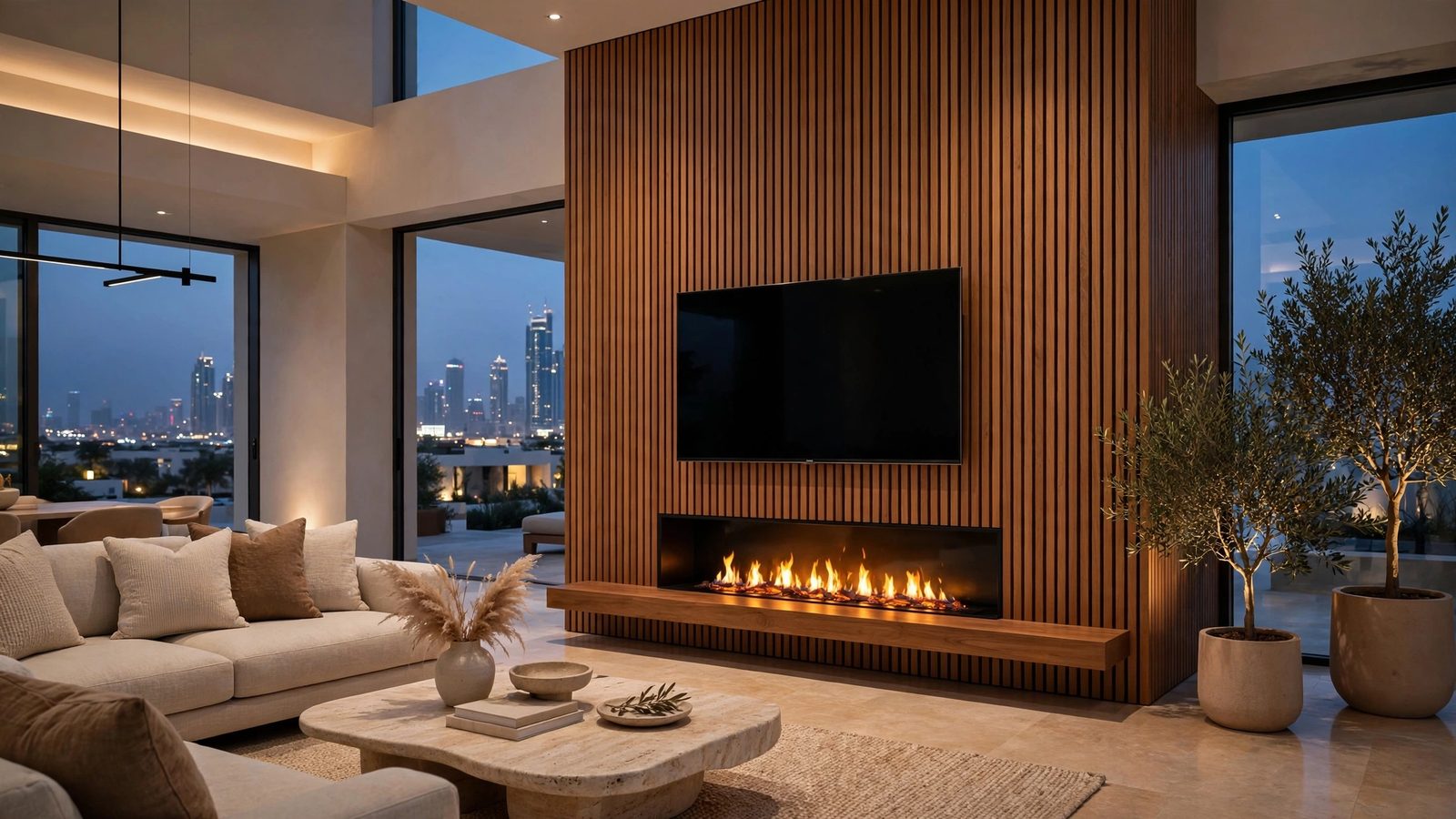
Vertical teak slats with a sleek linear fireplace recessed at the base and the TV above, floating teak bench below. Natural warmth meets a modern fire feature.
Best for: contemporary villas.
33. Natural Stone Cladding with Fireplace and Mantel

Full-height natural stone cladding with a wide linear fireplace below the TV and an oak mantel shelf with candles between. Rustic fireside comfort for cooler months.
Best for: cozy villa family rooms.
34. White Plaster Minimal Fireplace Wall
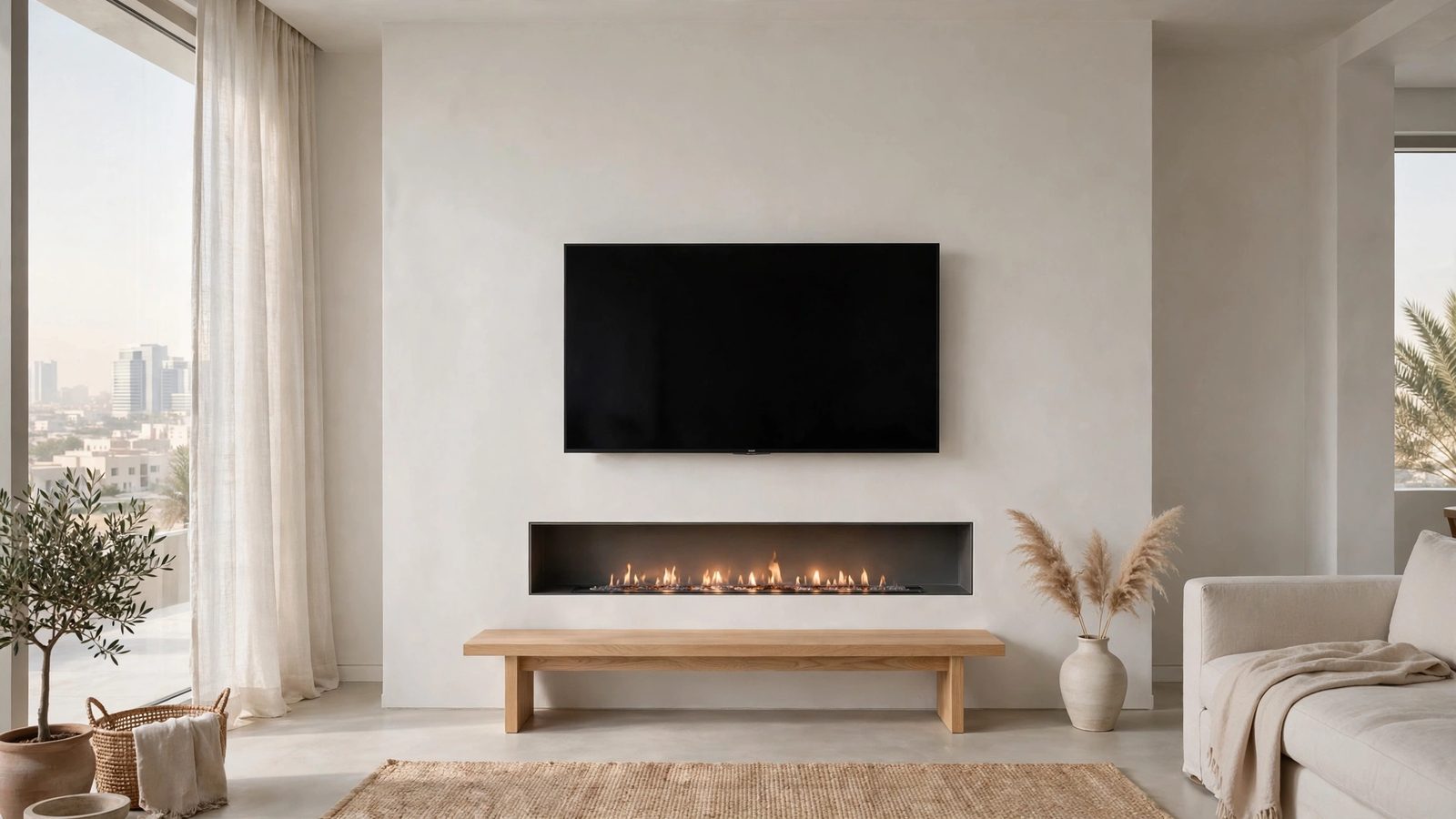
Smooth white plaster with a slim linear fireplace recessed low and the TV above, plus a single oak bench. Scandinavian purity, nothing extra.
Best for: minimalist apartments.
35. Bronze Mirror Fireplace Feature Wall
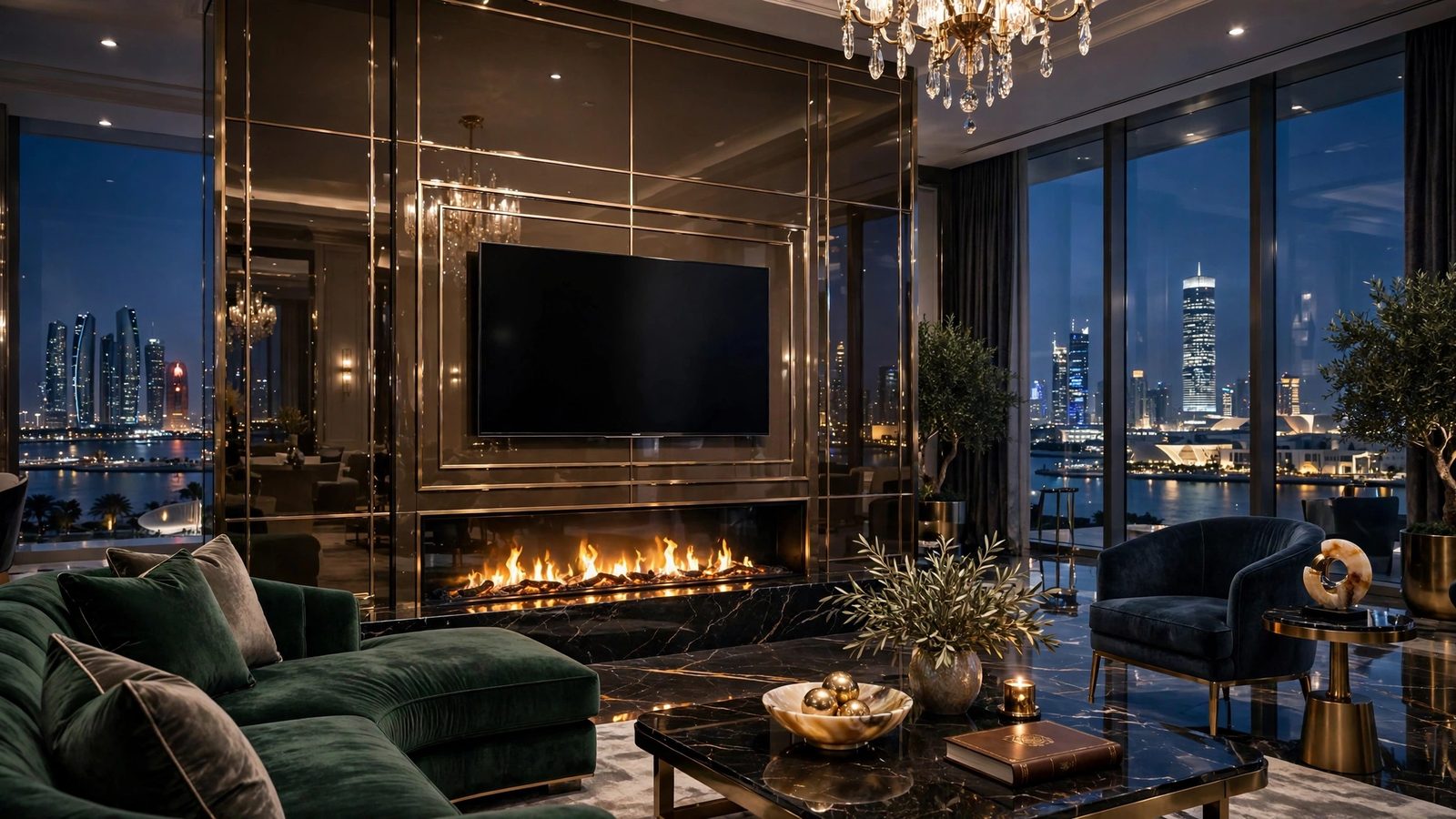
Dark bronze-tinted mirror panels with brass trim frame both the fireplace and the TV above, over a black marble hearth. High-glamour drama for evening entertaining.
Best for: luxury penthouses.
Small Apartment TV Wall Ideas
Compact living rooms need TV walls that do not visually shrink the space. Light colours, shallow profiles, mirrors, and acoustic panels keep small Abu Dhabi apartments feeling open while still giving the TV a designed home.
36. Compact Oak Slat Wall for Studios

Light oak slats on one compact wall section with a small TV and slim wall-hung oak console with two drawers. Everything a studio needs, nothing it does not.
Best for: studio apartments.
37. Crisp White Small-Space TV Wall

Clean white wall, small TV, slim white floating console with hidden storage below, one framed print alongside. Crisp and space-saving for first homes.
Best for: small apartments.
38. Grey Acoustic Panels in a Studio

Light grey acoustic wall panels behind the TV on a slim light-wood media unit with open book shelves, compact loveseat nearby. Softens sound in a studio while looking tailored.
Best for: studio apartments.
39. Beige Microcement Compact Wall

Beige microcement feature wall in a small space with the TV centered, one floating oak shelf and a narrow oak console. Understated small-space luxury.
Best for: compact apartments.
40. Mirror Panels to Double the Space

Tall mirror panels on both sides of the TV visually double a small room, with a low white lacquer console below. The oldest space trick, done elegantly.
Best for: small bright apartments.
Villa Majlis TV Wall Designs
Grand villa spaces call for grand walls. Double-height screens, mashrabiya latticework, book-matched marble, and arched niches bring Arabic architectural character to large-format media walls.
41. Double-Height Arabic Geometric Screen Wall

Soaring double-height wall of dark wood Arabic geometric screen panels with brass inlay, large TV centered over a marble console. Majestic scale with traditional craft.
Best for: grand villa majlis.
42. Mashrabiya Lattice Majlis Wall

Mashrabiya-inspired carved wooden lattice panels flank a central stone panel holding the TV, over an inlaid console, with lanterns and traditional seating. Arabic hospitality at its most luxurious.
Best for: villa majlis rooms.
43. Book-Matched Marble Grand Wall

Full-height book-matched marble-look stone wall with an 85-inch TV centered over a long travertine console. One grand gesture for a large lounge.
Best for: large villa lounges.
44. Arabic Arch Niches with Soft Lighting
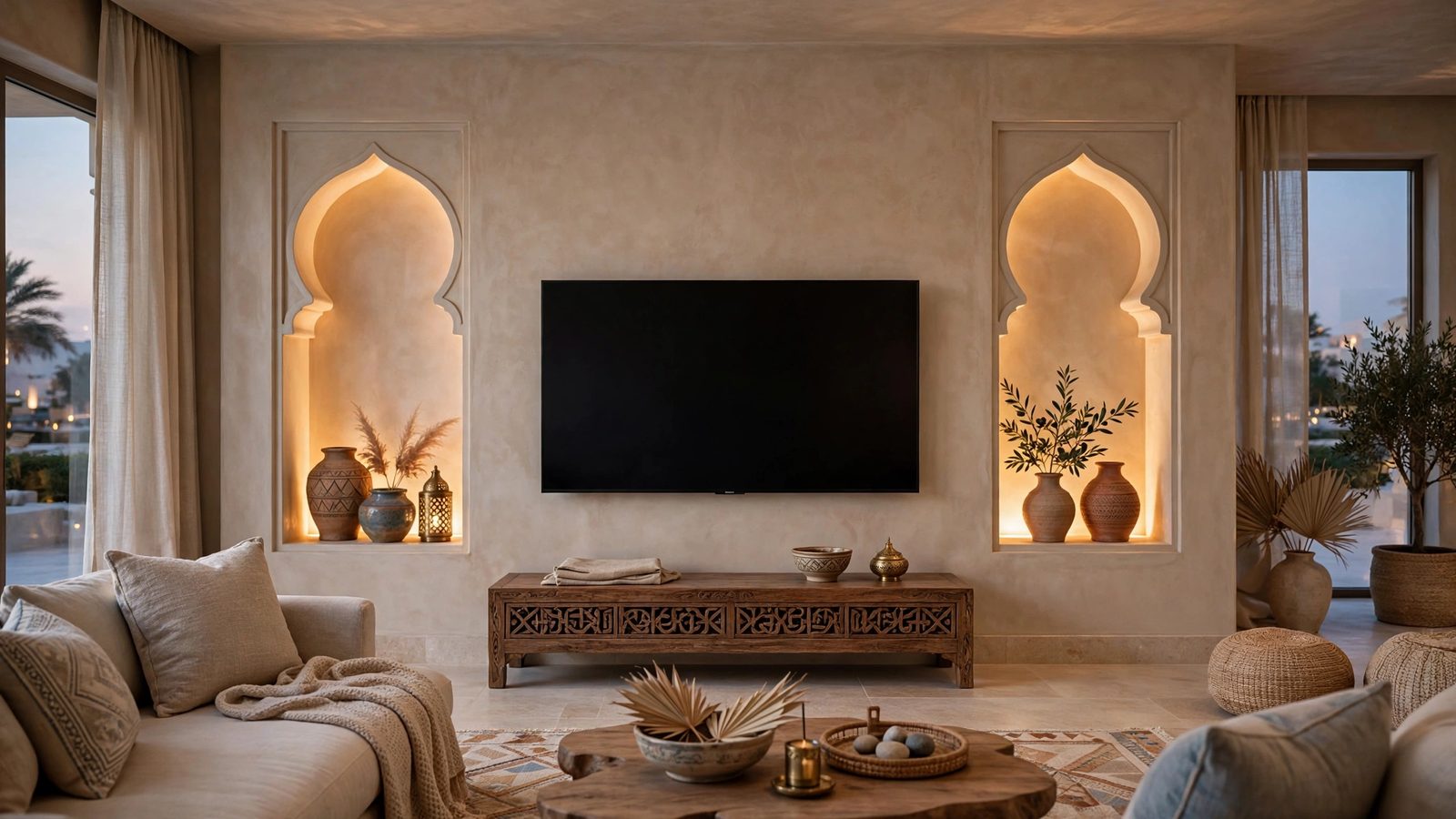
Warm plaster wall with two tall Arabic arch niches glowing softly on either side of the TV, over a carved-wood console. Graceful cultural elegance.
Best for: villa living rooms.
45. Mother-of-Pearl Inlay Statement Wall

Tall dark wood panels with mother-of-pearl Islamic geometric inlay around the TV, black marble console below, chandelier above. Regal craftsmanship for a grand salon.
Best for: luxury villa salons.
Family-Friendly TV Wall Ideas
Homes with kids need TV walls that survive real life: durable finishes, rounded edges, hidden toy storage, and wipeable surfaces. These five designs look sharp while standing up to daily family use.
46. Durable Oak Family Wall with Toy Storage

Light-oak laminate panels with rounded safe edges, TV at family viewing height, and a long bench with hidden toy compartments below. Built for real life with kids.
Best for: family villas.
47. Soft Sage Family Wall with Rounded Edges

Soft sage-green washable paint with rounded corner detailing, securely mounted TV, and a rounded-edge oak unit with closed storage and a toy basket. Gentle and safe for little ones.
Best for: young families.
48. Wainscoted Family Wall with Toy Baskets
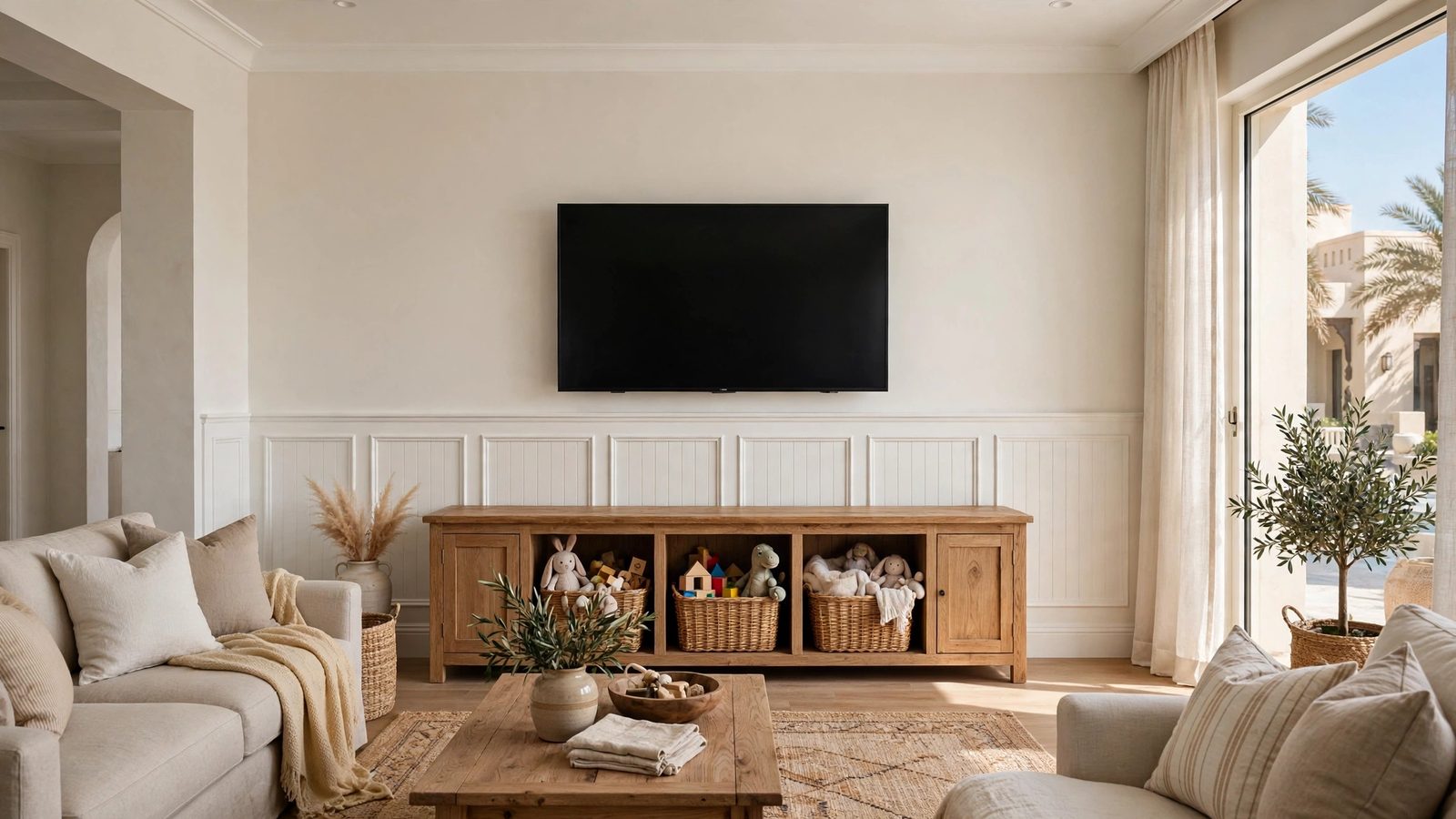
Classic white wainscoting below washable warm-white paint, TV centered over a farmhouse oak console with toy baskets. Timeless and easy to keep clean.
Best for: family living rooms.
49. Oak Slat Wall with Storage Bench Seating

Warm oak slat wall with the TV above a deep cushioned storage bench that doubles as toy-chest seating, baskets below, books alongside. Sit, store, and watch in one wall.
Best for: family apartments.
50. Walnut and Fabric Acoustic Checkerboard Wall
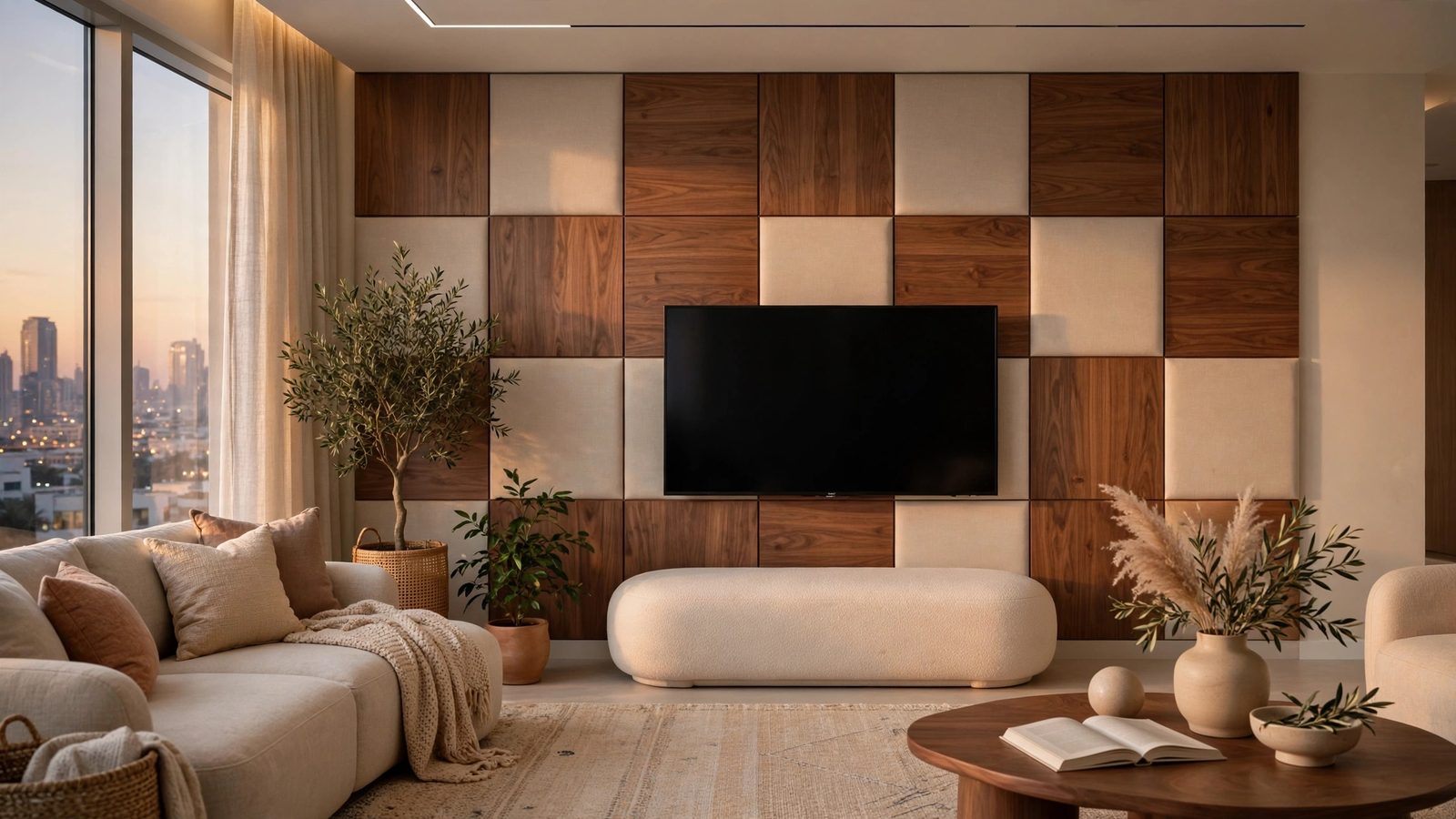
Walnut wood and soft beige fabric acoustic panels in a checkerboard rhythm behind the TV, with a rounded boucle ottoman console. Softens sound for family movie nights.
Best for: family lounges.
TV wall questions, answered
What is the best material for a TV wall in the UAE?
There is no single best material. Wooden slats and PU stone panels are the most popular because they handle the climate well and install cleanly. Backlit designs need materials that diffuse light nicely, while family homes do better with durable, wipeable finishes. The right choice depends on your room, light, and how you use the space.
Can a TV wall be installed in a rented apartment in Abu Dhabi?
Yes, with the right design. Panel-based TV walls can often be removed later with only minor wall repairs, which makes them renter-friendly. Fully built gypsum structures are more permanent and may need landlord approval. Tell your installer you rent before the design is drawn.
How long does it take to install a media wall?
A straightforward panel-and-slat media wall is usually a multi-day job once materials are on site. Designs with niches, stone cladding, fireplaces, or custom lighting take longer. Timelines are confirmed after a site visit, since every wall is different.
Do TV walls really hide all the cables?
Yes, when the cable plan is done before installation. Power, HDMI, and device cables run inside the wall build through conduits, so nothing shows. Adding cables after the wall is finished is possible but messier, which is why planning comes first.
Is backlighting worth adding to a TV wall?
For most living rooms, yes. Warm LED backlighting makes the wall look finished, adds gentle ambient light for evenings, and reduces eye strain from the contrast between a bright screen and a dark room. Decide before installation, since strips and drivers need hidden space and wiring.
What TV size works with a media wall?
Almost any size. The wall is designed around your screen, so tell your installer the biggest size you might ever hang and the backing and bracket get built for that. A future upgrade then means re-hanging the TV, not rebuilding the wall.
Ready to build yours?
Found a design you love? Message us on WhatsApp at +971 55 281 9239 with a photo of your wall and the design number, and we will give you a free site visit and quote. We design, supply, and install custom media walls across Abu Dhabi and the UAE, open daily 10 AM to 10 PM.
Every apartment living room in Abu Dhabi has the same problem. A big TV on a bare wall with a tangle of cables underneath. A media wall fixes all of it in one job, and it costs less than most people expect. Here is how the good ones are built, and where the money goes.
What is a media wall, exactly?
A media wall is a finished feature wall built around your television. Panels or cladding cover the wall, the cables disappear inside it, LED backlighting washes the edges, and floating shelves or a low console hold the boxes. The TV mounts flush on a bracket with access behind it.
Done well, it turns the wall into the room’s centerpiece. Done badly, it is expensive cladding around the same cable tangle.
One design rule worth knowing: plan the wall around your viewing distance. A 65-inch TV wants roughly 2 to 2.5 metres of sofa distance, and the panel layout should frame the screen at seated eye level, not higher. Walls designed around the TV look intentional. Walls designed around the panels end up with the TV as an afterthought.
Five media wall ideas that work in Abu Dhabi living rooms
Five looks we see requested in our Capital Mall showroom, from simplest to most dramatic.
- Full-height fluted WPC panels in walnut or oak tones with the TV centered and a warm LED strip along one edge. The most requested look we see.
- PU stone cladding with grazing backlight. It reads as real stone, weighs almost nothing, and looks far more expensive at night than the material cost suggests.
- Backlit onyx-look PVC panels flanking the TV. Dramatic, and the light does most of the decorating.
- Fluted panels on the lower two-thirds with a floating console beneath. Every cable hides inside, and the soundbar finally has a home.
- A half-wall unit with hidden storage for the router and consoles. Best for renters who want the look without touching the whole wall.
- Measure and design. Wall dimensions, TV size, sofa position. The design follows the viewing distance, not the other way round.
- Frame it out. Battens or a stud frame go up dead level. Everything else hangs off this.
- Run the wiring. Conduit for HDMI and power, LED channels where the light will sit. All of it happens before a single panel goes on.
- Fix the panels. Fluted WPC, PU stone or PVC, cut neatly around sockets and the TV bracket zone.
- Mount, light and dress. TV on its bracket, LED drivers connected, shelves and console in place. Then stand back and look.
What does a media wall cost in Abu Dhabi?
Honest answer first. Installed media wall prices in Abu Dhabi vary too much for a single number, because wall size, material, lighting and carpentry change everything. Anyone quoting a flat price without seeing your wall is guessing.
What we can anchor is materials. A 2026 wholesale reference puts decorative fluted and 3D WPC panels at roughly $12 to $30 per square metre, with standard indoor panels at $8 to $15 (LinkedIn, Erik Qiu). Factory prices exclude installation, and UAE retail sits above wholesale. A typical 3 by 2.7 metre wall is about 8 square metres, so you can do rough maths on panels alone. Wholesale listings on accio.com show co-extrusion WPC wall panels at $9.40 to $12.50 per square metre, which lands in the same zone and confirms the LinkedIn band is realistic for materials.
Our read on where the money actually goes: the panels are often the smaller part. Carpentry for framing and floating shelves, an electrician for hidden wiring and LED drivers, and finishing detail drive the final number. A simple panel job costs a fraction of a full build with backlighting, floating shelves, stone cladding and an electrician’s day.
Lighting is the line item people forget to budget. Aluminum channels, a quality LED driver and an electrician’s time add up fast, and they are also what separates a premium look from a DIY one. Cheap LED strips bought online tend to shift color within a year and die in sections. Specify the lighting with the same care as the panels.
For a current per-project quote, message us on WhatsApp with your wall measurements and a photo. We will give you a straight number.
Fluted panels, PU stone or backlit PVC: which material?
Three materials cover most of the media walls we discuss. Each has a clear best use.
| Fluted WPC panels | PU stone cladding | Backlit PVC panels | |
|---|---|---|---|
| The look | Warm wood slats, modern | Real stone texture | Glossy marble or onyx, dramatic |
| Material cost band | $12-30/sqm wholesale ref (LinkedIn) | Mid-range per panel | Budget-friendly per panel |
| Weight on the wall | Light | Very light | Light |
| Handles humidity | Yes, WPC resists moisture | Yes | Yes, PVC is waterproof |
| Install method | Battens and screws | Adhesive on a level wall | Adhesive or frame, plus LED wiring |
| The row that decides: renter-friendly | Yes, battens come off clean | No, it is glued for good | Yes, if framed rather than glued |
Renters should read that last row twice. Owners can glue whatever they like. For material details, see our wall panels and PU stone cladding pages.
Mixing materials is where the best walls come from. Fluted panels with a stone-clad center section, or PVC marble panels broken up by wood-look slats, give the wall depth that a single material cannot. The rule is simple: one dominant material, one accent. Two accents and the wall starts arguing with itself.
What goes wrong with cheap media wall jobs?
Four failures come up again and again.
- Visible cables, because nobody planned a conduit before the panels went up.
- LED strips stuck straight to the panel with no channel. They die early and glow in dots instead of a clean line.
- No access behind the TV, so the first bracket adjustment means cutting a hole.
- Floating shelves fixed to the panel instead of the wall, which sag within months.
The fix for all four is planning, not money. A conduit for cables, an aluminum channel for the LED, a service gap behind the TV, and shelves anchored to structure. Ask whoever builds yours how they handle each one. A confused look is your answer.
Where in Abu Dhabi media walls make the biggest difference
Al Reem Island apartments are open-plan boxes with one big living wall. A media wall gives the room an anchor and swallows the router, the console and the cable spaghetti in one move.
Yas Island villas have the opposite situation. Big living rooms with high walls that dwarf a 55-inch TV. A full-height fluted wall with backlighting scales the room back to human size.
Al Khalidiyah has older villas with good bones and tired living rooms. A media wall refreshes the whole space without touching the floors or the kitchen.
Can you mount any size TV on a media wall?
Yes, if the bracket zone is reinforced during framing. Tell us the TV size upfront and the support gets built for it. Retrofitting support behind finished panels is the expensive way round.
What happens to all the cables?
They run inside a conduit behind the panels to a hidden socket or cabinet. No visible wires, and you can pull new cables through later when you upgrade the box.
Will panels damage my wall? I rent.
Panels on battens come off with minor filling and a paint touch-up. Glued stone cladding does not. Renters should take the batten route every time.
How long does it take?
A straightforward panel wall takes two to three days. Full builds with stone, lighting and carpentry run closer to a week. Drying and finishing decide the schedule more than the panels.
Can I add lighting later?
You can, but it is messy. LED channels and drivers cost little during the build and a lot in patching after. Decide upfront.
Got a bare wall and a cable tangle? Send us the wall measurements and a photo on WhatsApp for a straight quote and a free site visit anywhere in Abu Dhabi. For panel pricing detail, read our WPC wall panels price guide, or browse the main TV and media wall page.
Fluted panels are everywhere right now. Scroll any interiors page and you will see those ribbed timber-look slats running behind a TV or across a majlis wall. Customers ask us about them in our Capital Mall showroom almost daily, so here is the full picture: what they cost, where they shine, and where they quietly let you down.
How much do WPC wall panels cost per square metre in the UAE?
Start with the factory numbers, because they explain everything else. A 2026 LinkedIn wholesale roundup on WPC panel pricing puts standard indoor panels at roughly $8 to $15 per sqm at wholesale, decorative fluted and 3D designs at $12 to $30, and premium solid or exterior products at $20 to $45. Those are factory-gate prices, usually before freight, 5% VAT, local warehousing and the cutting service.
Our read on what that means for you: a fluted panel that leaves a factory at $12 can easily reach an Abu Dhabi showroom at two to three times that figure once shipping, customs, stock-holding and fitting are stacked on top. The UAE imports nearly all of this product, so logistics is the biggest line in the price, not the panel itself. When a quote looks high, that is usually why. It is not greed, it is geography.
Another angle on the same story: 2026 factory listings on Accio show fluted WPC panels from about $1.20 to $1.50 per metre at factory level, before minimum order quantities kick in. Convert that to finished, fitted wall in Abu Dhabi and you can see why retail pricing sits where it does. We do not publish our own per-sqm prices because finishes and stock change constantly. Message us on WhatsApp with your wall measurements and we will quote you a current fitted price.
Indoor vs outdoor WPC: what is the difference?
They look similar in a photo. They are not the same product. Indoor WPC panels are lighter, thinner and finished for looks: timber grains, matte colours, fluted profiles. Outdoor WPC is denser, usually co-extruded with a UV-resistant outer skin, and built to take sun and rain.
Do not put indoor panels on an exterior villa wall. The UAE sun will fade them fast, and you will be replacing them within a couple of summers. The LinkedIn wholesale roundup prices premium exterior products at $20 to $45 per sqm at factory level, roughly double the indoor range, which tells you how different the construction is. If a supplier offers you “indoor-outdoor” panels at indoor prices, ask what the UV rating actually is. A vague answer is your answer.
For the inside of a villa or apartment, indoor panels are the right call and the cheaper one. Save the heavy-duty product for boundary walls, pergolas and outdoor kitchens.
WPC vs PVC panels: which one for which wall?
This is the comparison that actually matters, because the two products get confused constantly. WPC is wood-plastic composite: it gives you texture, grain and that ribbed 3D look. PVC panels and sheets are plastic through and through: flatter, glossier, and fully sealed against water.
| WPC fluted panels | PVC panels and sheets | |
|---|---|---|
| The look | Ribbed 3D texture, warm timber feel | Flat marble, stone or plain finishes |
| Best rooms | TV walls, majlis, office receptions | Bathrooms, kitchens, wet walls |
| Water resistance | Good, but grooves can trap steam | Fully sealed sheets, made for wet areas |
| Bathroom wall | Risky: moisture sits in the grooves | The right choice, no contest |
| Installation | Adhesive or battens, half a day per wall | Adhesive, quick and simple |
| Price position | Mid-range, texture costs more | Often cheaper per sqm |
The bathroom row is the decision-maker. If the wall gets wet, PVC wins outright. WPC’s grooves are its beauty and its weakness: steam and splashes settle into the ribs and stay there. For everything dry, WPC’s texture is the whole point.
Where do fluted panels work best?
TV and media walls are the classic. A flat screen on a flat wall looks unfinished; the ribs catch the light and give the wall a built-in, architectural feel that paint and wallpaper cannot touch. Majlis feature walls come next: one panelled wall in a warm timber tone, the rest plain. It reads as expensive without a full renovation.
Office receptions and waiting areas are the commercial sweet spot. A fluted wall behind a reception desk looks like a fit-out that cost three times what it did, and it installs in a day with minimal dust, which matters when the business cannot close.
They also do a quiet, practical job: covering plain or slightly uneven walls fast. If a wall has patchy plaster or old paint you do not want to strip, battens and panels hide all of it in an afternoon.
Where it wins
- TV and media walls, where the ribs add depth a screen cannot
- Majlis feature walls in warm timber tones
- Office receptions that need a premium look on a sensible budget
- Covering tired or uneven walls without replastering
Where it loses
- Bathrooms and wet walls, where PVC sheets are the right call
- Behind kitchen hobs, where grease settles into the grooves
- Exterior walls, unless the panel is rated for outdoor use
- Very small rooms, where deep texture can crowd the space
Where in Abu Dhabi do we see them most?
Al Reem Island leads the way: new apartments where the first upgrade after handover is a media wall in the living room. Khalifa City and Mohammed Bin Zayed City follow, mostly villa majlis walls, where one panelled wall sets the tone for the whole reception area. In Mussafah it is commercial: offices and showroom receptions that want a premium look without a premium fit-out bill.
And in Al Khalidiyah’s older apartments, we see a clever use: a single panelled wall that modernises a tired living room without touching anything else. No demolition, no repainting the whole flat. One wall, one day, and the room feels a decade newer.
Will fluted panels make a small room feel smaller?
Honest answer: they can. Deep grooves add visual weight, and a full room of dark, deeply ribbed panels will close a compact bedroom in. The fix is simple. Panel one wall only, usually the one your eye lands on first. Or pick shallow, light-toned slats that read as texture rather than stripes. In a small room, restraint is the whole trick: a little fluting goes a long way, and a lot of it fights you.
If a media wall is the plan, our TV and media wall cost guide walks through design options and budgets. For the full range of finishes, see our wall panels page and the dedicated media wall service. Pairing new walls with new floors? Our herringbone SPC guide covers the pattern everyone asks about.
Are WPC panels termite-proof?
The plastic content makes them far less appealing to termites than real timber, which is one reason they suit the UAE. But “termite-proof” is a strong claim, and we would rather you buy from a supplier who states the actual composition than one who leans on the word “proof”. Ask what is in the panel before you believe the label.
Can I install fluted panels myself?
On a straight, true wall, yes: adhesive, a spirit level and some patience will get you there. The honest catch is that many walls are not straight. On a wavy wall you need battens to pack the panels out, and that is a pro job. A wavy panel wall looks worse than plain paint, so know your wall before you start.
How do you clean the grooves?
Dry first: a soft brush or a vacuum with a brush head takes the dust out of the ribs. A lightly damp cloth handles marks. What you should not do is soak them. Standing water in the grooves is exactly what shortens their life, so wipe, do not flood.
Do fluted panels help with sound?
A little. The 3D surface breaks up echo in a bare, hard-floored majlis, and customers do notice the room sounds softer. But buy them for the look, not the acoustics. If noise is the real problem, you need proper acoustic treatment, not decor panels.
How much extra material should I order?
The LinkedIn wholesale guide suggests 5 to 10 percent extra for cutting and fitting, more for complex layouts with lots of corners or openings. That matches what we allow on every job. Running short on panels is worse than running short on flooring, because a shade mismatch across a feature wall is impossible to hide.
Thinking about a fluted feature wall for your TV, majlis or office? Message us on WhatsApp with your wall measurements and a photo of the space. We will arrange a free site visit and quote you a fitted price, panels, trims and finishing included.