Short answer: There is no single best wall finish for UAE interiors, only the right one for each room. PVC cladding beats paint and wallpaper on moisture resistance and maintenance, but paint is cheaper to refresh, wallpaper offers more patterns, WPC panels feel more premium, and tiles still rule the wettest areas. The honest answer depends on your room, your budget, and how long you plan to stay.

How to compare wall finishes fairly in the UAE
Our climate changes the maths. Humidity sits high for much of the year, bathrooms and kitchens deal with constant moisture, and floor-to-ceiling glass means many walls get serious sun. A finish that performs beautifully in a dry climate can struggle here.
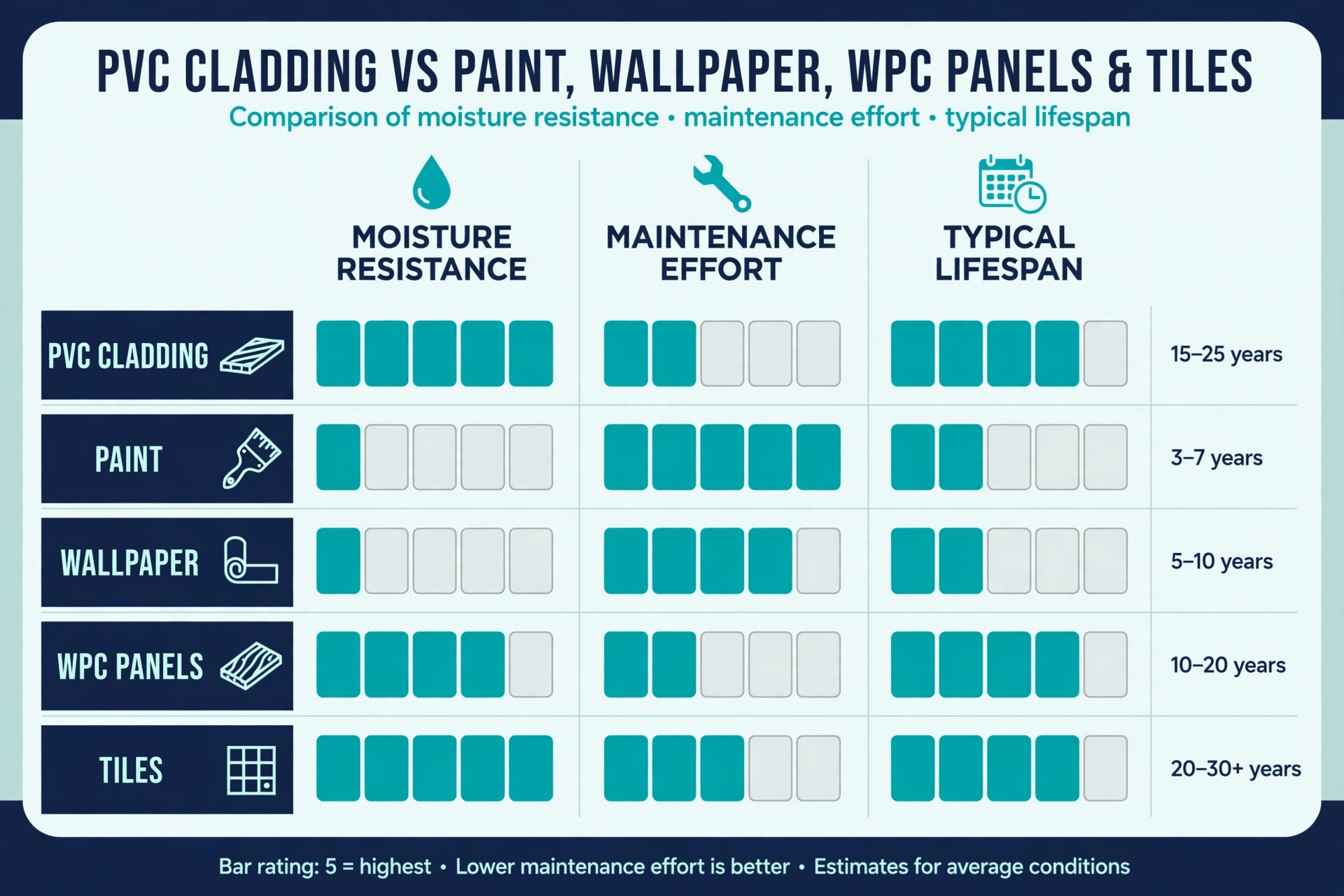
So let us judge each option on the five things that actually matter in a UAE home or office: moisture resistance, heat and sun tolerance, maintenance effort, looks, and realistic lifespan. No finish wins all five. Anyone who tells you otherwise is selling you something.
It is worth noting the direction of the market. The GCC PVC wall panels market is projected to grow at about 7.2% a year from 2026 to 2033, and the wider UAE PVC market at roughly 7.17% a year from 2025 to 2030 according to Bonafide Research. ReportLinker puts UAE PVC demand growth at 6.4% a year since 2012. Growth like that does not happen unless a material is solving real problems for real buyers. But popularity is not the same as suitability, so let us go finish by finish.
PVC cladding vs paint
Paint is the default wall finish in the UAE, and for good reason. It is the cheapest option, any colour is possible, and refreshing a room is a weekend job. For bedrooms and living rooms with normal humidity, good quality washable paint is genuinely hard to beat on value.
Where paint loses to PVC cladding is moisture and durability. In bathrooms, kitchens, and laundry areas, paint bubbles, peels, and grows mould spots over time, even the bathroom-grade formulas. Cladding simply does not absorb water, so those problems never start. Cladding also survives knocks and scuffs better; a painted wall in a corridor with kids or office chairs shows every mark, while a PVC panel wipes clean.
The honest trade: choose paint for dry rooms where you might want to change colours every few years. Choose cladding for wet or high-traffic areas where you want to fit it once and forget about it. If you are still deciding on cladding itself, our PVC cladding sheets buyer’s guide walks through what to check before buying.
PVC cladding vs wallpaper
Wallpaper wins on design variety, full stop. No cladding sheet matches the range of patterns, textures, and mural prints a good wallpaper collection offers. For a statement bedroom wall or a boutique hotel lobby, wallpaper gives you looks that cladding cannot.
But the UAE is rough on wallpaper. Humidity loosens seams, especially in bathrooms and kitchens, and once an edge lifts, the whole strip starts to go. Direct sun fades prints over time. PVC cladding has none of these weaknesses: no seams to lift, no fading if the sheets are UV stabilised, and it handles steam without complaint.
Maintenance is the other divider. A marked wallpaper panel usually means replacing the whole strip and hoping the batch matches. A marked cladding sheet wipes clean, and a damaged one can be swapped individually.
So the rule of thumb: wallpaper for dry feature walls where the pattern is the whole point, cladding for anywhere moisture, steam, or heavy use is part of daily life.
PVC cladding vs WPC wall panels
This is the closest contest, because the two products often sit side by side in showrooms and look similar at first glance. WPC, wood plastic composite, blends wood fibre with plastic, which gives it a slightly more natural feel and better rigidity than pure PVC.
On looks and feel, WPC usually has the edge. It reads as more premium, particularly in wood grains and fluted designs, and designers tend to specify it for high-end residential and hospitality projects. On moisture resistance, both perform well, though PVC has a slight advantage in genuinely wet areas since it contains no wood fibre at all. On installation speed and weight, PVC sheets are lighter and cover large areas faster.
We have covered this matchup in detail in our WPC versus PVC wall panels comparison, but the short version is: WPC when the premium feel matters most and the budget allows it, PVC when you want maximum moisture protection and value, especially in bathrooms and kitchens.
PVC cladding vs tiles
Tiles are the heavyweight champion of wet areas, and nothing here dethrones them on raw durability. A properly installed porcelain tile wall will outlast everything else in a shower or a commercial kitchen. Tiles also handle heat better than any plastic, so behind a cooker or near heat sources, tiles win clearly.
PVC cladding fights back on three fronts: speed, grout, and comfort. A tiled bathroom takes days of wet work, mess, and curing time. Cladding goes up in a fraction of the time with far less disruption. Then there is grout, the eternal enemy. Grout lines stain, harbour mould, and need regular scrubbing or resealing in UAE humidity. Cladding has minimal joints and no grout at all. Finally, tiles feel cold and hard; cladding feels slightly warmer to the touch, which some people prefer in living areas.
For a full wet room or shower enclosure, tiles remain the safer choice. For bathroom walls outside the direct splash zone, kitchen backsplashes, and anywhere you want the tiled look without the grout maintenance, cladding is a legitimate alternative. Marble-finish PVC sheets exist precisely because people love the look of marble tiles but not the upkeep.
The honest verdict: which finish for which room
Here is how we would actually spec it, room by room, for a typical Abu Dhabi villa or apartment:
Bathrooms: Tiles inside the shower, PVC cladding on the remaining walls. You get durability where water hits hardest and zero grout maintenance everywhere else.
Kitchens: PVC cladding as the backsplash and on the cooking wall, washable paint elsewhere. Grease wipes off cladding in seconds.
Living rooms and bedrooms: Paint for flexibility, or a single cladding or WPC feature wall if you want a focal point. Wallpaper only on dry interior walls away from windows.
TV and media walls: PVC or WPC panels. This is the signature use case: fast, dramatic, and cables hide behind the panels.
Offices and retail: PVC cladding in corridors, receptions, and washrooms. It takes abuse and still looks sharp, and individual panels can be replaced.
Outdoor or semi-outdoor walls: Neither PVC cladding nor wallpaper. Heat and UV will age any plastic faster, and this is where tiles, proper exterior paint systems, or stone make sense.
If you want to browse the actual materials, our PVC and acrylic sheet range is on display at our Capital Mall showroom in Mohamed Bin Zayed City, open daily from 10 AM to 10 PM.
Common questions about PVC cladding versus other finishes
Is PVC cladding better than paint?
It is better in wet and high-traffic areas because it resists moisture and wipes clean. It is not better everywhere; paint is cheaper, easier to change, and perfectly fine for dry bedrooms and living rooms.
Does PVC cladding last longer than wallpaper in the UAE?
Generally yes, especially in humid rooms. Wallpaper seams lift in UAE humidity and prints fade in sun, while properly installed cladding is unaffected by either. In a dry, shaded room the gap narrows.
Which looks more premium, WPC or PVC panels?
WPC usually looks and feels more premium, particularly in wood and fluted designs. PVC wins on moisture protection and value. Many projects mix them: WPC for the showpiece wall, PVC for bathrooms and kitchens.
Can PVC cladding replace tiles in a bathroom?
Outside the shower enclosure, yes, and many people prefer it for the lack of grout. Inside a shower with constant direct water, tiles remain the safer long-term choice.
What is the lowest maintenance wall finish for the UAE?
PVC cladding, by a clear margin. No repainting, no grout scrubbing, no seam repairs. A damp cloth handles almost everything.
Which finish adds the most value to a rental property?
For landlords, PVC cladding in bathrooms and kitchens tends to pay back best. It photographs well for listings, survives tenant turnover, and refreshes a tired flat far faster than retiling.
Still weighing your options? Message us on WhatsApp at +971 55 281 9239, tell us which rooms you are renovating, and we will give you a straight recommendation, even if the answer turns out to be paint.