
Room Guides - Clad and Craft Tradding LLC
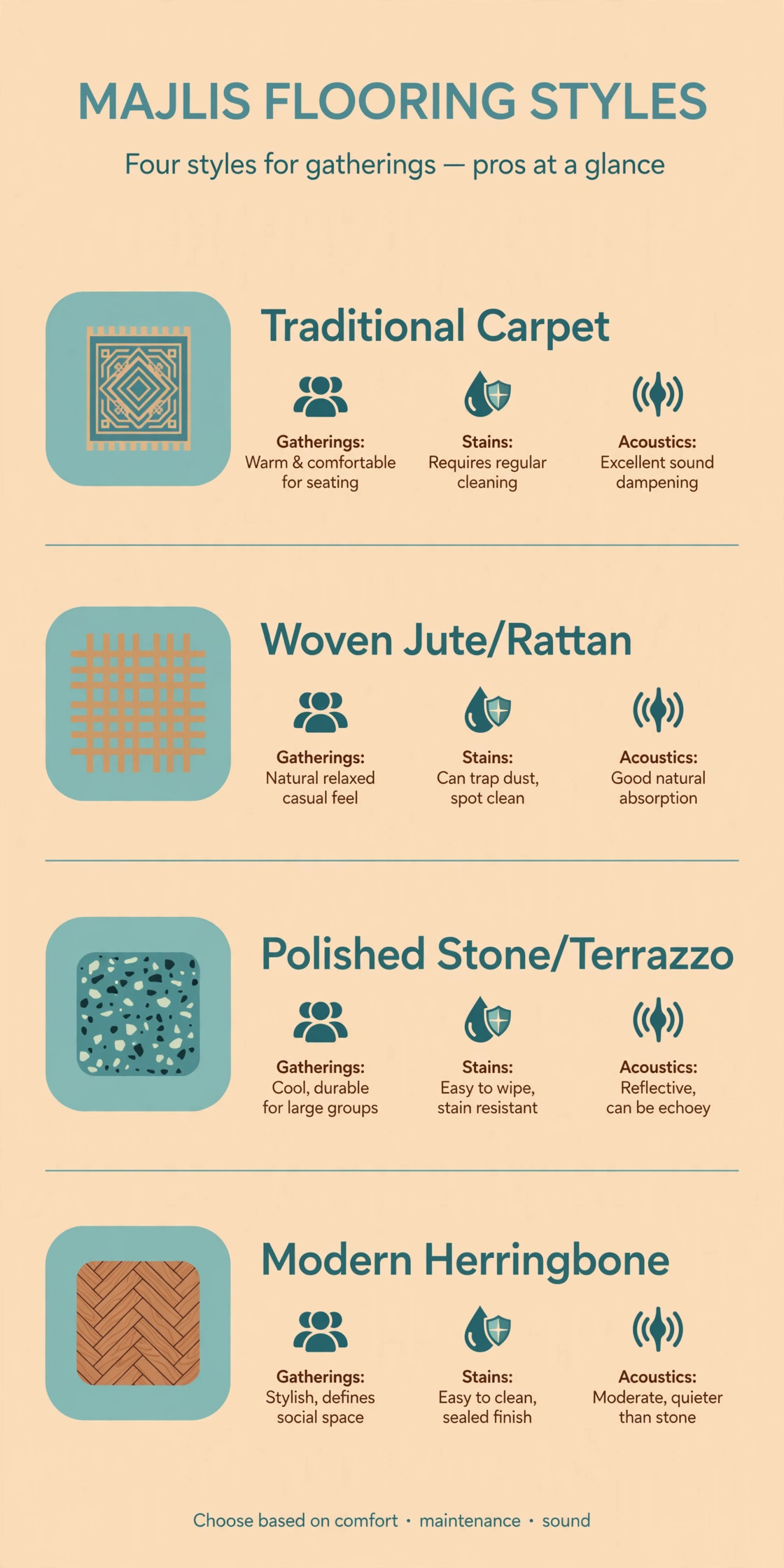
Short answer: The best majlis flooring ideas in the UAE balance hospitality, durability, and presence: wall-to-wall carpet for traditional warmth and acoustics, herringbone SPC for a luxurious modern statement, carpet tiles for large majlis areas that need practical maintenance, and SPC with layered rugs for versatile family use. The majlis is where you receive guests, so the floor must handle gatherings, Arabic coffee spills, and daily family life while looking dignified. Choose based on how your majlis is actually used, not just how it photographs.
Majlis flooring ideas for UAE villas: what the room demands
The majlis is unlike any other room in the house. It is a formal reception space and, in many villas, a daily family room as well. Guests are received here, coffee and dates are served, conversations run long. That dual role sets the brief: the floor must look worthy of guests and survive real life.
Three demands shape every decision. First, gatherings: during Eid, weddings, and family occasions, a majlis can hold dozens of people, so the floor takes concentrated foot traffic. Second, hospitality spills: Arabic coffee, karak, and dates will meet the floor sooner or later, and stain resistance is not optional. Third, acoustics: hard floors in a large, sparsely furnished majlis echo, while soft floors absorb sound and make conversation comfortable. Seating style matters too: floor-level cushions and traditional wall seating pair naturally with carpet, while sofa-based modern majlis layouts suit hard floors with rugs.
Wall-to-wall carpet: the traditional choice
For a classic majlis, wall-to-wall carpet remains the benchmark. It is warm underfoot for floor seating, quietens the room beautifully, and gives that enveloping sense of hospitality that hard floors cannot match. Patterned or textured carpets in deep tones hide the marks of daily life and frame traditional furniture perfectly.
The practical notes: choose a dense, low-pile carpet rather than deep plush, which shows footprints and is harder to clean. Stain-resistant treatments are worth it in a room where coffee is served daily. And plan for professional deep cleaning periodically; a majlis carpet that is maintained looks luxurious for years, while a neglected one does not. For households where the majlis doubles as a children’s hangout, our guide to safe flooring for kids’ rooms covers the durability principles that apply here too.
Herringbone SPC: the luxury statement
If you want the majlis to make an impression the moment guests enter, herringbone is the pattern that does it. Herringbone SPC flooring delivers the timeless zigzag of classic parquet in a waterproof, humidity-stable plank that suits the UAE climate far better than real wood. It reads as genuinely high-end, pairs beautifully with both traditional Arabic furniture and contemporary pieces, and layered with a large ornate rug it gives you the best of both worlds: a stunning hard floor with a soft, defined seating zone.
Herringbone installation is more skilled work than straight plank laying, since the pattern must be set out precisely, so choose an installer with real herringbone experience. Our comparison of herringbone SPC vs herringbone laminate explains why the SPC version is the safer choice in humid conditions.
Carpet tiles: the practical large-majlis solution
Large villa majlis areas, and majlis spaces used for frequent big gatherings, are where carpet tiles quietly excel. They give the warmth and acoustics of carpet with a decisive practical advantage: if one tile is stained beyond cleaning, that single tile is lifted and replaced, not the whole floor. For a room that hosts crowds and coffee in volume, that replaceability is worth more than any other feature. Modern carpet tiles come in sophisticated textures and patterns that suit formal spaces, not just offices.
SPC with layered rugs: the versatile modern approach
Many contemporary villas use straight-lay SPC through the majlis and define the seating area with a large, high-quality rug. This gives easy cleaning, full waterproofing against spills, and the freedom to change the room’s character by changing the rug. It suits sofa-based majlis layouts and households where the room serves multiple purposes. The rug does the acoustic and comfort work; the SPC does the durability work. Choose a rug with proper underlay so it does not slip or trap grit against the floor.
Entrances, shoe traffic, and transitions
The majlis entrance takes the hardest wear in the room: shoes come off here, sand comes in here. A hard-wearing entrance zone, whether a mat well, a tile inset, or simply durable flooring with good mats, protects the main floor. If the majlis opens directly off the villa entrance, consider how the two floors meet; a clean transition between entrance flooring and the majlis surface keeps the whole arrival sequence looking intentional.
Stain strategy for coffee and daily life
Whatever surface you choose, have a spill plan. Blot coffee immediately rather than rubbing it, keep a suitable spot cleaner for your floor type, and place small tables or trays where cups actually get set down so rings and drips land on something washable. For carpet, professional cleaning after big gatherings keeps stains from setting permanently. For hard floors with rugs, a washable rug in the highest-spill zone saves the statement rug underneath.
Torn between traditional warmth and a modern statement? WhatsApp us photos of your majlis and we will bring carpet, herringbone, and rug-layering samples on a free site visit anywhere in Abu Dhabi, so you can see each option in your own light and layout.
Frequently asked questions
What is the best flooring for a majlis in the UAE?
It depends on use. Wall-to-wall carpet suits traditional majlis with floor seating; herringbone SPC suits formal, statement spaces; carpet tiles suit large or heavily used majlis; SPC with rugs suits modern multi-use rooms. All four handle UAE conditions well when properly installed.
Is carpet or hard flooring better for a majlis?
Carpet wins on warmth, acoustics, and traditional feel; hard flooring wins on spill cleanup and versatility with rugs. Households that host often and serve coffee daily sometimes prefer hard floors with rugs for the easier maintenance.
How do I protect majlis flooring from Arabic coffee stains?
Blot spills immediately, use stain-resistant carpet or easy-clean hard floors, place trays where cups are set down, and schedule professional carpet cleaning after major gatherings. For carpet tiles, keep spare tiles to swap out stained ones.
Does a majlis need special acoustic treatment?
Soft flooring is the main acoustic treatment a majlis needs. If you choose hard flooring, a large rug with quality underlay, upholstered seating, and curtains will control echo effectively in most rooms.
Can I use herringbone flooring in a humid villa?
Herringbone SPC is well suited to humidity because its mineral core does not swell or shrink like wood. Solid wood herringbone needs careful climate control; SPC gives the look without the movement.
Should the majlis floor match the rest of the villa?
Not necessarily. The majlis is a distinct ceremonial space, and a deliberate change in flooring can mark that transition beautifully. Just make the threshold between spaces clean and level.
Design a majlis that welcomes everyone
The right floor makes hospitality effortless. Visit our showroom at Shop No. AA-110, Capital Mall, Khourat Al Heel St, Mohamed Bin Zayed City, open Monday to Sunday 10:00 to 22:00, call +971 55 281 9239, or WhatsApp us to book a free site visit anywhere in Abu Dhabi. Bring your room dimensions and we will help you compare carpet, herringbone, and rug-layered options side by side. For adjacent rooms, our bedroom flooring ideas continue the same thinking.
Short answer: The most practical waterproof bathroom flooring options in the UAE are SPC and LVT vinyl for their seamless, grout-free, warm surfaces, sheet vinyl for maximum watertightness, and porcelain tile for traditional durability. What matters more than the visible surface is the waterproofing beneath it: a proper membrane, correct falls to the drain, and sealed edges are what keep a bathroom dry for decades. In a climate this humid, mold prevention and slip resistance deserve equal billing with looks.
Bathroom flooring options in the UAE: what waterproof really means
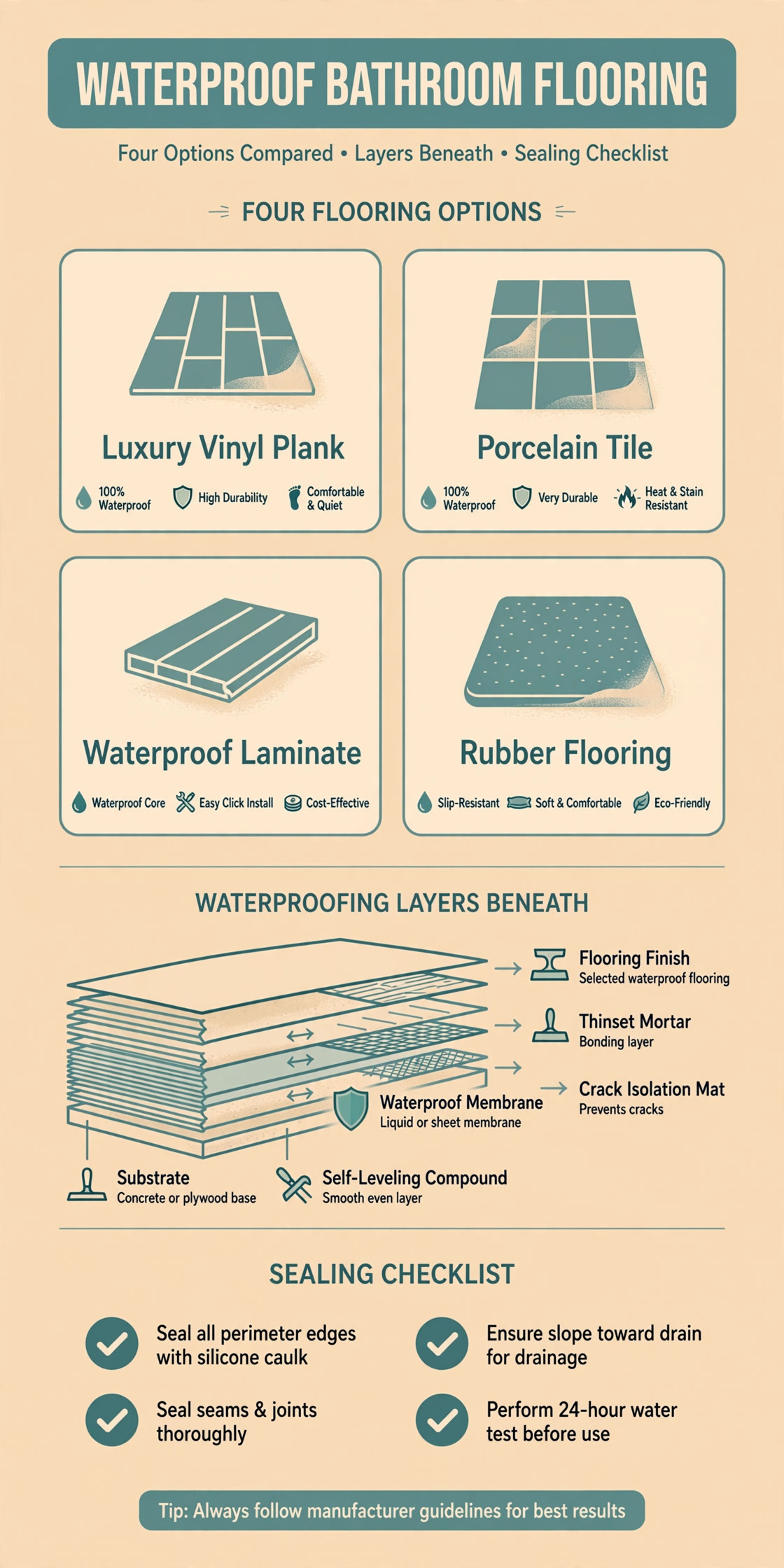
A bathroom floor lives in standing water, steam, and humidity every single day. Waterproof here has to mean the whole assembly, not just the top surface. There are three layers that matter: the visible flooring, the waterproofing membrane beneath it, and the drainage falls that move water to the drain. A beautiful waterproof plank over a failed membrane is a renovation waiting to happen. When we assess bathrooms in Abu Dhabi homes, we check all three, because the surface is only as good as what is under it.
Two terms worth defining. Waterproof means water cannot pass through; water-resistant means it can resist water for a time but not indefinitely. Bathrooms need waterproof, full stop.
The waterproofing layer: the part you never see
Before any finish floor goes down, a bathroom needs tanking: a liquid or sheet waterproofing membrane applied to the slab and turned up the walls, especially in showers and around the bath. Falls, the slight slopes in the floor, must direct water to the drain rather than letting it pond in corners. Drains, pipe penetrations, and wall-to-floor junctions get reinforcing tape and sealant. This work is invisible once finished, which is exactly why it gets skipped in rushed jobs, and why failed bathrooms almost always fail here rather than at the surface. If your bathroom floor is being replaced because of leaks or mold, budget the waterproofing properly; it is the cheapest insurance in the whole project.
SPC flooring: the modern bathroom standard
SPC, stone plastic composite, has become the go-to bathroom floor for good reason. The rigid core ignores water completely, the click installation needs no adhesive to break down, and the grout-free surface means no moldy joints to scrub. It feels warmer under bare feet than tile, a genuine comfort difference on winter mornings, and textured finishes provide reliable wet grip. Stone and concrete looks suit contemporary bathrooms; wood looks warm up classic ones. Our SPC flooring range includes finishes specified for wet areas.
LVT: design freedom with full waterproofing
LVT, luxury vinyl tile, offers the same waterproofing in a more flexible plank with an enormous design range, including convincing marble and stone effects that suit high-end bathrooms. It is slightly softer underfoot than SPC. The requirement, as always with flexible vinyl, is a properly leveled base, since LVT shows every imperfection beneath it. In bathrooms this matters doubly, because the falls to the drain must be preserved in the leveling work. Done right, LVT flooring is elegant and completely practical.
Sheet vinyl: the most watertight surface
A single sheet of vinyl with heat-welded seams is as close to a waterproof skin as flooring gets. There are no joints for water to exploit at all. It is the pragmatic choice for family bathrooms that take heavy daily use, and for anyone who wants minimum maintenance. The trade-off is aesthetic: even premium sheet vinyl does not match plank realism. For a focused look at this option, see our guide to waterproof bathroom vinyl flooring in Abu Dhabi.
Porcelain tile: traditional and tough
Porcelain tile is waterproof, heat-proof, and as hard-wearing as it gets. In the UAE it remains the default bathroom surface in most new builds. Its weaknesses are the grout lines, which stain, need sealing, and can grow mold in humid bathrooms, and the cold, hard feel underfoot. Large-format tiles with tight epoxy-grouted joints are the best version of this option. If you keep tile, commit to the grout maintenance; if you want to escape grout entirely, the vinyl options above are the way.
Sealing: the details that keep water out
Every bathroom has the same vulnerable points: where the floor meets the shower curb or tray, around the toilet base and pedestal, where pipes penetrate, and along the bath edge. These all get flexible silicone sealant, not grout, because buildings move and rigid joints crack. Sealant needs inspection every year or two and replacement when it discolors, shrinks, or peels. Ten minutes of maintenance here prevents the slow leaks that rot subfloors and feed the mold problems we are regularly called to fix.
Mold prevention in UAE bathrooms
Bathrooms combine everything mold loves: moisture, warmth, and poor ventilation. The floor choices above remove grout as a food source, but habits matter too. Run the exhaust fan during and after showers, squeegee shower walls, and do not leave bathmats sitting damp on the floor for days. Pair the floor with wall finishes that do not trap moisture: PVC bathroom panels are grout-free and wipe clean, unlike painted drywall in a steamy room. If a bathroom has no window and weak extraction, say so during the site visit; ventilation advice is part of a proper flooring consultation.
Slip resistance for every age
Wet bathroom floors must grip. Choose textured, matte finishes and check the product’s wet slip rating rather than trusting the word anti-slip on a brochure. This matters most in homes with children or elderly family members; our anti-slip flooring guide for elderly homes covers ratings and room-by-room choices in depth. A bathmat with proper backing at the shower exit is a simple addition that prevents the most common bathroom slip.
Planning a bathroom refit? WhatsApp us photos of the space and book a free site visit anywhere in Abu Dhabi. We will check the existing waterproofing, falls, and ventilation, then recommend the right surface for how your household actually uses the room.
Frequently asked questions
What is the best waterproof flooring for bathrooms in the UAE?
SPC is the best all-rounder: fully waterproof, grout-free, warm underfoot, and available in stone and wood looks. Sheet vinyl is the most watertight; porcelain tile is the toughest. All three need proper waterproofing membrane and drainage beneath.
Can SPC flooring be used inside a shower area?
SPC handles wet-area use, but inside the shower enclosure itself, tiled falls and drainage detailing usually make porcelain the practical choice. SPC excels on the main bathroom floor outside the shower zone.
Do I need to waterproof under vinyl bathroom flooring?
Yes. The membrane beneath the finish floor is what protects the structure. Vinyl keeps surface water out, but waterproofing, falls to the drain, and sealed penetrations are separate and essential work.
How do I stop mold growing in my bathroom?
Ventilate with the exhaust fan, squeegee after showers, avoid leaving damp mats on the floor, choose grout-free surfaces like SPC or PVC panels, and reseal silicone joints before they fail. Persistent mold usually points to a ventilation or waterproofing problem worth investigating.
Is LVT slippery when wet in bathrooms?
Textured LVT with a proper wet slip rating grips well. Polished or high-gloss finishes can be slippery when wet, so choose matte, embossed finishes for bathrooms and check the rating.
How long does a bathroom floor installation take?
A straightforward like-for-like replacement is usually a few days including waterproofing cure times. Full refits with plumbing changes take longer. The membrane curing stage cannot be rushed, so be wary of anyone promising a one-day bathroom.
Get an honest bathroom assessment
Bathrooms reward proper preparation more than any other room. Visit our showroom at Shop No. AA-110, Capital Mall, Khourat Al Heel St, Mohamed Bin Zayed City, open Monday to Sunday 10:00 to 22:00, call +971 55 281 9239, or WhatsApp us for a free site visit anywhere in Abu Dhabi. We will check what is under your current floor before recommending what goes on top.
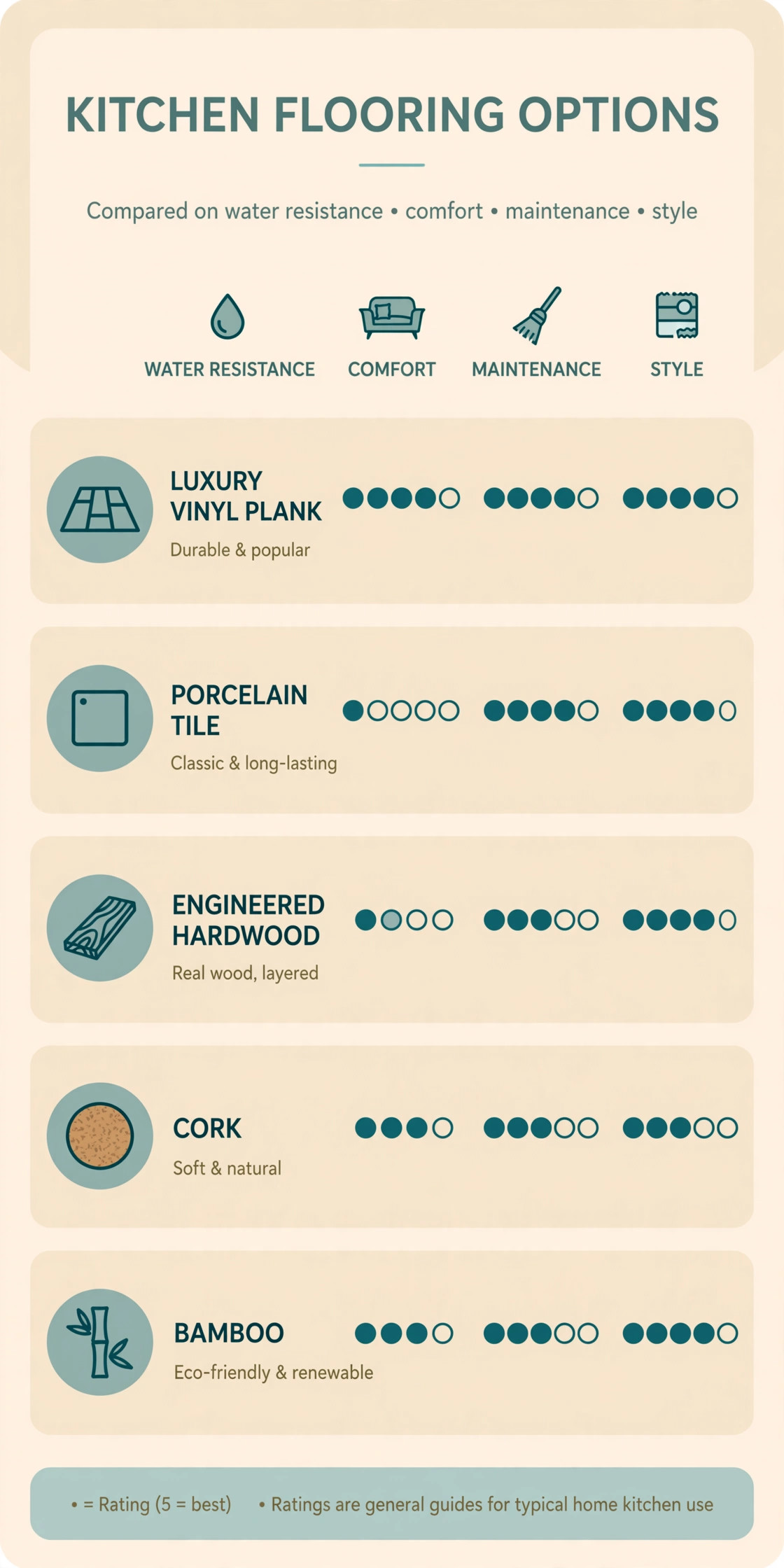
Short answer: The strongest kitchen flooring options in Abu Dhabi are SPC and LVT for their waterproofing and comfort, porcelain tile for raw durability, and sheet vinyl for a seamless, practical surface. Standard laminate and hardwood struggle with kitchen moisture and humidity. The right choice depends on how you cook, whether the kitchen is open-plan, and whether you prioritize easy cleaning, underfoot comfort, or a particular look. Whichever you pick, sealed edges and a level subfloor matter as much as the material itself.
Kitchen flooring options Abu Dhabi homeowners ask about most
Every kitchen consultation starts with the same questions: how much water does this room really see, who cooks here, and what does the rest of the home look like? A villa kitchen where big family meals are cooked daily is a different brief from a compact apartment kitchen used for light cooking. Before comparing materials, it helps to fix your priorities in this order: waterproofing first, then durability, then comfort, then looks. A beautiful floor that swells at the sink is a renovation you will do twice.
SPC flooring: the all-rounder
SPC, stone plastic composite, is the option we recommend most often for kitchens, and for straightforward reasons. The rigid limestone-based core does not swell, so boiling water, steam, and daily mopping do not change its shape. Click installation means no adhesive to fail near the dishwasher. It is hard enough to resist dents from dropped utensils yet forgiving enough that a dropped plate sometimes survives. The wood and stone designs have become genuinely convincing.
For a full breakdown of how SPC behaves in local conditions, read our SPC flooring for kitchens guide and the broader SPC flooring collection. If waterproofing is your top concern, our waterproof flooring for kitchens article compares the watertight options head to head.
LVT: the comfort pick
LVT, luxury vinyl tile, trades some of SPC’s rigidity for a softer, warmer feel underfoot, which long cooking sessions appreciate. The design range is the widest of any kitchen option: pale oaks, dark walnuts, marble looks, concrete looks. It is fully waterproof and easy to clean.
The catch is subfloor preparation. Flexible LVT follows every dip and ridge in the base, so the slab or old tiles beneath must be properly leveled, and glue-down versions depend on adhesive quality around wet zones. With correct preparation, LVT flooring is a superb kitchen floor; without it, you will feel every shortcut.
Porcelain tile: the traditional choice
Most Abu Dhabi kitchens were built with tile, and porcelain remains nearly indestructible: heat-proof, waterproof, and immune to stains when glazed. The downsides are comfort and maintenance. Tile is cold and hard, tiring to stand on and merciless to dropped glassware. Grout lines collect grease and need periodic sealing and scrubbing, and in humid conditions unsealed grout can harbor mold. Large-format tiles with minimal, sealed grout joints are the modern way to do it if you choose tile.
Sheet vinyl: seamless and sensible
Sheet vinyl arrives in rolls and goes down with minimal seams, making it one of the most watertight options available. It is forgiving of imperfect subfloors, easy to mop, and practical for rental kitchens or utility areas. The compromise is realism and repairability: it looks like vinyl, and a deep cut cannot be patched invisibly the way a single SPC plank can be replaced. For pure function, vinyl flooring in sheet form earns its place.
What about laminate?
Standard laminate’s wood-based core and kitchen water do not mix. Around sinks, dishwashers, and fridge water lines, moisture eventually finds the edges and the core swells. Water-resistant laminates buy time against quick spills but not against slow leaks. If you want the click-together wood look in a kitchen, SPC gives you the same installation with a core that ignores water. Our comparison of waterproof laminate vs SPC lays out the difference honestly.
Villa kitchens vs apartment kitchens
Villa kitchens in Abu Dhabi tend to be larger, see heavier daily cooking, and sit on ground-floor slabs where moisture management matters more. Durability and waterproofing lead the brief. Apartment kitchens are smaller, often open to the living area, which raises a design question: one continuous floor flowing through, or a defined kitchen zone? Continuous SPC or LVT through an open-plan space makes compact apartments feel larger and avoids awkward transitions. Separate zones let you put maximum waterproofing in the kitchen and something softer in the living area. There is no wrong answer, but decide before ordering materials.
Style notes that actually matter
Light wood tones keep kitchens feeling bright and show less dust, which is a real consideration with UAE sand. Mid-tone woods hide crumbs and everyday marks best. Dark floors look dramatic but show every footprint and dust mote, meaning more sweeping. Large planks suit spacious villa kitchens; narrower planks feel right in compact apartment galleys. Matte and low-sheen finishes hide wear far better than glossy ones and are less slippery when wet.
Installation details for kitchens
Kitchens have more fixed obstacles than any other room, and each is a potential water path: cabinet plinths, island bases, appliance recesses, pipe penetrations. Silicone sealing at all of these is what makes a waterproof product into a waterproof floor. Under-sink and under-dishwasher areas deserve leak trays or at least periodic checks. If you are replacing a kitchen floor, coordinate with any plumbing work first; it is far cheaper to move a pipe before the floor goes down than after.
Measuring a kitchen with its angles and island cutouts is fiddly, so our villa quantity estimator helps you work out material quantities before you visit.
Choosing between the top contenders? WhatsApp us photos of your kitchen and we will recommend the right option on a free site visit anywhere in Abu Dhabi, with samples you can compare in your own lighting.
Frequently asked questions
What is the best flooring for a kitchen in Abu Dhabi?
For most homes, SPC: fully waterproof, dent-resistant, comfortable enough for daily cooking, and stable in humidity. LVT suits those who prioritize softness and design variety; porcelain tile suits those who want maximum heat and scratch resistance and accept grout maintenance.
Can I put SPC flooring in a kitchen with heavy daily cooking?
Yes, that is exactly what it is made for. Steam, splashes, and mopping do not affect it. Just keep silicone seals intact around cabinets and check under-sink plumbing periodically, as with any kitchen floor.
Should kitchen flooring match the living room floor?
In open-plan apartments, running the same floor through both spaces looks seamless and spacious. In closed kitchens, matching is optional. Either way, use a proper transition strip where materials change.
Is tile or vinyl better for kitchens?
Tile wins on heat resistance and hardness; vinyl (SPC or LVT) wins on comfort, warmth, grout-free cleaning, and forgiveness when things drop. Most families we work with prefer vinyl for daily cooking kitchens.
How do I protect kitchen flooring from water damage?
Seal edges with silicone, use mats at the sink, fix plumbing drips immediately, and avoid soaking the floor when mopping. Most kitchen floor damage starts with an unnoticed slow leak, not with cooking splashes.
Can new kitchen flooring go over my old tiles?
Often yes, if the old tiles are sound and level. Deep grout lines need skimming, and clearances under appliances and doors must be checked. An on-site assessment confirms it quickly.
See the options in person
Flooring is a touch-and-stand-on decision. Visit our showroom at Shop No. AA-110, Capital Mall, Khourat Al Heel St, Mohamed Bin Zayed City, open Monday to Sunday 10:00 to 22:00, call +971 55 281 9239, or WhatsApp us to book a free site visit anywhere in Abu Dhabi. Walk on SPC, LVT, and vinyl side by side and choose with confidence.
Villa life in Abu Dhabi is harder on floors than apartment life. Kids run in from the garden. The dog’s claws click down the hallway. The maid mops with a soaking wet mop, daily, because dust settles on everything by noon. If your floor cannot handle all three at once, it is the wrong floor for a villa.
What is the best flooring for a villa in Abu Dhabi?
SPC flooring, in most cases. The logic is simple once you list what a villa floor has to survive. It has to be waterproof, because mopping here means real water, not a damp cloth. It has to resist scratches, because sand gets tracked in no matter how many doormats you buy. And it has to stay dimensionally stable, because the villa swings between 45-degree heat outside and 22-degree AC inside every single day.
SPC ticks all three. Its core is waterproof, its wear layer takes the scratches, and its expansion rate sits at 0.08 percent or less, about half that of standard flexible vinyl according to manufacturer test data. A homeowner writing on Medium about three Dubai villas put it to a harder test than any lab: his SPC floor survived three years, two tenants, a dog and a leaking dishwasher, and still looked new. That is villa life in one sentence.
Kids, pets and daily mopping: the real test
Let us be specific about each one, because vague reassurance helps nobody.
Kids mean impact and grit. Toys get dropped, chairs get dragged, and sand from the garden acts like sandpaper under small feet. The wear layer is what stands between you and a scratched floor. A flooring writer on Medium who has installed in several Dubai homes recommends 0.5mm as the minimum for a lived-in home and 0.7mm for homes with pets, warning that anything under 0.3mm shows every mark. We agree with him, and we say the same thing in our showroom every week.
Pets mean claws and the occasional accident. SPC’s rigid core resists claw scratches far better than laminate or soft vinyl, and because the core is waterproof, an accident that sits for an hour does not become a swollen plank. Laminate cannot say that. One wet patch under a water bowl is all it takes to start laminate swelling at the joints.
Daily mopping means water, lots of it. This is where waterproof stops being a marketing word. SPC and LVT both handle wet mopping. Laminate does not, and engineered wood tolerates it only if you are quick and careful. If your household mops the way most Abu Dhabi households mop, cross laminate off the list for ground floors.
Room by room: what actually works
Living and dining rooms take the most foot traffic and the most sand. SPC in a wood look handles it, and the rigid planks do not show traffic lanes the way carpet does. Kitchens get water, dropped utensils and chair legs scraping at breakfast. SPC again, ideally 0.5mm wear layer minimum, because kitchen chairs are scratch machines.
Bedrooms are the one place where comfort competes with durability. SPC works fine, but if someone in the house hates cold floors at 6am, this is the room to consider LVT or a good rug over the SPC rather than a different floor. Bathrooms and laundry areas need waterproof without argument. SPC handles them. Hallways and stairs take concentrated traffic in narrow strips, so the wear layer matters most here, and stair nosings should be colour-matched SPC or aluminium, not an afterthought.
Kids’ rooms deserve a special note. They get the hardest use in the house and the least careful maintenance. SPC with a 0.7mm wear layer is the closest thing to a kid-proof floor that still looks like a grown-up home.
- Check the wear layer first. 0.5mm for normal family life, 0.7mm if you have large dogs or very heavy traffic. Everything else is secondary.
- Confirm the core is waterproof. SPC and LVT yes, laminate and wood no. Ask the supplier to put it in writing on the quote.
- Feel it underfoot. Walk on the sample in socks. SPC is firm like tile, LVT is softer. There is no wrong answer, only your preference.
- Get the quote itemised. Planks, installation, skirting, trims, subfloor prep and old floor removal on separate lines. Compare like with like.
| Flooring | Waterproof | Scratch resistance | Daily wet mopping | Installed AED per sqm |
|---|---|---|---|---|
| SPC | Yes, rigid waterproof core | High, especially 0.5mm+ wear layer | Fine, no swelling | 85-140 (standard tier) |
| LVT | Core yes, install depends on adhesive | Medium, softer surface dents easier | Fine with correct install | Slightly under SPC |
| Laminate | No, HDF core swells | Good surface, weak joints | Risky, water finds the joints | Lower upfront |
| Porcelain tiles | Yes | Excellent | Fine | Similar or higher installed |
| The daily mopping verdict | If your home gets mopped with real water every day, SPC and tiles are the safe choices. Laminate is the one that fails here, usually at the joints first, usually within two years. This single row rules laminate out for most villa ground floors. | |||
Why one good flooring beats four different ones
We see this pattern a lot: tiles in the kitchen, laminate in the living room, carpet in the bedrooms, something else in the hallway. It usually starts as a budget decision and ends as a maintenance headache. Every transition strip is a dirt trap and a trip edge. Every material ages at a different rate, so in five years the house looks patchy. And when one section needs replacing, matching the old batch is impossible.
One good floor through the whole villa costs more on day one and less over ten years. You buy in bulk, the install is faster, there are no transition strips to fail, and the house feels bigger because the eye travels uninterrupted. SPC is the easiest material to commit to whole-house because it works in wet rooms and living rooms alike. Tiles can do the same job, but they are cold, hard and unforgiving when a toddler falls.
What about tiles? Everyone in the UAE has tiles
Fair question, and tiles deserve respect. Porcelain is waterproof, nearly indestructible and cool underfoot, which many people love in summer. chic-floors.com lists porcelain and ceramic tiles among its top picks for the Dubai climate for exactly these reasons.
The tradeoffs are comfort and grout. Tiles are hard. Dropped plates shatter, toddler knees bruise, and standing to cook for an hour is tiring. Grout lines collect grime and need periodic deep cleaning, while a click-lock SPC floor has no grout at all. Tiles also cost more to install properly, with adhesive, levelling, cutting and curing time. Many villa owners keep tiles in bathrooms and go SPC everywhere else, which is a reasonable compromise if you cannot face giving up tiles entirely.
Yas Island, Al Khalidiyah and Al Ain: villa floors in the real world
Yas Island villas are the classic new-build case: big open-plan ground floors, sliding doors onto gardens, young families. This is the exact profile SPC was made for. The open plan means one continuous floor looks spectacular, and the garden access means water and sand are a daily reality, not a hypothetical.
Al Khalidiyah has older villas with more compartmentalised layouts, separate majlis, separate dining room. Owners here often ask about mixing materials per room, and this is where we make the case for one floor hardest, because four small rooms in four materials looks busy and dates fast. A single SPC tone through the whole floor plan modernises these villas more than any single renovation item.
Al Ain villas tend to be larger, with extended family under one roof and heavy daily use. Durability per dirham is the whole conversation. The standard 5mm SPC tier at AED 85 to 140 per sqm installed is usually the answer, with 0.7mm wear layer in the living areas if the budget stretches. For the numbers behind that recommendation, see our SPC flooring price guide.
Will SPC handle my maid mopping with lots of water every day?
Yes. This is one of SPC’s genuine strengths. The core is waterproof and the click-lock joints are tight, so daily wet mopping does not swell or damage it the way it damages laminate. Just avoid flooding the floor and leaving standing water for hours, and skip steam mops, which can force moisture into any joint over time.
My dog’s claws scratched my old floor. Will SPC hold up?
Better than anything else at this price. Go for a 0.7mm wear layer if you have a large dog, keep claws trimmed, and put a mat under the water bowl. No floor is truly scratch-proof against a 40-kilo dog sprinting for the door, but SPC with a thick wear layer is the closest you will get without jumping to porcelain.
Can I install SPC over my villa’s existing tiles?
Usually yes, if the tiles are flat, sound and well bonded. SPC’s rigid core bridges minor grout lines and small lippage. Cracked or hollow tiles need fixing first, and very uneven floors may need a levelling screed. We check this free on a site visit, because guessing wrong here is expensive.
Is SPC too cold underfoot for bedrooms?
It is firmer and cooler than carpet or LVT, similar to tiles. Most people adapt within a week, and a rug beside the bed solves the 6am problem completely. If someone in the house genuinely hates hard floors, consider LVT for the bedrooms and SPC everywhere else. That is the one mix we endorse.
Does SPC look formal enough for a majlis?
The wood-look SPC ranges have come a long way. Embossed grain, matte finishes and long planks read as proper wood flooring to most guests, especially in warm oak and walnut tones. For a very traditional formal majlis, some owners still prefer marble-look porcelain, and that is a fair choice. Ask to see large samples, not just small chips.
Flooring a whole villa is a big decision, but it gets simple once you test the floor against your actual life: kids, pets, water, heat. If you want a straight answer for your villa, message us on WhatsApp and we will come out for a free site visit, check your subfloor, and quote you properly. You can also compare materials in our SPC vs LVT guide, or look at laminate and wood flooring and vinyl flooring options on our services pages.
Walk into our Capital Mall showroom and ask about gym flooring, and the first question back is always the same. What are you actually going to do on it? Yoga twice a week is a different floor from deadlifts at 6am. Get that answer right and the rest is easy.
What actually breaks a foam mat?
EVA foam is soft, light and cheap. Three good qualities in a yoga mat. The trouble starts when weight enters the picture. Drop a dumbbell on foam and it compresses past the point where it springs back. Do it a few dozen times and you get permanent dents, then cracks along the interlocking edges. Foam tiles in a lifting corner age fast, and that part we see regularly.
A research team measuring gym noise found that dropping a 90kg barbell produced a peak of 118.5 dB(A) on hard rubber flooring, falling to 102.8 dB(A) with an extra layer of high-density rubber foam on top (MDPI, Noise Source Identification in Training Facilities and Gyms). That is a 15.7 dB cut from one extra rubber layer. Our reading of that number is simple. Mass and density absorb impact. Foam mostly passes it through to whatever sits underneath.
So foam mats have a real place. They cushion knees during floor work and roll up for storage, all for very little money. They are simply not impact flooring, whatever the packaging suggests.
How thick should home gym flooring be?
A Dubai gym flooring guide lays out the bands plainly: 6 to 8mm suits cardio and light work, 10 to 15mm suits general fitness areas, 20 to 25mm suits weightlifting, and 30mm plus is for extreme impact zones (dubaicityguide.com). We agree with those bands, and we would add one rule of our own. Buy for the heaviest thing you will drop, not the average workout.
- 8mm if the floor only ever sees yoga, stretching and bodyweight work.
- 15mm for dumbbells up to about 15kg, kettlebells and general training.
- 20mm or more if you deadlift, drop weights or own an Olympic bar.
- 30mm in a dedicated lifting platform zone, which is overkill anywhere else.
Going thicker than you need wastes money and makes the floor feel wobbly under a bench. Going thinner than you need wastes the floor itself.
Rubber tiles vs foam mats vs rubber rolls: the honest comparison
Three products cover nearly every home gym in Abu Dhabi. Here is how they compare on the things that actually decide.
| Factor | Interlocking rubber tiles | EVA foam mats | Rubber rolls |
|---|---|---|---|
| Typical thickness | 15-30mm | 10-20mm | 6-10mm |
| Price per sqm, UAE retail | AED 90-280 (Harley Fitness via uae.microless.com; TERRAFIT via noon.com) | About AED 35-80 (puzzle mat sets on noon.com) | AED 95-130 (floorland.ae) |
| Best for | Home gyms with weights | Yoga, kids, light use | Garages and large cardio zones |
| Installation | Click together, no glue | Click together, no glue | Cut to fit, usually glued down |
| Noise to the flat below | Good at 20mm plus | Poor | Moderate |
| The row that decides: a dropped 20kg dumbbell | Survives at 20mm plus | Dents, then tears | Needs a platform underneath |
Read the last row twice. That is the whole buying decision in one line. Everything else is comfort and budget.
What does home gym flooring cost in Abu Dhabi?
Retail prices move, so treat these as anchors from real listings rather than quotes. The cheapest proper rubber we found is the Harley Fitness 16mm interlocking mat at AED 90 per square metre on uae.microless.com. At the other end, TERRAFIT 3cm dual-layer tiles sell for AED 280 per square metre on noon.com, with four tiles covering exactly one square metre. A Dubai supplier, floorland.ae, lists rubber flooring from AED 95 to 130 per square metre, and dedicated sports flooring from AED 130 to 360.
Foam is cheaper. Puzzle mat sets on noon.com work out to roughly AED 35 to 80 per square metre. The gap looks tempting until you remember the dumbbell row in the table above. For a typical 12-square-metre spare bedroom, rubber tiles land somewhere between AED 1,100 and 3,400 in materials. That is our arithmetic from the listings above, not a price list. For a current per-square-metre figure on supplied and installed gym flooring, message us on WhatsApp and we will measure the room properly.
Will your downstairs neighbor hear you train?
If you live in a tower on Al Reem Island, this section matters more than the price section. Concrete slabs carry low-frequency thuds straight through, and a dropped dumbbell is basically a drum hit on the floor below.
Lab testing gives a sense of the scale. Riverbank Acoustical Laboratories tested a 2-inch rubber tile against a bare 6-inch concrete slab and measured a 34.4 dB noise reduction when a 25-pound weight was dropped from 36 inches (reported by Athletic Business). Thirty-four decibels is roughly the gap between a shout and a normal conversation. Our takeaway: thick rubber over a slab genuinely changes what the neighbor hears, while a thin mat barely registers.
Four things that actually help in an apartment:
- Train with bumper plates, or simply lower dumbbells instead of dropping them.
- Lay 20mm-plus tiles wall to wall, not just a small square under the rack.
- Add a proper lifting platform if you deadlift heavy.
- Keep the heavy sessions to daytime hours. The building will thank you.
If the flat below you is empty right now, plan for the day it is not.
What we would buy for our own home gym
Say a friend asks what to order tonight. The answer is short, and it depends on the training.
- Yoga, stretching and bodyweight only: EVA foam mats are fine. Spend the savings on a better mat.
- Treadmill or bike corner: 10 to 15mm rubber tiles to kill vibration and protect the floor.
- Dumbbells, kettlebells and general training: 15 to 20mm interlocking rubber tiles. This is where most home gyms land.
- Deadlifts and Olympic lifts: 20 to 30mm tiles plus a proper lifting platform.
One more note for mixed-use rooms. If half the space doubles as a home office, carpet tiles handle office chair wheels better than rubber, and the two can sit side by side with a simple transition strip.
Where in Abu Dhabi this matters most
Al Reem Island towers are the classic case. Thin slabs and close neighbors, with home gyms tucked into second bedrooms. Here thickness is about keeping the peace as much as performance. Go 20mm or train light.
Khalifa City and Mohammed Bin Zayed City are villa territory. Spare rooms and garages become gyms, and durability matters more than noise. Rubber rolls start making sense for larger garage floors, and you can bolt a rack down without asking a landlord. If the garage still parks a car, vinyl flooring handles tyres and oil better than rubber tiles, so plan the zones before you buy.
Yas Island sits in between. Apartments with bikes on balconies, villas with garden rooms turned into gyms. Measure the space, check the building rules on noise, then pick thickness.
Can I lay gym flooring over my existing tiles?
Yes. Interlocking tiles float over ceramic or marble with no glue, which keeps landlords happy too. Just make sure the base floor is clean and level first, because grit trapped underneath will grind away at the finish.
Do rubber tiles smell?
New rubber has a smell for the first few days. Air the room out and it fades fast. If you are sensitive to it, leave the tiles on a balcony for a day before laying them.
How much flooring do I need for a small home gym?
Measure length times width, then add about 10 percent for cutting around doorways and edges. A 3 by 4 metre spare room is 12 sqm, so order 13 to 14.
Will it damage the floor underneath?
Interlocking tiles need no adhesive, so the tiles or marble underneath stay untouched. Rolls usually need glue, which is a different story in a rental.
Foam or rubber under a treadmill?
Rubber. Treadmills are heavy and they vibrate, and foam compresses into permanent dips under the feet. 10 to 15mm rubber tiles handle it without complaint.
Still torn between foam and rubber? Send us your room size and what you train on WhatsApp and we will tell you straight which thickness to buy, plus a current quote for supply and install with a free site visit anywhere in Abu Dhabi.