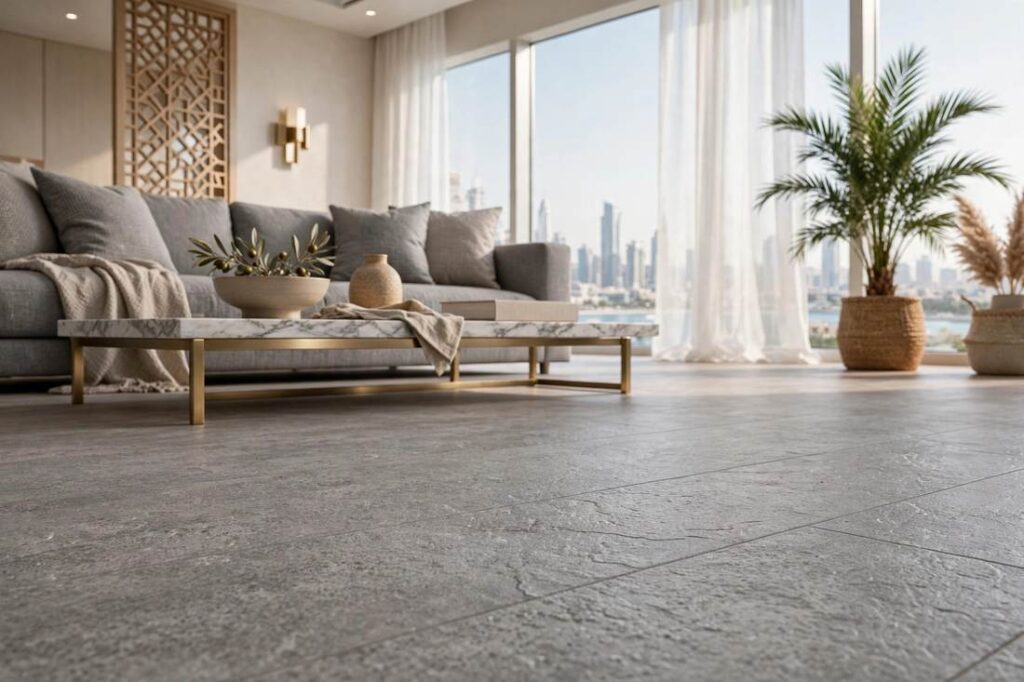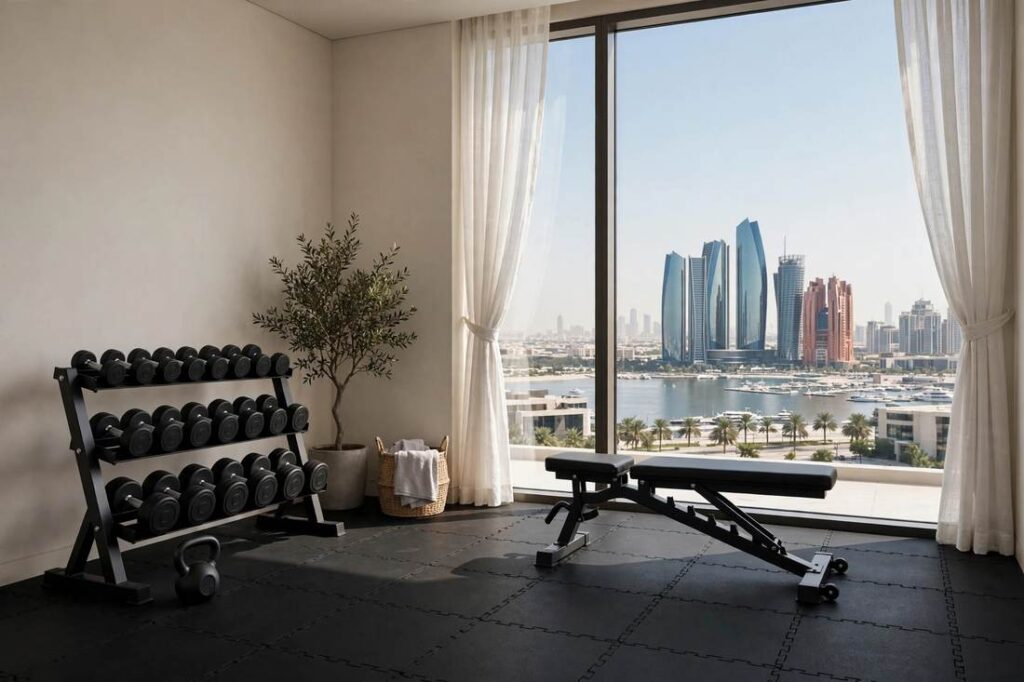
Walk into our Capital Mall showroom and ask about gym flooring, and the first question back is always the same. What are you actually going to do on it? Yoga twice a week is a different floor from deadlifts at 6am. Get that answer right and the rest is easy.
What actually breaks a foam mat?
EVA foam is soft, light and cheap. Three good qualities in a yoga mat. The trouble starts when weight enters the picture. Drop a dumbbell on foam and it compresses past the point where it springs back. Do it a few dozen times and you get permanent dents, then cracks along the interlocking edges. Foam tiles in a lifting corner age fast, and that part we see regularly.
A research team measuring gym noise found that dropping a 90kg barbell produced a peak of 118.5 dB(A) on hard rubber flooring, falling to 102.8 dB(A) with an extra layer of high-density rubber foam on top (MDPI, Noise Source Identification in Training Facilities and Gyms). That is a 15.7 dB cut from one extra rubber layer. Our reading of that number is simple. Mass and density absorb impact. Foam mostly passes it through to whatever sits underneath.
So foam mats have a real place. They cushion knees during floor work and roll up for storage, all for very little money. They are simply not impact flooring, whatever the packaging suggests.
How thick should home gym flooring be?
A Dubai gym flooring guide lays out the bands plainly: 6 to 8mm suits cardio and light work, 10 to 15mm suits general fitness areas, 20 to 25mm suits weightlifting, and 30mm plus is for extreme impact zones (dubaicityguide.com). We agree with those bands, and we would add one rule of our own. Buy for the heaviest thing you will drop, not the average workout.
- 8mm if the floor only ever sees yoga, stretching and bodyweight work.
- 15mm for dumbbells up to about 15kg, kettlebells and general training.
- 20mm or more if you deadlift, drop weights or own an Olympic bar.
- 30mm in a dedicated lifting platform zone, which is overkill anywhere else.
Going thicker than you need wastes money and makes the floor feel wobbly under a bench. Going thinner than you need wastes the floor itself.
Rubber tiles vs foam mats vs rubber rolls: the honest comparison
Three products cover nearly every home gym in Abu Dhabi. Here is how they compare on the things that actually decide.
| Factor | Interlocking rubber tiles | EVA foam mats | Rubber rolls |
|---|---|---|---|
| Typical thickness | 15-30mm | 10-20mm | 6-10mm |
| Price per sqm, UAE retail | AED 90-280 (Harley Fitness via uae.microless.com; TERRAFIT via noon.com) | About AED 35-80 (puzzle mat sets on noon.com) | AED 95-130 (floorland.ae) |
| Best for | Home gyms with weights | Yoga, kids, light use | Garages and large cardio zones |
| Installation | Click together, no glue | Click together, no glue | Cut to fit, usually glued down |
| Noise to the flat below | Good at 20mm plus | Poor | Moderate |
| The row that decides: a dropped 20kg dumbbell | Survives at 20mm plus | Dents, then tears | Needs a platform underneath |
Read the last row twice. That is the whole buying decision in one line. Everything else is comfort and budget.
What does home gym flooring cost in Abu Dhabi?
Retail prices move, so treat these as anchors from real listings rather than quotes. The cheapest proper rubber we found is the Harley Fitness 16mm interlocking mat at AED 90 per square metre on uae.microless.com. At the other end, TERRAFIT 3cm dual-layer tiles sell for AED 280 per square metre on noon.com, with four tiles covering exactly one square metre. A Dubai supplier, floorland.ae, lists rubber flooring from AED 95 to 130 per square metre, and dedicated sports flooring from AED 130 to 360.
Foam is cheaper. Puzzle mat sets on noon.com work out to roughly AED 35 to 80 per square metre. The gap looks tempting until you remember the dumbbell row in the table above. For a typical 12-square-metre spare bedroom, rubber tiles land somewhere between AED 1,100 and 3,400 in materials. That is our arithmetic from the listings above, not a price list. For a current per-square-metre figure on supplied and installed gym flooring, message us on WhatsApp and we will measure the room properly.
Will your downstairs neighbor hear you train?
If you live in a tower on Al Reem Island, this section matters more than the price section. Concrete slabs carry low-frequency thuds straight through, and a dropped dumbbell is basically a drum hit on the floor below.
Lab testing gives a sense of the scale. Riverbank Acoustical Laboratories tested a 2-inch rubber tile against a bare 6-inch concrete slab and measured a 34.4 dB noise reduction when a 25-pound weight was dropped from 36 inches (reported by Athletic Business). Thirty-four decibels is roughly the gap between a shout and a normal conversation. Our takeaway: thick rubber over a slab genuinely changes what the neighbor hears, while a thin mat barely registers.
Four things that actually help in an apartment:
- Train with bumper plates, or simply lower dumbbells instead of dropping them.
- Lay 20mm-plus tiles wall to wall, not just a small square under the rack.
- Add a proper lifting platform if you deadlift heavy.
- Keep the heavy sessions to daytime hours. The building will thank you.
If the flat below you is empty right now, plan for the day it is not.
What we would buy for our own home gym
Say a friend asks what to order tonight. The answer is short, and it depends on the training.
- Yoga, stretching and bodyweight only: EVA foam mats are fine. Spend the savings on a better mat.
- Treadmill or bike corner: 10 to 15mm rubber tiles to kill vibration and protect the floor.
- Dumbbells, kettlebells and general training: 15 to 20mm interlocking rubber tiles. This is where most home gyms land.
- Deadlifts and Olympic lifts: 20 to 30mm tiles plus a proper lifting platform.
One more note for mixed-use rooms. If half the space doubles as a home office, carpet tiles handle office chair wheels better than rubber, and the two can sit side by side with a simple transition strip.
Where in Abu Dhabi this matters most
Al Reem Island towers are the classic case. Thin slabs and close neighbors, with home gyms tucked into second bedrooms. Here thickness is about keeping the peace as much as performance. Go 20mm or train light.
Khalifa City and Mohammed Bin Zayed City are villa territory. Spare rooms and garages become gyms, and durability matters more than noise. Rubber rolls start making sense for larger garage floors, and you can bolt a rack down without asking a landlord. If the garage still parks a car, vinyl flooring handles tyres and oil better than rubber tiles, so plan the zones before you buy.
Yas Island sits in between. Apartments with bikes on balconies, villas with garden rooms turned into gyms. Measure the space, check the building rules on noise, then pick thickness.
Can I lay gym flooring over my existing tiles?
Yes. Interlocking tiles float over ceramic or marble with no glue, which keeps landlords happy too. Just make sure the base floor is clean and level first, because grit trapped underneath will grind away at the finish.
Do rubber tiles smell?
New rubber has a smell for the first few days. Air the room out and it fades fast. If you are sensitive to it, leave the tiles on a balcony for a day before laying them.
How much flooring do I need for a small home gym?
Measure length times width, then add about 10 percent for cutting around doorways and edges. A 3 by 4 metre spare room is 12 sqm, so order 13 to 14.
Will it damage the floor underneath?
Interlocking tiles need no adhesive, so the tiles or marble underneath stay untouched. Rolls usually need glue, which is a different story in a rental.
Foam or rubber under a treadmill?
Rubber. Treadmills are heavy and they vibrate, and foam compresses into permanent dips under the feet. 10 to 15mm rubber tiles handle it without complaint.
Still torn between foam and rubber? Send us your room size and what you train on WhatsApp and we will tell you straight which thickness to buy, plus a current quote for supply and install with a free site visit anywhere in Abu Dhabi.