Short answer: The question can SPC flooring be installed over existing tiles UAE homeowners ask most is a simple one to answer: yes, in most cases. Tiles make an excellent base because they are flat, hard, and stable. The job works when the tiles are firmly bonded, the grout lines are filled or levelled, and door clearances are checked. Tiles that are loose, cracked across a large area, or very uneven should be repaired or removed first.
Why this question matters so much in the UAE
Walk into almost any apartment or villa in Abu Dhabi that is more than a few years old and you will find tile. Developers here tile everything: living rooms, bedrooms, hallways. It is durable and it was the default choice for decades.
But tastes change, and so do tenants. That cold glossy tile that looked fine in 2015 now makes a rental apartment feel dated, and villa owners want the warmth of a wood look without the maintenance of real wood. The biggest objection we hear is always the same: “Do we have to break up all the tile first?” Breaking tile is noisy, dusty, slow, and it creates a mountain of debris. For an apartment, it can also mean complaints from neighbours and building management headaches.
The good news is that in most cases, you do not have to. SPC is a floating floor, which means it clicks together and sits on top of the existing surface rather than being glued to it. A sound tile floor is one of the best surfaces to float SPC over.
Can SPC flooring be installed over existing tiles UAE: the conditions
An installer will check four things before giving the green light.
The tiles are firmly bonded. Walk the floor and listen. Solid tiles sound solid; loose or hollow tiles sound drummy when tapped. A few loose tiles can be re-bonded or removed and filled. A floor where large sections sound hollow is not a reliable base and needs a different approach.
The surface is level. SPC needs a flat base. Small grout lines are fine and get dealt with in prep, but if the tile floor has significant lippage (edges sticking up) or slopes, the SPC planks will flex over the unevenness. Flexing stresses the click-lock joints, and stressed joints eventually separate or break. A long straightedge or level laid across the floor reveals the truth quickly.
The tiles are clean and dry. This sounds basic, but tile floors in kitchens and entrances hold grease and grime in the grout lines. The floor must be thoroughly cleaned so nothing interferes with the underlay sitting flat.
Door clearances work. SPC plus underlay adds height, typically around 5 to 7 mm over the tile. Doors need to clear the new floor level. In most UAE homes this means trimming the bottom of interior doors slightly, which is a quick job. Entrance doors, especially fire-rated apartment doors, need checking too. This is a planning detail, not a dealbreaker, but it must be measured before installation day.
Prep work: what happens before the first plank
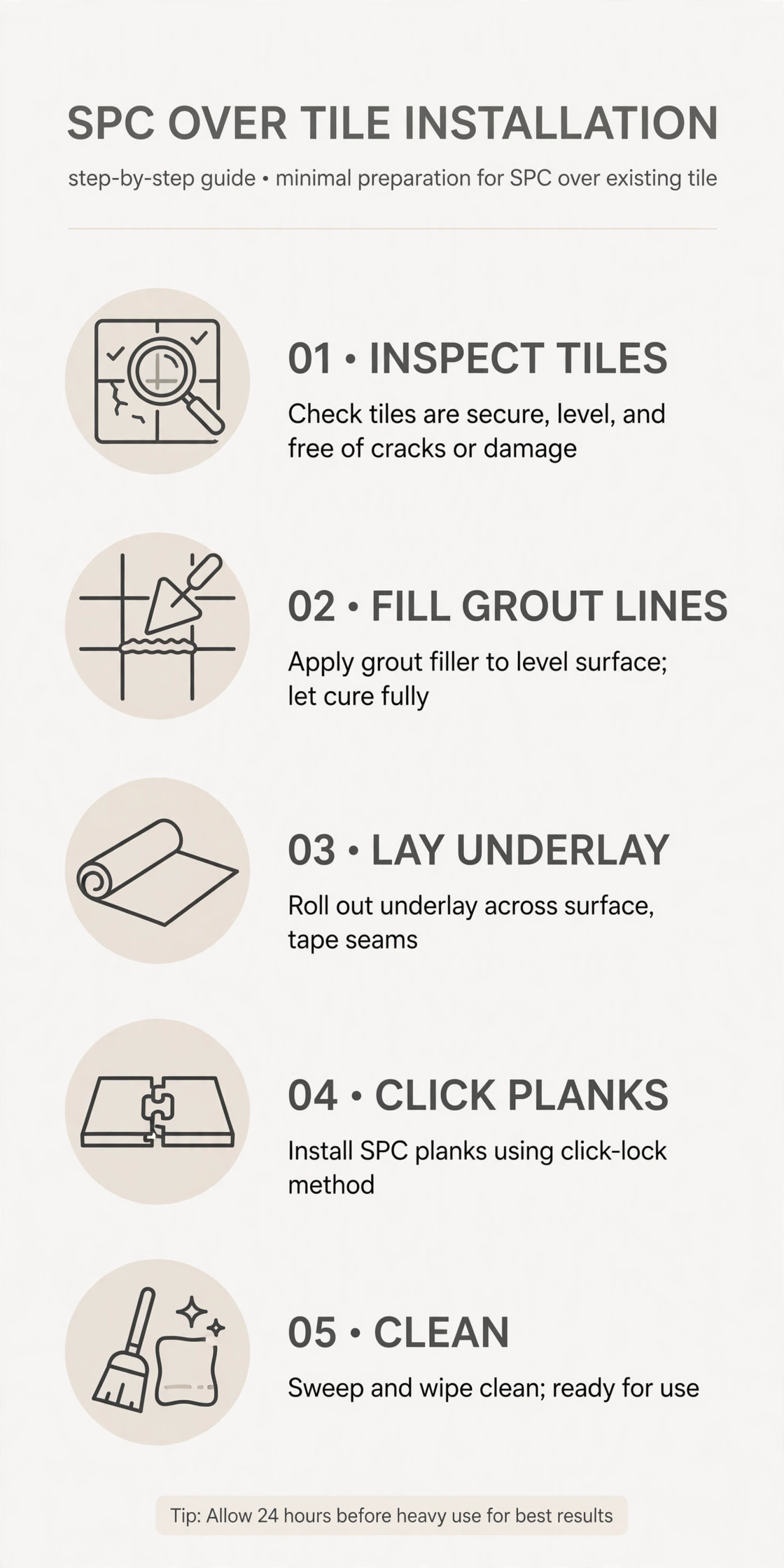
Proper prep is what separates a floor that lasts from one that fails in a year. Here is what a professional installation over tile involves.
First, any loose, cracked, or drummy tiles are dealt with. Small areas get re-bonded with tile adhesive or removed and filled with a levelling compound. The goal is a base with no movement and no sharp edges.
Second, the grout lines are addressed. Deep or wide grout lines can telegraph through to the SPC surface over time, meaning you eventually see faint lines mirroring the tile grid, or the planks flex slightly into the gaps. The standard fix is skimming the floor with a levelling compound or a suitable filler so the grout lines sit flush with the tile faces. For tiles with very narrow grout lines, a good underlay alone is often enough.
Third, an underlay goes down. Many SPC products come with an attached underlay, and even then installers often add a thin additional underlay over tile for sound reduction and to smooth out micro unevenness. In apartments, this also helps with the impact noise that travels to the unit below, which neighbours will appreciate.
Fourth, the room is measured and planned. Planks are laid out so the seams are staggered properly and the first and last rows are a sensible width. Expansion gaps are left at every wall, covered later by skirting. This planning stage is quick for an experienced installer and it shows in the finished floor.
If you want to understand the base requirements in more depth, our guide on how to prepare a subfloor for SPC flooring covers the standards we work to.
When the tiles should come up instead
Laying over tile is the right call most of the time, but not always. An honest installer will tell you when removal is better.
If the tile floor has widespread hollow spots, the base is unreliable and SPC laid over it will eventually move and creak. If the floor is significantly uneven, no amount of underlay will fix it, and a levelling compound thick enough to correct it may cost more in labour than just removing the tile. If there is moisture coming up through the tile, for example in a ground-floor villa with no damp proofing, that moisture issue needs solving at the source, and covering it up only hides the problem. And if the added height creates unsolvable problems, such as an entrance door that cannot be trimmed and a step down to a balcony that becomes a trip hazard, removal may be the cleaner option.
In these cases, removing tile is dusty and disruptive for a day or two, but it gives a perfect base for the new floor. It is better to do it once properly than to lay a new floor over a bad base and regret it.
What about LVT or laminate over tiles?
The same principle applies to other floating floors, with small differences. Quality LVT flooring can also go over tile, but because LVT is more flexible than SPC, the prep needs to be even more careful about grout lines and flatness. Any unevenness shows through flexible vinyl faster. Laminate can go over tile too, but laminate brings its moisture vulnerability with it, so in kitchens and entrances it remains the riskier choice. For most tile-over projects in the UAE, SPC is the material our installers reach for first, and you can see why on our SPC flooring page.
How long does it take?
For a typical apartment living room and hallway, a professional team usually completes the prep and installation in one to two days once materials are on site. Before you book dates, run your room measurements through our free flooring calculator so the material quantity is right first time. And if you are still weighing up the material itself, read our honest answer to is SPC flooring good for UAE climate. A full villa takes longer, but the tile stays, the dust stays minimal, and you are not living in a construction zone for a week. The speed of a tile-over installation is one of its biggest advantages for families who cannot move out during the work. We cover full timelines in our guide to how long flooring installation takes for a villa.
Not sure whether your tiles are a suitable base? Send us a WhatsApp message with a few photos of your current floor. We offer a free site visit anywhere in Abu Dhabi, where we will tap-test the tiles, check the levels, measure the door clearances, and tell you honestly whether a tile-over installation will work in your home.
FAQ
Can SPC flooring be installed over existing tiles in the UAE?
Yes, in most cases. Firmly bonded, reasonably level tiles make an excellent base for floating SPC. The tiles need to be sound, grout lines filled or levelled, and door clearances checked. This is standard practice in UAE apartments and villas.
Do grout lines need to be filled before laying SPC over tile?
Deep or wide grout lines should be skimmed with levelling compound so they sit flush with the tile faces. If they are left as deep grooves, they can telegraph through to the SPC surface over time or let planks flex into the gaps, stressing the click-lock joints.
Will installing SPC over tile make the floor too high?
SPC plus underlay typically adds around 5 to 7 mm. Interior doors usually need a small trim at the bottom, which is routine. Your installer should measure all door clearances and transitions to adjoining rooms before installation day.
Can you install SPC over cracked tiles?
Isolated cracked tiles can be repaired or filled as part of the prep. Widespread cracking or large hollow areas mean the tile base is unreliable, and in that case the tiles should be removed rather than covered.
Is it better to remove tiles before installing SPC?
Removal gives a perfect base but adds days of dusty, noisy demolition and debris removal. If the existing tiles are sound and level, laying over them gives an equally good result with far less disruption. Removal is only better when the tile base itself is failing.
Does SPC over tile work in kitchens and bathrooms?
Yes, SPC is waterproof so it suits kitchens well. For bathrooms, SPC works on the floor but the wet areas still need proper waterproofing detailing at edges and around fixtures. Discuss the bathroom specifics with your installer during the site visit.
Get your tiles assessed before you decide
Every tile floor is different, and a ten-minute assessment tells you everything: tap test, level check, door measurements. Message us on WhatsApp to book a free site visit anywhere in Abu Dhabi. We will tell you whether your tiles can stay, what prep they need, and give you a clear plan for the installation. You can also explore the materials on our SPC flooring page or visit us at Shop No. AA-110, Capital Mall, Mohamed Bin Zayed City, open daily from 10:00 to 22:00.